 Coach
CoachThe formal charge of an atom in a Lewis structure is
where is the number of valence electrons of the free atom, the number of electrons in its lone pairs and the number of electrons in the bonds it forms. It is written or next to the atom when it is not zero.
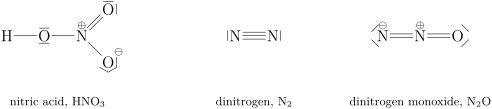
Examples
Example 3.5 (Nitric acid)
: electrons, 12 pairs. Skeleton: nitrogen central, bonded to three oxygens, one of which carries the hydrogen. Completing octets with single bonds leaves nitrogen with six electrons; one oxygen lone pair becomes an bond. Formal charges: nitrogen ; the singly bonded oxygen without hydrogen ; the others 0. The total is 0, as Proposition 3.3 requires.
Example 3.9 (Ammonia and boron trifluoride)
. In the adduct, boron completes its octet; nitrogen, which now shares its lone pair, carries the formal charge and boron . Once formed, the bond is an ordinary covalent bond.