All books

Professional

Apps About Coach Log in Start reading

Chemistry · Glossary

What is Half-life?

Definition 41.11 School Chemistry — Grades 1 to 12 · Chapter 41 — Reaction Rates

The half-life t1/2t_{1/2} of a reaction is the time it takes for the concentration of the limiting reactant to fall to half of its initial value.

Examples

Example 41.13 (Reading the half-lives)

For k=0.050 min−1k = 0.050\,\mathrm{min}^{-1}, t1/2=0.693/0.050=13.9 mint_{1/2} = 0.693 / 0.050 = 13.9\,\mathrm{min}: the concentration falls from 10.0 to 5.0, then 2.5, then 1.25 mmol/L1.25\,\mathrm{mmol}/\mathrm{L} at 13.9, 27.7 and 41.6 min41.6\,\mathrm{min}. The warmer run, with kk twice as large, has half the half-life, 6.9 min6.9\,\mathrm{min}, as the figure shows.

Read in context →
Definition 8.7 University Chemistry — Year 1 · Chapter 8 — Chemical Kinetics: Rate Laws

The half-life t1/2t_{1/2} of a reactant is the time after which half of its initial amount has been consumed.

Three reactions with the same initial concentration (1.00\, mol/ L) and the same initial rate (0.050\, mol\, L-1\, min-1). Top: each integrated law becomes a straight line in its own coordinates. Bottom: the concentrations; the half-lives are 10, 13.9 and 20 minutes. Three reactions with the same initial concentration (1.00\, mol/ L) and the same initial rate (0.050\, mol\, L-1\, min-1). Top: each integrated law becomes a straight line in its own coordinates. Bottom: the concentrations; the half-lives are 10, 13.9 and 20 minutes.
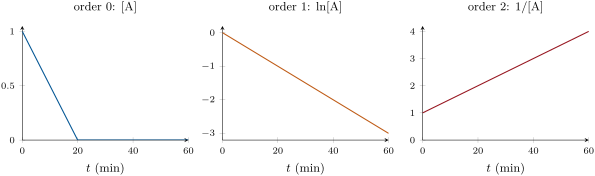
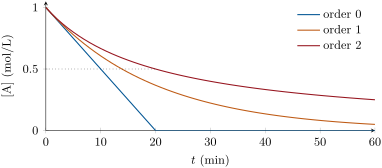
Three reactions with the same initial concentration (1.00 mol/L1.00\,\mathrm{mol}/\mathrm{L}) and the same initial rate (0.050 mol L−1 min−10.050\,\mathrm{mol}\,\mathrm{L}^{-1}\,\mathrm{min}^{-1}). Top: each integrated law becomes a straight line in its own coordinates. Bottom: the concentrations; the half-lives are 10, 13.9 and 20 minutes.
Read in context →