
All books

Professional

Apps About Coach Log in Start reading

Chemistry · Glossary

What is Interstitial sites?

Also known as: interstitial site · tetrahedral site · octahedral site · habitability

Definition 5.15 University Chemistry — Year 1 · Chapter 5 — Crystals I: The Perfect Crystal and Metals

An interstitial site is a gap between the atoms of a crystal where a smaller atom can sit. A tetrahedral site lies at the centre of a tetrahedron of four atoms, an octahedral site at the centre of an octahedron of six. The habitability of a site is the radius of the largest sphere that fits in it without pushing the surrounding atoms apart.
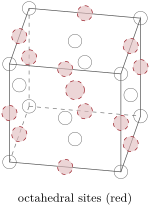
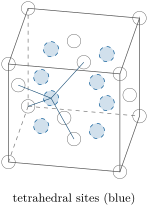
Interstitial sites of the FCC cell. Left: the octahedral site at the centre and those at the edge middles (shared by four cells). Right: the eight tetrahedral sites at the centres of the eighths of the cube, one shown joined to its four atoms. Interstitial sites of the FCC cell. Left: the octahedral site at the centre and those at the edge middles (shared by four cells). Right: the eight tetrahedral sites at the centres of the eighths of the cube, one shown joined to its four atoms.
Interstitial sites of the FCC cell. Left: the octahedral site at the centre and those at the edge middles (shared by four cells). Right: the eight tetrahedral sites at the centres of the eighths of the cube, one shown joined to its four atoms.

Examples

Example 5.21 (Steel)

Carbon, of covalent radius 77 pm77\,\mathrm{pm} (half the C−C\ce{C-C} distance in diamond), is too large for the sites of iron without distortion, but much less so in γ\gamma-iron, whose octahedral sites are the largest. Steel is made by dissolving carbon in hot γ\gamma-iron; quenched, the carbon is trapped as the iron returns to a body-centred structure, which it distorts, and the distorted crystal is hard.

Read in context →