 Coach
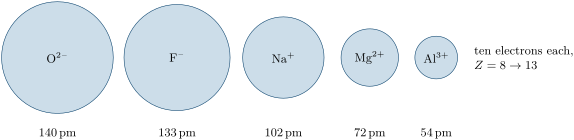
CoachThe covalent radius of an element is half the length of a single bond between two of its atoms: for chlorine, half the distance of . The ionic radius of an ion is the share of the distance between neighbouring cations and anions in ionic crystals attributed to it, from a convention that fixes the radius of one reference ion (); it depends slightly on the number of neighbours.
Examples
Example 2.7 (The halogens)
The bond lengths of , , and are 141.2, 198.8, 228.1 and , so the covalent radii are 71, 99, 114 and : each step down the group adds a shell and about or more.