All books

Professional

Apps About Coach Log in Start reading

Chemistry · Glossary

What is Modes of addition?

Also known as: 1,2-addition · conjugate addition

Definition 26.3 University Chemistry — Year 2 · Chapter 26 — Conjugated Carbonyls: Michael and Robinson

A nucleophile adding to the carbonyl carbon of an α,β\alpha,\beta-unsaturated carbonyl compound gives a 1,2-addition (counting from the oxygen): an allylic alkoxide, then an alcohol. A nucleophile adding to the β\beta carbon gives a conjugate addition (or 1,4-addition): an enolate, which is protonated on carbon to give a saturated carbonyl compound substituted at the β\beta carbon.

Cyclohex-2-en-1-one with two methyl nucleophiles. Methyllithium, a hard nucleophile, adds to the carbonyl carbon: 1-methylcyclohex-2-en-1-ol (1,2-addition). Lithium dimethylcuprate, a soft one, adds to the  carbon: 3-methylcyclohexanone (conjugate addition). Cyclohex-2-en-1-one with two methyl nucleophiles. Methyllithium, a hard nucleophile, adds to the carbonyl carbon: 1-methylcyclohex-2-en-1-ol (1,2-addition). Lithium dimethylcuprate, a soft one, adds to the  carbon: 3-methylcyclohexanone (conjugate addition).
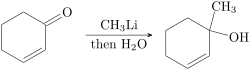
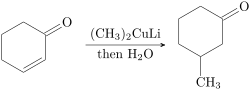
Cyclohex-2-en-1-one with two methyl nucleophiles. Methyllithium, a hard nucleophile, adds to the carbonyl carbon: 1-methylcyclohex-2-en-1-ol (1,2-addition). Lithium dimethylcuprate, a soft one, adds to the β\beta carbon: 3-methylcyclohexanone (conjugate addition).
Read in context →