University Chemistry — Year 2 · Bachelor Year 2
26Conjugated Carbonyls: Michael and Robinson
The four rings of a steroid hormone were first assembled one ring at a time, and one sequence of reactions became the standard way of adding a ring: it builds a whole six-membered ring, ketone included, from a ketone and a small unsaturated ketone. It works because a carbonyl group conjugated with a double bond passes its electrophilic character on to the far end of that double bond. This chapter is about that far end: which nucleophiles attack it, why, and what can be built with it.
You already know
Chapter 25: enolates, the aldol condensation. Chapter 17: charge and orbital control, hard and soft reagents. Chapter 16: Hückel orbitals and charges. The Year 1 volume: Grignard reagents and hydrides, kinetic and thermodynamic control, conjugated systems.
26.1 Two electrophilic sites
Definition 26.1 (-Unsaturated carbonyl compounds)
An -unsaturated carbonyl compound has a double bond between the and carbons of a carbonyl compound, conjugated with the : an enone (ketone), an enal (aldehyde), an unsaturated ester or nitrile. The simplest are propenal and but-3-en-2-one (methyl vinyl ketone).

Proposition 26.2 (Two sites)
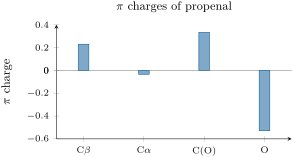
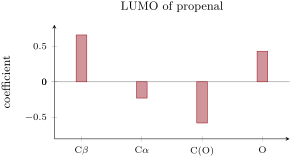
In an -unsaturated carbonyl compound, both the carbonyl carbon and the carbon are electrophilic. The carbonyl carbon carries the larger positive charge; the carbon carries the larger coefficient in the LUMO.
Argument. The resonance structures place a positive charge on the carbonyl carbon and, through the , on the carbon; the carbon is never positive. The Hückel model of propenal makes this quantitative: summing over the two occupied orbitals gives the charges (Definition 16.6) on the carbonyl carbon, on the carbon, on the carbon and on oxygen. The LUMO, the orbital that receives a nucleophile’s electrons, is largest at the carbon. The two sites therefore answer to the two kinds of control of Definition 17.5. ∎
26.2 1,2-Addition or conjugate addition
Definition 26.3 (Modes of addition)
A nucleophile adding to the carbonyl carbon of an -unsaturated carbonyl compound gives a 1,2-addition (counting from the oxygen): an allylic alkoxide, then an alcohol. A nucleophile adding to the carbon gives a conjugate addition (or 1,4-addition): an enolate, which is protonated on carbon to give a saturated carbonyl compound substituted at the carbon.
Proposition 26.4 (Which site)
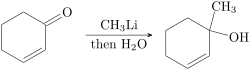
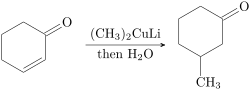
Hard nucleophiles (organolithiums, most Grignard reagents, ) add mainly 1,2, under charge control, usually irreversibly. Soft nucleophiles (organocuprates, stabilised enolates, thiolates, amines) add mainly 1,4, under orbital control; the conjugate adduct, which keeps the bond, is also the more stable product.
Argument. A hard nucleophile, small and charged, interacts mostly through charges: it goes to the most positive centre, the carbonyl carbon (Proposition 26.2); its addition is fast and does not reverse, so the 1,2-product, formed faster, stays (kinetic control). A soft nucleophile, large and polarisable, with a high HOMO, interacts mostly through the frontier orbitals: it goes where the LUMO is largest, the carbon. The 1,4-product keeps a bond, stronger than the bond kept by the 1,2-product; when the additions are reversible (cyanide, amines, stabilised enolates, alkoxides), the equilibrium therefore drifts to the conjugate adduct even when the 1,2-adduct formed first (thermodynamic control). ∎
Method 26.5 (Predicting the mode of addition)
- Classify the nucleophile: hard (, , , with an aldehyde) or soft (, a 1,3-dicarbonyl enolate, , , cyanide at equilibrium).
- Check reversibility: an irreversible hard addition gives the 1,2-product; a reversible one, given time, the 1,4-product.
- Check hindrance: a substituted carbon slows the 1,4-addition; an aldehyde, less hindered and more reactive at its carbonyl than a ketone, favours 1,2.
- Write the enolate formed by the 1,4-addition: it can be protonated, or trapped by an electrophile.
26.3 Michael additions
Definition 26.6 (Michael addition)
A Michael addition is the conjugate addition of a stabilised carbanion, usually an enolate, to an -unsaturated carbonyl compound or a similar electron-poor alkene. The nucleophile is the Michael donor (a 1,3-dicarbonyl compound, a nitroalkane, a cyanoester); the unsaturated compound is the Michael acceptor (an enone, an enal, an unsaturated ester, nitrile or nitro compound).


Proposition 26.7 (Michael mechanism)
A Michael addition runs in three steps (deprotonation of the donor, conjugate addition, protonation of the new enolate), and the base is regenerated in the last step: a catalytic amount suffices.
Argument. The donor’s hydrogen, between two carbonyls, is acidic: about 13 for diethyl propanedioate, 10.7 for ethyl 3-oxobutanoate. Ethoxide (ethanol, 15.9) removes it in large part, which is more than enough. The stabilised, soft enolate adds 1,4 (Proposition 26.4). The enolate formed is a stronger base than the donor’s enolate (it is stabilised by one carbonyl, not two), so it takes a proton from the solvent, giving back one ethoxide for the one consumed. The overall reaction forms a bond from a bond: it is favourable, and with a stabilised donor the adduct does not revert. ∎
A Michael adduct with a ketone on the donor side and one on the acceptor side is a 1,5-dicarbonyl compound: the two carbonyls are five carbons apart, counting both carbonyl carbons. That pattern is the signature of a Michael addition, as the -hydroxy carbonyl was that of the aldol (Method 25.13).
26.4 Organocuprates
Definition 26.8 (Organocuprates)
An organocuprate is a copper(I) compound carrying two organic groups, made from two equivalents of an organolithium and one of a copper(I) halide:
Organocuprates (also called Gilman reagents) are prepared and used in ether at low temperature under inert gas, like their organolithium parents. Copper is less electropositive than lithium or magnesium, so the bond is more covalent and the carbon less charged: the methyl group of a cuprate is a soft nucleophile. Three uses follow.
- Conjugate addition of an alkyl or aryl group to an enone, which Grignard reagents and organolithiums do not do cleanly; only one of the two groups is transferred.
- Trapping: the enolate formed by the conjugate addition can be alkylated at its carbon, so two new bonds are made in one operation.
- Substitution of halides: , a coupling that an organolithium would spoil by eliminating or exchanging.
26.5 The Robinson annulation
Definition 26.9 (Annulation)
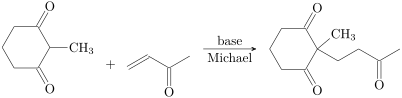
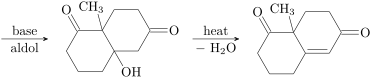
An annulation builds a new ring onto an existing molecule. The Robinson annulation builds a cyclohex-2-en-1-one: a Michael addition of a ketone’s enolate to an -unsaturated ketone (typically but-3-en-2-one), followed by an intramolecular aldol condensation of the 1,5-diketone formed.
Proposition 26.10 (Robinson annulation)
A ketone with an hydrogen and but-3-en-2-one, in base, give a cyclohex-2-en-1-one in three steps: Michael addition, intramolecular aldol addition forming a six-membered ring, and dehydration. The new ring contains the former carbon of the ketone and its carbonyl carbon, and the four carbons of but-3-en-2-one.
Proof. Follow the atoms in the figure. The enolate carbon of the ketone (call it C) bonds to the carbon of but-3-en-2-one: the chain C–––– hangs on C, and C is still bonded to the ketone’s carbonyl carbon C. In base, the methyl ketone of the chain forms its enolate at the terminal , which attacks C. The ring closed counts C, C, the two , the side-chain carbonyl carbon and the former methyl carbon: six atoms, the strain-free ring size, which is why this enolate, among the possible ones, leads to a stable product (an attack by the chain’s internal enolate would close a four-membered ring). The aldol has its on C, to the chain carbonyl; dehydration puts the between C and the former methyl carbon, conjugated with the carbonyl: a cyclohex-2-en-1-one. ∎
Method 26.11 (Disconnecting a cyclohexenone)
- Find a cyclohex-2-en-1-one in the target; number its carbonyl carbon C1, the double bond C2=C3, and the ring on to C6.
- Undo the dehydration: an on C3, a on C2.
- Undo the aldol: cut C2–C3. C3 becomes a ketone carbonyl, C2 a methyl group of a methyl ketone: a 1,5-diketone.
- Undo the Michael addition: cut the bond between C4 (the carbon of the C3 ketone) and C5. The donor is that ketone; the acceptor is the enone C5=C6–C1(=O)–C2, which is but-3-en-2-one when C5, C6 and C2 carry only hydrogens.
History — The annulation, 1935
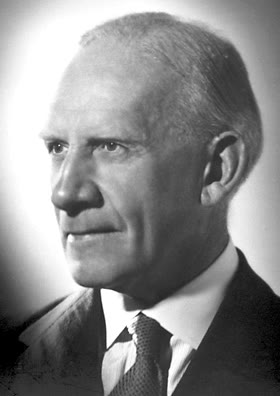
Robert Robinson and William Rapson published the ring-forming sequence in 1935, in work aimed at the synthesis of steroids. Robinson’s main achievements were the structures and syntheses of alkaloids, for which he received the 1947 Nobel Prize in Chemistry. In 1950 Peter Wieland and Karl Miescher made the bicyclic diketone of this chapter’s problem, which became a common starting point for steroid and terpene syntheses. (Portrait: unknown author, public domain; Wikimedia Commons.)
Safety


But-3-en-2-one is flammable, very toxic, corrosive and hazardous to the aquatic environment, and a powerful lachrymator; it is handled only in a fume hood. Cyclohex-2-en-1-one is flammable and toxic. Organolithiums, Grignard reagents and cuprates react violently with water and are handled under inert gas.
26.6 Exercises
Exercise 26.1 ★
Predict 1,2- or 1,4-addition to cyclohex-2-en-1-one for: ; ; with a little base; .
Solution
Solution of Exercise 26.1.
- : mainly 1,2 (hard, irreversible), 1-methylcyclohex-2-en-1-ol.
- : 1,4, 3-methylcyclohexanone.
- Thiophenol with base: 1,4 (the thiolate is soft), 3-(phenylsulfanyl)cyclohexanone.
- : 1,2, cyclohex-2-en-1-ol.
Exercise 26.2 ★
Classify as Michael donor or Michael acceptor: pentane-2,4-dione, propenenitrile , nitromethane, methyl propenoate, diethyl propanedioate, but-3-en-2-one.
Solution
Solution of Exercise 26.2.
Donors: pentane-2,4-dione, nitromethane, diethyl propanedioate (acidic ). Acceptors: propenenitrile, methyl propenoate, but-3-en-2-one ( conjugated with an acceptor group).
Exercise 26.3 ★
Write the preparation of lithium dibutylcuprate from 1-bromobutane, lithium and copper(I) iodide.
Solution
Solution of Exercise 26.3.
, then , in ether at low temperature under inert gas.
Exercise 26.4 ★
Give the product of diethyl propanedioate with but-3-en-2-one and a catalytic amount of sodium ethoxide, then the product after hydrolysis and heating.
Solution
Solution of Exercise 26.4.
Diethyl (3-oxobutyl)propanedioate, . Hydrolysis gives the substituted propanedioic acid, which loses on heating (Proposition 25.8): 5-oxohexanoic acid, .
Exercise 26.5 ★★
Propose a preparation of 3-methylcyclohexanone from cyclohex-2-en-1-one, and explain why methylmagnesium bromide would be a poor choice.
Solution
Solution of Exercise 26.5.
Lithium dimethylcuprate in ether at low temperature, then aqueous work-up: conjugate addition. Methylmagnesium bromide, harder, adds mostly 1,2 and gives 1-methylcyclohex-2-en-1-ol as the main product.
Exercise 26.6 ★★
Ethanethiol adds to but-3-en-2-one with a trace of triethylamine. Write the mechanism and say why the thiolate adds 1,4.
Solution
Solution of Exercise 26.6.
removes a little to give ; the thiolate adds to the carbon, the enolate formed takes the proton of another , which regenerates . Product: 4-(ethylsulfanyl)butan-2-one. Sulfur is large and polarisable, its lone pair high in energy: a soft nucleophile, under orbital control, so it attacks where the LUMO is largest, and the addition is reversible, which also favours the more stable 1,4-adduct.
Exercise 26.7 ★★
Cyanide with cyclohex-2-en-1-one gives, at low temperature and short times, the cyanohydrin; at higher temperature and longer times, 3-oxocyclohexane-1-carbonitrile. Explain with kinetic and thermodynamic control.
Solution
Solution of Exercise 26.7.
Cyanide attacks the more positive carbonyl carbon faster: the cyanohydrin is the kinetic product. Its formation is reversible; at higher temperature, given time, cyanide is released and re-adds at the carbon, giving the adduct that keeps the stronger bond, the thermodynamic product.
Exercise 26.8 ★★
Give the Robinson annulation product of 2-methylcyclohexane-1,3-dione with but-3-en-2-one, then that of cyclohexanone with but-3-en-2-one.
Solution
Solution of Exercise 26.8.
With 2-methylcyclohexane-1,3-dione: the Wieland–Miescher ketone (figure of the Robinson annulation). With cyclohexanone: 4,4a,5,6,7,8-hexahydronaphthalen-2(3H)-one, a bicyclic enone whose ends at a ring-fusion carbon, with no angular methyl group.
Exercise 26.9 ★★
Disconnect heptane-2,6-dione into a Michael donor and a Michael acceptor, and propose conditions.
Solution
Solution of Exercise 26.9.
: C2 and C6 are the carbonyls, five carbons from C2 to C6 counted inclusively, a 1,5-diketone. Cut C3–C4: donor, the enolate of propanone at C3 (better, ethyl 3-oxobutanoate, whose ester is removed later by hydrolysis and decarboxylation); acceptor, but-3-en-2-one. Conditions: ethyl 3-oxobutanoate, but-3-en-2-one, catalytic sodium ethoxide in ethanol; then aqueous acid and heat.
Exercise 26.10 ★★★
A simple aldol addition is easily reversed in base; the Michael adduct of diethyl propanedioate and but-3-en-2-one is not. Explain with the bonds made and broken and with the acidity of the product.
Solution
Solution of Exercise 26.10.
The aldol makes a bond but turns a bond into a bond; the balance is small and two molecules become one, so is modest and the retro-aldol is easy. The Michael addition makes a bond at the cost of a weaker bond and keeps both : it is clearly favourable. The reverse would need the ketone enolate to expel the stabilised propanedioate anion; the equilibrium lies so far on the adduct side that under catalytic base the adduct persists.
Exercise 26.11 ★★★
Diethyl propanedioate with two equivalents of methyl propenoate and a catalytic base gives a product with no remaining between its two ester groups. Draw it and explain.
Solution
Solution of Exercise 26.11.
. After the first Michael addition the central carbon still has one hydrogen between two esters, as acidic as before: the base removes it and a second addition follows.
Exercise 26.12 ★★★
2-Methylcyclohexanone and but-3-en-2-one in a Robinson annulation can react through either enolate. Draw both products and say which conditions favour the one with the methyl group on the ring-fusion carbon.
Solution
Solution of Exercise 26.12.
Through the more substituted enolate (towards the methyl-bearing carbon): the octalone with the methyl group on the ring-fusion carbon, 4a-methyl-4,4a,5,6,7,8-hexahydronaphthalen-2(3H)-one. Through the less substituted enolate (at the side): the methyl group ends on a ring carbon next to the fusion. The first is favoured under equilibrating conditions (an alkoxide in its alcohol, or the enamine route with a secondary amine and acid), which give the thermodynamic, more substituted enolate (Proposition 25.6).
26.7 Problem: The Wieland–Miescher Ketone
Problem 26.1
Weekend problem — the acidic donor, the Michael adduct, the intramolecular aldol and its dehydration, the stereocentre and the mass balance of a preparation
Preparation (exercise data): of 2-methylcyclohexane-1,3-dione react with a slight excess of but-3-en-2-one and a catalytic base (Michael addition); the triketone is then cyclised with a secondary amine and an acid (aldol, dehydration). Overall yield: 70 %. The parent cyclohexane-1,3-dione has in water. Molar masses (): C 12.011, H 1.008, O 15.999.
Part I — The donor.
- Draw 2-methylcyclohexane-1,3-dione and mark its most acidic hydrogen.
- Why is that hydrogen so much more acidic than the hydrogens of cyclohexanone?
- Draw the three resonance structures of its enolate.
- Is hydroxide or ethoxide strong enough to form this enolate completely? Use the .
- Write the enol of the dione that involves C2, and say why the methyl group on C2 does not prevent it.
- Is this enolate hard or soft? Which site of but-3-en-2-one will it attack?
Part II — The Michael adduct.
- Write the Michael addition and name the triketone formed.
- Why is only a catalytic amount of base needed?
- Why does the new bond form at C2 of the dione rather than at its oxygen?
- How many quaternary carbons does the triketone have?
- Identify the 1,5-dicarbonyl relationship in the triketone.
- Why is a slight excess of but-3-en-2-one used, and why only slight?
Part III — The ring closure.
- List the carbons of the triketone that bear hydrogens.
- Which enolate, attacking which carbonyl, closes a six-membered ring?
- Which other ring closures could be attempted, and why do they not give the product?
- Write the aldol formed and the dehydration that follows.
- Why is the dehydration easy?
- Name the functional groups of the Wieland–Miescher ketone.
Part IV — Stereochemistry and mass balance.
- Which carbon of the product is a stereocentre?
- Is the product of this preparation optically active? Explain.
- Compute the molar masses of the dione, of but-3-en-2-one and of the product .
- Write the overall equation and check it with the formulas.
- Compute the amount of dione used.
- State the mass of Wieland–Miescher ketone obtained at 70 % overall yield.
Solution
Solution of Problem 26.1.
1. A cyclohexane ring with at C1 and C3 and a methyl group on C2; the hydrogen on C2 is the most acidic. 2. Its removal gives an anion whose charge is delocalised over C2 and both oxygens; for cyclohexanone only one oxygen shares it, and the acidity is too weak to measure in water. 3. Charge on C2; with on C1; with on C3. 4. Yes: with hydroxide, (water as the conjugate acid, from ); with ethoxide, . Either is complete.
5. : C2 still carries one hydrogen, which is all an enol needs; the methyl group only replaces the second one. 6. Soft: the charge is spread over three atoms and the anion is stabilised. It attacks the carbon (Proposition 26.4). 7. The enolate’s C2 bonds to the end of but-3-en-2-one; the enolate formed takes a proton: 2-methyl-2-(3-oxobutyl)cyclohexane-1,3-dione. 8. Each new enolate takes a proton from a molecule of dione (or from the solvent) and so regenerates the donor enolate: the base is not consumed. 9. The enolate is ambident; with a soft carbon electrophile, under orbital control, it reacts at carbon, and the adduct keeps two bonds, the stronger combination; an -adduct, if formed, would revert. 10. One: C2, bonded to C1, C3, the methyl and the chain. 11. The chain carbonyl carbon and the ring carbonyl C1 (or C3): –––C2–C1, five carbons counted inclusively. 12. To consume all the dione, the more valuable reagent; only slightly, because but-3-en-2-one is very toxic and polymerises. 13. Ring C4 and C6 (next to C3 and C1), the chain next to its carbonyl, and the chain’s terminal . C2 has none. 14. The enolate of the terminal attacks a ring carbonyl: the ring closed counts that carbon, the chain carbonyl carbon, two , C2 and the attacked carbonyl carbon: six atoms. 15. The internal chain enolate would close a four-membered ring, strained. A ring enolate (C4 or C6) attacking the chain carbonyl closes a six-membered ring too, but bridged: that aldol cannot dehydrate (the double bond would sit at a bridgehead of a small bicyclic system) and reverts, while the fused aldol is drained by dehydration. 16. The aldol carries on the former ring carbonyl carbon, now at the ring fusion; loss of water with a hydrogen of the former carbon (now to the chain ketone) gives the conjugated with that ketone. 17. The new double bond is conjugated with the carbonyl: an E1cB elimination through the enolate, favoured by heating (Proposition 25.11). 18. A saturated ketone and an -unsaturated ketone (a cyclohexenone). 19. The ring-fusion carbon carrying the methyl group: four different substituents. 20. No: the dione is achiral, and its two carbonyls are attacked equally (they are mirror images of each other with respect to the chain); with achiral reagents the product is racemic. Chiral amine catalysts favour one carbonyl and give one enantiomer in excess (Year 3 volume). 21. Dione : ; : ; : . 22. : C 11, H 16, O 3 on each side. 23. . 24. of Wieland–Miescher ketone.