সব বই

পেশাদার

1 Markets I: The Ecosystem and Exchange-Traded Marketsবাজার অনলাইন 2 Markets II: Rates, FX and Creditবাজার অনলাইন 3 Markets III: Commodities, Energy and Cryptoবাজার অনলাইন 4 Quantitative Methodsপদ্ধতি অনলাইন 5 Derivatives and Volatilityডেরিভেটিভস অনলাইন 6 Rates, Credit, XVA and Riskসুদহার, ঋণ ও ঝুঁকি অনলাইন 7 Research Craft: Predictors, Backtests, Measurement, Portfoliosগবেষণা অনলাইন 8 Strategies I: Equities and Futuresকৌশল অনলাইন 9 Strategies II: Volatility, Relative Value, Macro and the Bank Desksকৌশল অনলাইন 10 Microstructure and Executionএক্সিকিউশন অনলাইন 11 Market Making and High-Frequency Tradingমার্কেট মেকিং অনলাইন 12 Machine Learning for Marketsমেশিন লার্নিং অনলাইন 13 Low-Latency Softwareপ্রযুক্তি অনলাইন 14 Networks, Hardware and Trading Infrastructureপ্রযুক্তি অনলাইন 15 Research, Data and Risk Platformsপ্রযুক্তি অনলাইন 16 The Desk and the Firmপ্রতিষ্ঠান অনলাইন 17 The Industry: Firms, Roles and Careersক্যারিয়ার অনলাইন 18 Interviews I: Maths, Probability and Speedক্যারিয়ার অনলাইন 19 Interviews II: Markets, Trading Games and the Final Roundক্যারিয়ার অনলাইন 20 Interviews III: Codeক্যারিয়ার অনলাইন
অ্যাপ পরিচিতি Coach সাইন ইন পড়া শুরু করো

বইগুলো এখনো বাংলা ভাষায় পাওয়া যায় না — ইংরেজি সংস্করণ দেখানো হচ্ছে।

Chemistry · পরিভাষা

Nucleus and electron কী?

অন্য নাম: nucleus · electron

Definition 16.1 School Chemistry — Grades 1 to 12 · অধ্যায় 16 — Inside the Atom

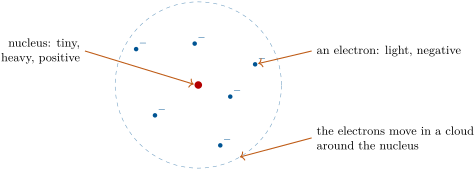
Every atom has a tiny, heavy core, the nucleus, which carries a positive electric charge. Around it move much lighter particles, the electrons, each carrying the same negative charge, −e-e.

An atom, not to scale. If the nucleus were drawn the size of the red dot, the cloud of electrons would be a few hundred metres across.

উদাহরণ

Example 16.9 (Isotopes of carbon and of hydrogen)

Natural carbon is about 98.9 %98.9\,\% carbon-12, X612X26212C\ce{^{12}_{6}C}, and 1.1 %1.1\,\% carbon-13, X613X26213C\ce{^{13}_{6}C}, with a trace of carbon-14, X614X26214C\ce{^{14}_{6}C}, whose slow change into another nucleus is used to date ancient wood and bones (radioactivity belongs to the physics book). Hydrogen has three isotopes: X11X2121H\ce{^{1}_{1}H}, with no neutron at all, the commonest by far; deuterium X12X2122H\ce{^{2}_{1}H}, a few atoms in every hundred thousand; and tritium X13X2123H\ce{^{3}_{1}H}.

Example 16.12 (A marble in a stadium)

If the nucleus of an atom were a marble 1 cm1\,\mathrm{cm} across, the atom would be about 1 cm×100 000=1 km1\,\mathrm{cm} \times 100\,000 = 1\,\mathrm{km} across: a marble in the middle of a huge stadium, with a few specks of dust — the electrons — whirling around the stands. Matter is mostly empty space.

প্রসঙ্গসহ পড়ো →