School Chemistry — Grades 1 to 12 · Grades 1–12
16Inside the Atom
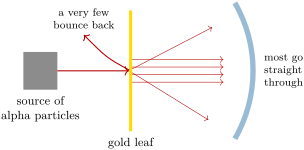
In 1909, in a laboratory in Manchester, a beam of tiny, fast particles was fired at a sheet of gold leaf a few hundred atoms thick. Nearly all of them went straight through, as if the gold were empty. But about one in several thousand bounced back. “It was as if you fired a 15-inch shell at a piece of tissue paper and it came back and hit you,” said Ernest Rutherford, whose students had made the experiment. The atom, the uncuttable piece of matter, had a structure — and it was almost entirely empty.
You already know
All matter is made of atoms, about a hundred different kinds of them, each with a symbol such as , , , . Atoms join into molecules, described by formulas such as (Chapter 11).
16.1 Nucleus and electrons
Definition 16.1 (Nucleus and electron)
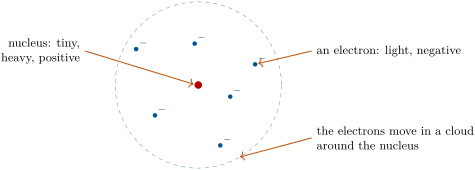
Every atom has a tiny, heavy core, the nucleus, which carries a positive electric charge. Around it move much lighter particles, the electrons, each carrying the same negative charge, .
Proposition 16.2 (An atom is neutral)
An atom as a whole carries no electric charge: the positive charge of its nucleus is exactly balanced by the negative charges of its electrons. The charge is tiny: (the coulomb, unit of charge, is the physics book’s).
16.2 Protons and neutrons
Definition 16.3 (Proton, neutron, nucleon)
The nucleus is made of two kinds of particles: protons, each carrying the charge , and neutrons, which carry no charge. Protons and neutrons, which have almost the same mass, are together called nucleons.
Definition 16.4 (Atomic number and mass number)
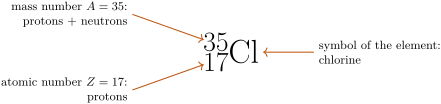
The number of protons in a nucleus is the atomic number, written . The number of nucleons (protons and neutrons together) is the mass number, written . The number of neutrons is .
Notation 16.5 (The nuclide symbol)
An atom with a given nucleus is written with its symbol, the mass number at the top left and the atomic number at the bottom left: . For example has 6 protons and neutrons; has 26 protons and 30 neutrons.
Method 16.6 (Reading a nuclide symbol)
For :
16.3 The chemical element and its isotopes
Definition 16.7 (Chemical element)
A chemical element is the set of all the atoms, and of all the charged atoms made from them, that have the same atomic number . Each element has a name and a symbol: every atom with 6 protons is a carbon atom, ; every atom with 8 protons is an oxygen atom, .
Definition 16.8 (Isotopes)
Atoms of the same element that have different numbers of neutrons, and so different mass numbers, are isotopes of that element. They have the same and different .
Example 16.9 (Isotopes of carbon and of hydrogen)
Natural carbon is about carbon-12, , and carbon-13, , with a trace of carbon-14, , whose slow change into another nucleus is used to date ancient wood and bones (radioactivity belongs to the physics book). Hydrogen has three isotopes: , with no neutron at all, the commonest by far; deuterium , a few atoms in every hundred thousand; and tritium .
Proposition 16.10 (Isotopes behave alike in chemistry)
The chemistry of an atom depends on its electrons, and the isotopes of an element have the same number of electrons. Isotopes therefore react in the same way: water made with deuterium looks and behaves almost exactly like ordinary water.

16.4 Sizes and masses
Proposition 16.11 (The nucleus is tiny and holds almost all the mass)
An atom measures about across; its nucleus, about to : some ten thousand to a hundred thousand times smaller. The masses of the particles are
A proton is about 1836 times heavier than an electron, so more than of the mass of an atom is in its nucleus.
Example 16.12 (A marble in a stadium)
If the nucleus of an atom were a marble across, the atom would be about across: a marble in the middle of a huge stadium, with a few specks of dust — the electrons — whirling around the stands. Matter is mostly empty space.
Method 16.13 (The mass of an atom)
Since protons and neutrons have nearly the same mass and electrons are very light, the mass of an atom is close to , where is its mass number. A carbon-12 atom: .
16.5 A short history of the atomic model
History — From the uncuttable to the nucleus, 1897–1932
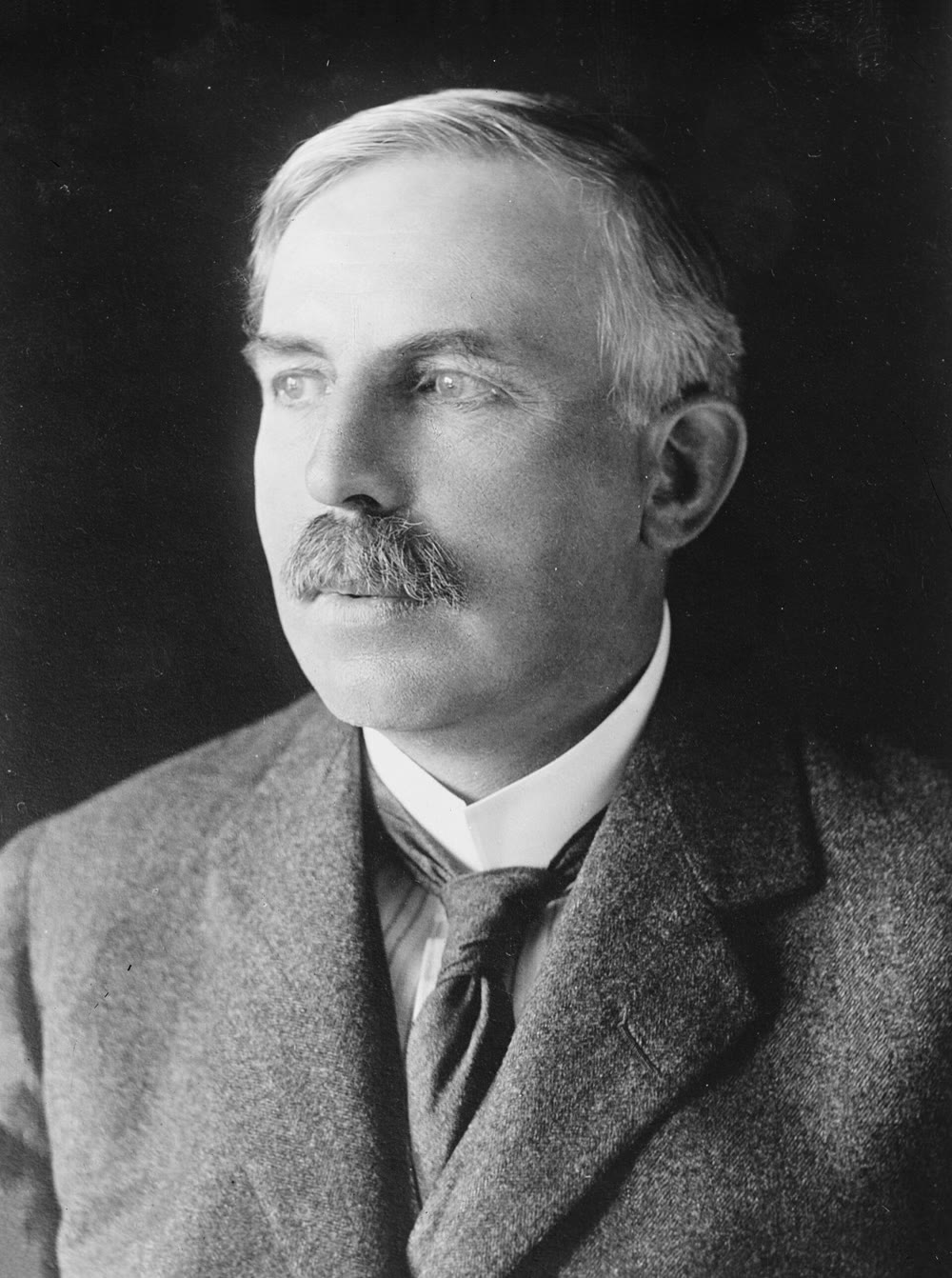
In 1897 J. J. Thomson discovered the electron, a particle far lighter than any atom: atoms could be cut after all. He pictured the atom as a ball of positive matter studded with electrons. In 1909–1911 the gold-foil experiment of Rutherford’s team showed that the positive charge and almost all the mass sit in a tiny nucleus. In 1913 Niels Bohr proposed that the electrons occupy fixed energy levels around it, and in 1932 James Chadwick found the neutron.
16.6 Exercises
Exercise 16.1 ★
Name the particles of the nucleus and the particles around it, with the sign of their charge.
Exercise 16.2 ★
Give the number of protons, neutrons and electrons of , and .
Exercise 16.3 ★
Why is an atom electrically neutral?
Exercise 16.4 ★
An atom has 26 protons and 30 neutrons. Write its nuclide symbol (the element is iron, ).
Solution
Solution of Exercise 16.4.
: .
Exercise 16.5 ★★
Are and the same element? Are they isotopes? Explain.
Solution
Solution of Exercise 16.5.
Yes: both have , so both are chlorine. They have different mass numbers (18 and 20 neutrons): they are isotopes.
Exercise 16.6 ★★
Are and isotopes? Explain.
Solution
Solution of Exercise 16.6.
No: they have different atomic numbers (6 and 7), so they are different elements, carbon and nitrogen. Isotopes have the same .
Exercise 16.7 ★★
Compute, in scientific notation, the approximate mass of an atom of .
Solution
Solution of Exercise 16.7.
.
Exercise 16.8 ★★
In the gold-foil experiment, why do most particles go straight through the gold?
Exercise 16.9 ★★
How many times smaller than an atom () is a nucleus of ? Write the answer as a power of ten.
Solution
Solution of Exercise 16.9.
: a hundred thousand times smaller.
Exercise 16.10 ★★
Why do the isotopes of an element have the same chemistry?
Exercise 16.11 ★★★
An iron atom has 26 electrons. Compute their total mass, then the fraction of the mass of a atom that they make up (use the mass found in exercise 7).
Solution
Solution of Exercise 16.11.
. Fraction: , about of the mass.
Exercise 16.12 ★★★
Natural copper is copper-63 and copper-65. Among 10 000 copper atoms, how many are of each isotope? What is the average number of nucleons per copper atom?
16.7 Problem: Weighing Chlorine
Problem 16.1
Weekend problem — two isotopes of chlorine, the mass of each atom, and the average mass of a chlorine atom
Natural chlorine is a mixture of two isotopes, chlorine-35 and chlorine-37: out of 1000 chlorine atoms, about 758 are chlorine-35 and 242 chlorine-37. Take the mass of a nucleon as and the mass of an electron as . The atomic number of chlorine is 17.
Part I — Two nuclei.
- Write the nuclide symbols of the two isotopes.
- Give the number of protons, neutrons and electrons of each.
- Why are both called chlorine? Why are they isotopes?
- Will a sample of chlorine-37 react with sodium the same way as a sample of chlorine-35? Explain.
Part II — The mass of each atom.
- Compute the mass of the nucleus of a chlorine-35 atom.
- Compute the mass of the 17 electrons, and check that it can be neglected beside the nucleus.
- Compute the mass of a chlorine-37 atom.
- How many chlorine-35 atoms would weigh ? Give the answer in scientific notation.
Part III — The average atom.
- What percentage of chlorine atoms are chlorine-35? Chlorine-37?
- In 1000 atoms of natural chlorine, compute the total mass of the chlorine-35 atoms and of the chlorine-37 atoms.
- Compute the mass of these 1000 atoms.
- Deduce the average mass of a chlorine atom.
Solution
Solution of Problem 16.1.
1. and .
2. Chlorine-35: 17 protons, 18 neutrons, 17 electrons. Chlorine-37: 17 protons, 20 neutrons, 17 electrons.
3. Both have 17 protons, so both are the element chlorine; they differ only by their number of neutrons, so they are isotopes.
4. Yes: chemistry depends on the electrons, and both have 17.
5. .
6. : about 4000 times less than the nucleus, negligible.
7. .
8. ; atoms.
9. and .
10. ; .
11. .
12. : the average mass of a chlorine atom.