
全部书籍

专业

应用 关于 Coach 登录 开始阅读

书籍暂未推出简体中文版——当前显示英文版。

Chemistry · 术语表

什么是 Recrystallisation?

Definition 28.8 School Chemistry — Grades 1 to 12 · 第 28 章 — Synthesis: Yield and Purity

Recrystallisation purifies a solid by dissolving it in the smallest possible volume of a hot solvent, then letting the solution cool: the product, much less soluble in the cold, crystallises, while the impurities, present in small amounts, stay dissolved.
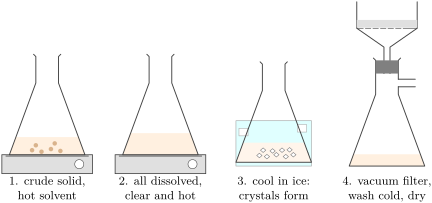
Recrystallisation in four steps. The impurities stay dissolved in the cold solvent and pass into the filtrate.
在原文中阅读 →
Definition 29.17 University Chemistry — Year 1 · 第 29 章 — Lab Techniques I: Safety, Measurement and Separation

Recrystallisation purifies a solid by dissolving it in the minimum of a hot solvent in which it is very soluble hot and little soluble cold, then letting it crystallise on cooling; the impurities either stay dissolved in the cold solvent (the mother liquor) or, being insoluble, are removed beforehand by hot filtration.

在原文中阅读 →