School Chemistry — Grades 1 to 12 · Grades 1–12
28Synthesis: Yield and Purity
Aspirin is one of the most widely used medicines in the world. Its story begins with willow bark, long chewed against pain and fever; the active substance of the bark was traced, in the nineteenth century, to a family of compounds from which chemists prepared salicylic acid. Too harsh on the stomach to be taken in large doses, salicylic acid was turned into a gentler substance, acetylsalicylic acid: aspirin. Today it is made by the tonne in steel reactors, by the same reaction a school laboratory can carry out in an afternoon. Making a substance is only half of the work: it must also be separated from everything else in the flask, purified, checked, and weighed to see how much of what was possible has really been obtained.
You already know
Extraction, distillation, thin-layer chromatography and the retention factor; a pure solid melts at a sharp, known temperature (Chapter 22). A filter holds back a solid and lets a liquid through (Chapter 3). The progress table gives the maximum amount of product from the limiting reactant (Chapter 27).
28.1 The steps of a synthesis
Definition 28.1 (Synthesis, crude product)
A synthesis is the preparation of a chemical species by one or several chemical reactions, starting from other species. The solid or liquid recovered straight from the reaction mixture, before any purification, is the crude product: it still contains reactants, by-products and solvent.
Method 28.2 (Planning a synthesis)
A synthesis is carried out in four steps:
- Reaction: mix the reactants in the right amounts, often with one in excess, and heat if needed.
- Isolation: separate the crude product from the reaction mixture (filtration, extraction).
- Purification: remove the impurities from the crude product (recrystallisation for a solid, distillation for a liquid).
- Analysis: check the identity and the purity of the product (melting point, chromatography), then weigh it and compute the yield.
Example 28.3 (Making aspirin)
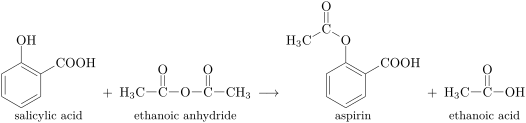
Salicylic acid reacts with ethanoic anhydride (also called acetic anhydride) to give aspirin and ethanoic acid:
The anhydride is put in excess, so that all the salicylic acid reacts; the ethanoic acid formed is a by-product.
28.2 Heating under reflux
Definition 28.4 (Heating under reflux)
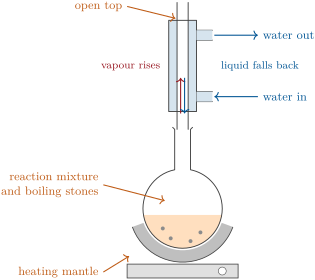
Heating under reflux is heating a reaction mixture in a flask topped by a vertical condenser: the vapours rise, cool in the condenser, and the liquid flows back into the flask.
Proposition 28.5 (Why reflux)
Heating makes most reactions faster; reflux allows heating for as long as needed at the boiling temperature of the mixture without losing any reactant, product or solvent as vapour.
Proof. The temperature of a boiling liquid cannot rise above its boiling point, and every vapour that escapes the liquid is condensed and returned: nothing leaves the apparatus, which stays open at the top so that no pressure builds up. ∎
Remark 28.6 (Water in at the bottom)
Fed from the top, the water would run straight down and leave the upper part of the jacket filled with air; fed from the bottom, it must fill the whole jacket before it can leave.
28.3 Isolating and purifying
Definition 28.7 (Vacuum filtration)
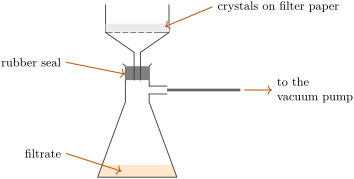
Vacuum filtration is a filtration in which the liquid is drawn through the filter paper by suction: a flat funnel with a perforated plate (a Büchner funnel) sits on a side-arm flask connected to a vacuum pump.
Definition 28.8 (Recrystallisation)
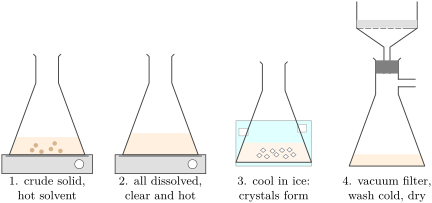
Recrystallisation purifies a solid by dissolving it in the smallest possible volume of a hot solvent, then letting the solution cool: the product, much less soluble in the cold, crystallises, while the impurities, present in small amounts, stay dissolved.
Method 28.9 (Recrystallising a solid)
- Choose a solvent in which the product is very soluble hot and hardly soluble cold.
- Add the hot solvent little by little to the crude solid, just until it has all dissolved.
- Let the solution cool slowly, then in an ice bath: crystals form.
- Collect them by vacuum filtration, wash them with a little ice-cold solvent, and dry them.
Remark 28.10 (Losses are unavoidable)
Even cold, the solvent keeps some product dissolved. Aspirin dissolves in water at about at , three times more at , and much more when hotter: every millilitre of filtrate and of washing water carries a little aspirin away. A recrystallisation buys purity at the price of mass.
28.4 Analysing the product
Proposition 28.11 (Two checks of purity)
A synthesised solid is pure, within the limits of these tests, when:
- it melts sharply at the melting point given in the tables;
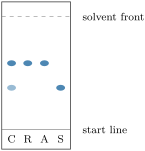
- on a thin-layer chromatography plate, it gives a single spot, at the same height as a sample of the pure substance.
Proof. Admitted: an impurity lowers the melting point and spreads it over a range (Chapter 22), and a second species usually travels a different distance on the plate. ∎
28.5 Yield
Definition 28.12 (Yield)
The yield of a synthesis is the ratio of the amount of product actually obtained, pure and dry, to the maximum amount the limiting reactant could give:
usually given as a percentage.
Proposition 28.13 (Yield from masses)
Since obtained and maximum amounts concern the same product, of molar mass , the yield is also the ratio of masses:
where comes from the progress table, at .
Proof. . ∎
Example 28.14 (Yield of a small synthesis)
of salicylic acid (), that is , react with excess ethanoic anhydride. The maximum amount of aspirin is , that is . If of pure dry aspirin are obtained, , a yield of .
Remark 28.15 (Why yields are below 100 %)
Product is lost at every step: stuck on glassware, dissolved in the filtrate and the washings, left behind in a recrystallisation; some reactions also give side products, or stop before the limiting reactant is used up. A yield above always signals an error, most often a product weighed while still wet or impure.
In the lab — Making aspirin
In a dry flask, the teacher mixes salicylic acid with an excess of ethanoic anhydride and a few drops of an acid that speeds up the reaction, and heats the mixture under reflux in a water bath at about for a quarter of an hour. After cooling, cold water is added: the excess anhydride reacts with it, and the aspirin, hardly soluble in cold water, comes out as white crystals. These are collected by vacuum filtration, recrystallised, dried, weighed, and their melting point is measured.
Safety


Ethanoic anhydride is flammable, harmful if swallowed or inhaled, and causes severe burns of the skin and the eyes: it is handled by the teacher, under a fume hood, with gloves and goggles. Salicylic acid is harmful if swallowed and can damage the eyes. The aspirin made in a laboratory is never taken as a medicine.
28.6 Exercises
Exercise 28.1 ★
A synthesis could give at most of product; of pure dry product are obtained. Compute the yield.
Exercise 28.2 ★
Put these steps of a synthesis in order: measuring the melting point; heating under reflux; recrystallisation; vacuum filtration of the crude product; weighing the reactants.
Solution
Solution of Exercise 28.2.
Weighing the reactants; heating under reflux; vacuum filtration of the crude product; recrystallisation; measuring the melting point.
Exercise 28.3 ★
In a reflux set-up, why is the cooling water fed into the condenser at the bottom? Why is the top of the condenser left open?
Solution
Solution of Exercise 28.3.
Fed from the bottom, the water fills the whole jacket before leaving at the top, so the whole length of the condenser is cooled. The top is left open so that the apparatus is not closed: heating a closed apparatus would build up pressure and could make it burst.
Exercise 28.4 ★
What two properties must a solvent have to recrystallise a product? Where do the impurities end up?
Exercise 28.5 ★
A sample of synthesised aspirin melts between and . Pure aspirin melts at about . Is the sample pure? What should be done?
Solution
Solution of Exercise 28.5.
No: it melts below and over a range of several degrees, the sign of an impure solid. It should be recrystallised, dried, and its melting point measured again.
Exercise 28.6 ★★
of salicylic acid react with excess ethanoic anhydride; of pure dry aspirin are obtained. Compute the maximum mass of aspirin and the yield.
Exercise 28.7 ★★
A student weighs her aspirin while it is still wet and finds a yield of . Explain. Would weighing the crude product, unpurified but dry, give a yield that is too high or too low compared with the true yield?
Solution
Solution of Exercise 28.7.
The weighed mass includes water, so it is larger than the mass of aspirin: the computed yield is too high, here impossibly above . The dry crude product still contains impurities (unreacted salicylic acid, by-products), which add mass too: its yield is also too high compared with the true yield of pure aspirin.
Exercise 28.8 ★★
Give two advantages of a vacuum filtration over an ordinary filtration through a paper cone, for collecting crystals.
Solution
Solution of Exercise 28.8.
It is much faster, and it leaves the crystals much drier, since the suction draws out most of the liquid; the crystals are also easy to wash on the funnel and to scrape off the flat filter paper.
Exercise 28.9 ★★
On a chromatography plate the solvent front has moved . The spot of a synthesised product has moved , that of pure aspirin , that of salicylic acid . Compute the three retention factors. What can be concluded about the product?
Solution
Solution of Exercise 28.9.
Product ; aspirin ; salicylic acid . The product travels like aspirin and shows no spot of salicylic acid: it is aspirin, with no salicylic acid detected.
Exercise 28.10 ★★
The solubility of a product in two solvents is:
| solvent | cold () | hot (near boiling) |
|---|---|---|
| A | ||
| B |
Which solvent is better for a recrystallisation? For of crude product, about what volume of hot solvent is needed, and what mass at most stays dissolved once cold?
Exercise 28.11 ★★
Why is the round-bottom flask of a reflux set-up never more than half full? Why are boiling stones added?
Solution
Solution of Exercise 28.11.
A boiling liquid needs room above it: froth and splashes must not reach the condenser. Boiling stones give the vapour small places to form bubbles, so that the liquid boils smoothly instead of in sudden bursts.
Exercise 28.12 ★★★
A medicine is made in two steps, of yields and . What is the overall yield? What would it be for three steps of each? Why do chemists try to make medicines in as few steps as possible?
Solution
Solution of Exercise 28.12.
: . Three steps of : , . Every step loses product (and time and money), and the losses multiply: the fewer steps, the more product is left at the end.
Exercise 28.13 ★★★
Aspirin dissolves in water at about at . Crystals are washed with of water at that temperature. What mass of aspirin may be lost at most? Why is the washing water cooled in ice first?
Solution
Solution of Exercise 28.13.
At most of aspirin. Ice-cold water dissolves even less aspirin, since its solubility falls with the temperature.
Exercise 28.14 ★★★
of salicylic acid are mixed with of ethanoic anhydride. After the reaction, water is added and destroys the excess anhydride: .
- Fill the progress table of the synthesis; what amount of anhydride is left?
- What total amount of ethanoic acid is present at the end?
Solution
Solution of Exercise 28.14.
- , anhydride : the salicylic acid is limiting, , and of anhydride is left.
- The synthesis gives of ethanoic acid, the destruction of the excess : in all.
Exercise 28.15 ★★★
A factory must make of aspirin, with an overall yield of from salicylic acid. What mass of salicylic acid must it buy?
28.7 Problem: Making Aspirin
Problem 28.1
Weekend problem — from three grams of salicylic acid to a jar of pure aspirin: what is the yield?
A class makes aspirin. In the flask: of salicylic acid and of ethanoic anhydride, of density , with a few drops of acid; the mixture is heated under reflux. The crude product collected by vacuum filtration weighs wet and once dry. After recrystallisation and drying, of white crystals remain.
Part I — The reaction.
- Check that the equation is balanced.
- Compute the molar masses of salicylic acid, ethanoic anhydride, aspirin and ethanoic acid.
- Name the reactants, the product wanted and the by-product.
- Why is the mixture heated under reflux rather than in an open flask?
Part II — The maximum mass.
- Compute the initial amount of salicylic acid.
- Compute the mass, then the amount, of ethanoic anhydride.
- Fill the progress table. Which reactant is limiting? Give .
- Deduce the maximum mass of aspirin.
- Why is the anhydride, rather than the salicylic acid, put in excess?
Part III — Isolating and purifying.
- Why can the wet mass, , not be used to compute a yield?
- Compute the yield of crude dry product.
- Why does the recrystallisation lower the mass?
- The crystals were washed with of water at , where aspirin dissolves at about . What mass could at most be lost this way?
- Compute the yield of pure product.
Part IV — Checking the product.
- The recrystallised crystals melt sharply at . What does this show?
- The crude product melted between and . What does this show?
- On a chromatography plate, the crude product gives two spots, one at the height of pure aspirin and one at the height of salicylic acid; the recrystallised product gives one spot, at the height of aspirin. Conclude.
- The spot of the recrystallised product moved and the solvent front . Compute its retention factor.
- Between the reaction and the recrystallisation, which part of the work lost more aspirin?
- State the final answer: what is the yield of the synthesis?
Solution
Solution of Problem 28.1.
1. C: and ; H: and ; O: and . Balanced.
2. Salicylic acid ; anhydride ; aspirin ; ethanoic acid .
3. Reactants: salicylic acid and ethanoic anhydride; product wanted: aspirin; by-product: ethanoic acid.
4. Heating makes the reaction faster; under reflux the vapours are condensed and returned, so no reactant or product is lost.
5. .
6. ; .
7. Salicylic acid: ; anhydride ; aspirin and ethanoic acid: . Salicylic acid runs out first: , salicylic acid is limiting.
8. .
9. So that all the salicylic acid is turned into aspirin: any left over would stay mixed with the aspirin and be hard to remove, whereas the excess anhydride is destroyed by the water added at the end, and the ethanoic acid it gives is washed away.
10. It includes water: would give a false .
11. : of crude dry product, which is not pure.
12. The impurities are removed, and part of the aspirin stays dissolved in the cold solvent and in the washings.
13. at most.
14. : .
15. A sharp melting point at the value of pure aspirin: the crystals are aspirin, and pure.
16. Melting below and over a wide range: the crude product was impure.
17. The crude product contained aspirin and unreacted salicylic acid; the recrystallisation removed the salicylic acid.
18. .
19. About as much in each: from possible to of crude product, and from to in the recrystallisation, about each. Since the crude product was not pure aspirin, the first part of the work in fact lost a little more aspirin than .