
All books

Professional

Apps About Coach Log in Start reading

Chemistry · Glossary

What is SN1 mechanism, racemisation, solvolysis?

Also known as: SN1 mechanism · racemisation · solvolysis

Definition 19.6 University Chemistry — Year 1 · Chapter 19 — Nucleophilic Substitution

The SN1 mechanism (substitution, nucleophilic, unimolecular) has two steps: the slow heterolysis of the C–Y bond, giving a carbocation, then the fast addition of the nucleophile to the carbocation. A reaction that turns a single enantiomer into a mixture of both is a racemisation; a substitution in which the solvent is the nucleophile is a solvolysis.
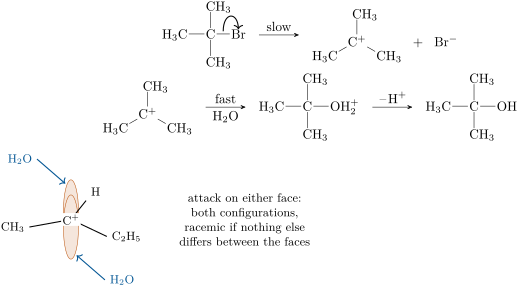
SN1 solvolysis of 2-bromo-2-methylpropane in water: slow ionisation to the tertiary carbocation, then capture by water and loss of a proton. Below: a chiral secondary carbocation (from 2-bromobutane) is planar, and water adds on either face with equal probability.
Read in context →