University Chemistry — Year 1 · Bachelor Year 1
19Nucleophilic Substitution
Take a bottle of (S)-2-bromobutane, a single enantiomer that rotates polarised light. Heated with sodium hydroxide in a polar aprotic solvent, it gives butan-2-ol that is a single enantiomer too — but the other one, (R): the reaction has turned the molecule inside out like an umbrella in the wind. Left instead in warm water, the same bromide gives butan-2-ol that is partly racemic. The same overall change, an OH group replacing a Br atom, follows two different paths. This chapter establishes the two mechanisms from their rate laws, explains their stereochemistry, and gives the rules that decide between them — the first full use of the tools of the kinetics and electronic-effects chapters.
You already know
Rate laws, elementary steps, the rate-determining step and the steady-state approximation are in Chapters 8 and 9; configurations, Cram drawings and optical activity in Chapter 16; nucleophiles, electrophiles, leaving groups and carbocations in Chapter 18; protic and aprotic solvents in Chapter 4.
19.1 The substitution and its partners
Definition 19.1 (Nucleophilic substitution, substrate)
A nucleophilic substitution is the replacement, on a saturated carbon, of a leaving group Y by a nucleophile Nu: . The compound R–Y is the substrate; the carbon bearing Y is electrophilic because the C–Y bond is polarised towards Y.
Halogenoalkanes are the typical substrates, with , or as leaving groups. Hydroxide gives alcohols; alkoxides give ethers; cyanide gives nitriles (one more carbon); ammonia and amines give amines; iodide exchanges with the other halides. Water and alcohols, used as solvents, can also act as nucleophiles: the substitution is then a solvolysis.
19.2 The SN2 mechanism
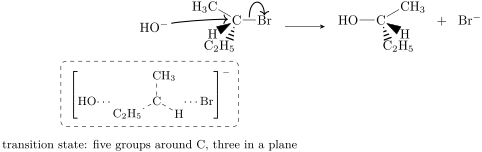
When bromomethane reacts with hydroxide in water, doubling either concentration doubles the rate: , a reaction of order one in each reactant.
Definition 19.2 (SN2 mechanism, Walden inversion)
The SN2 mechanism (substitution, nucleophilic, bimolecular) is a single elementary step in which the nucleophile attacks the carbon from the side opposite the leaving group while the leaving group departs. The three other substituents of the carbon flip over, like an umbrella turned inside out: the Walden inversion.
Proposition 19.3 (Rate law of SN2)
For an SN2 reaction, .
Proof. The mechanism is a single bimolecular elementary step; by the law of mass action for elementary steps (Chapter 9) its rate is proportional to the product of the concentrations of the two partners. ∎
Proposition 19.4 (Stereochemistry of SN2)
An SN2 reaction at a stereogenic carbon gives a single stereoisomer, with inverted arrangement of the three unchanged groups: a reaction of this kind is stereospecific.
Proof. The nucleophile can only reach the empty side of the carbon, opposite the leaving group; the three other groups pass through a plane in the transition state and end on the other side. The new bond points where the old one did not: each molecule of substrate gives the mirror arrangement of its groups. The descriptor usually changes from (S) to (R) or back, but not always, since it depends on the ranks of the nucleophile and of the leaving group. ∎
Definition 19.5 (Stereospecific reaction)
A reaction is a stereospecific reaction when stereoisomeric substrates give stereoisomerically different products, each substrate giving its own product.
19.3 The SN1 mechanism
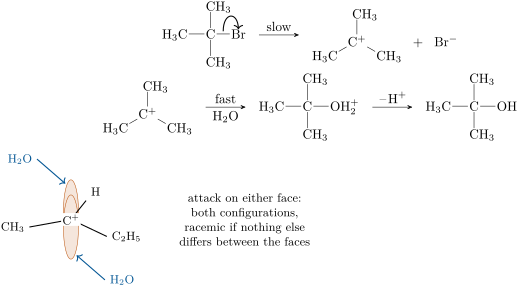
2-Bromo-2-methylpropane reacts with water at a rate that does not depend on the concentration of the nucleophile: . A step that does not involve the nucleophile must decide the rate.
Definition 19.6 (SN1 mechanism, racemisation, solvolysis)
The SN1 mechanism (substitution, nucleophilic, unimolecular) has two steps: the slow heterolysis of the C–Y bond, giving a carbocation, then the fast addition of the nucleophile to the carbocation. A reaction that turns a single enantiomer into a mixture of both is a racemisation; a substitution in which the solvent is the nucleophile is a solvolysis.
Proposition 19.7 (Rate law of SN1)
For the SN1 mechanism, if the carbocation is captured much faster than it returns to the substrate, , independent of the nucleophile.
Proof. Steps: (, ), (). The carbocation is a reactive intermediate: by the steady-state approximation (Chapter 9), , so . When this reduces to : the first step is rate-determining. ∎
Proposition 19.8 (Stereochemistry of SN1)
An SN1 reaction at a stereogenic carbon gives both configurations: the reaction is not stereospecific, and leads to racemisation when nothing distinguishes the two faces of the carbocation.
Proof. The carbocation is planar (Chapter 18): its two faces are mirror images. If the leaving group has gone far before the capture, the nucleophile adds to either face at the same rate, giving the two enantiomers in equal amounts. In practice the leaving ion still shields one face for a while, and a slight excess of inversion is often observed. ∎
19.4 What decides the mechanism
Proposition 19.9 (Substrate)
Methyl and primary substrates react by SN2; tertiary substrates by SN1; secondary substrates by either, depending on the other factors. Allylic and benzylic substrates react fast by both.
Proof. SN2 needs room behind the carbon: each alkyl group in place of a hydrogen crowds the transition state, which carries five groups, and slows the reaction; three groups block it. SN1 needs a stable carbocation: the order of stability (Proposition 18.8) makes ionisation fast for tertiary, possible for secondary, and too slow for primary and methyl carbocations. Allylic and benzylic carbocations are stabilised by resonance, and the same system stabilises the SN2 transition state. ∎
Proposition 19.10 (Leaving group)
Both mechanisms are faster the better the leaving group, that is the weaker the base it becomes: ; and do not leave.
Proof. In both, the C–Y bond is broken in or before the rate-determining step, and the transition state carries part of the negative charge on Y. A group that holds a negative charge well — the conjugate base of a strong acid — lowers that transition state. , and are strong acids, a weak one ( 3.2), water and alcohols very weak ones: and are strong bases and poor leaving groups. ∎
Proposition 19.11 (Solvent)
Polar protic solvents (water, alcohols) favour SN1; polar aprotic solvents (propanone, dimethyl sulfoxide, dimethylformamide) favour SN2 with anionic nucleophiles.
Proof. SN1 creates two ions from a neutral substrate: a polar protic solvent stabilises both, the cation through its lone pairs and the anion through hydrogen bonds, and lowers the ionisation barrier. In SN2 the charge of an anionic nucleophile is spread in the transition state; a protic solvent, which binds the small anion strongly by hydrogen bonds, slows it, whereas an aprotic solvent leaves the anion free and reactive (Chapter 4). ∎
Method 19.12 (Choosing the mechanism)
- Substrate: methyl or primary SN2; tertiary SN1; secondary go on.
- Nucleophile: strong and anionic (, , , ) SN2; weak and neutral (water, alcohol) SN1.
- Solvent: aprotic SN2; protic SN1.
- Predict the stereochemistry (inversion or racemisation) and check that a strong base does not rather cause an elimination (Chapter 20).
| SN2 | SN1 | |
|---|---|---|
| steps | one | two, via a carbocation |
| rate law | ||
| substrate | methyl primary secondary | tertiary secondary |
| nucleophile | strong, anionic | weak, neutral (often the solvent) |
| solvent | polar aprotic | polar protic |
| stereochemistry | inversion (stereospecific) | racemisation (mostly) |
19.5 Exercises
Exercise 19.1 ★
Write the products of: bromoethane with sodium hydroxide; iodomethane with sodium ethoxide; 1-chloropropane with potassium cyanide; bromomethane with ammonia (first step). Identify substrate, nucleophile and leaving group.
Solution
Solution of Exercise 19.1.
; ; ; . Substrates: the halogenoalkanes; nucleophiles: , , , ; leaving groups: the halide ions.
Exercise 19.2 ★
For a reaction with , what happens to the initial rate if is tripled? If both concentrations are halved? Same questions if .
Solution
Solution of Exercise 19.2.
Second order: tripled; both halved, divided by 4. First order in RY only: unchanged; halved.
Exercise 19.3 ★
Predict the mechanism (SN1 or SN2): 1-bromobutane with sodium iodide in propanone; 2-bromo-2-methylpropane in water; bromomethane with hydroxide; 2-bromobutane in ethanol without added base.
Solution
Solution of Exercise 19.3.
SN2 (primary, good nucleophile, aprotic); SN1 (tertiary, water); SN2 (methyl, strong nucleophile); SN1 solvolysis (secondary, weak neutral nucleophile, protic solvent), possibly with some SN2.
Exercise 19.4 ★
Draw the product of the SN2 reaction of cyanide with (R)-2-bromobutane in Cram representation and give its descriptor.
Solution
Solution of Exercise 19.4.
The cyanide takes the place opposite the bromine and the three other groups flip. In the product the CN group ranks first, as Br did, the other ranks unchanged: the inverted arrangement has the opposite descriptor, (S)-2-methylbutanenitrile.
Exercise 19.5 ★★
Write the full SN1 mechanism of the hydrolysis of 2-bromo-2-methylpropane, with curly arrows, including the loss of the proton. Why is the rate law first order although three species take part?
Solution
Solution of Exercise 19.5.
1. Heterolysis: arrow from the C–Br bond to Br, giving and (slow). 2. A lone pair of water to the cationic carbon: . 3. A lone pair of another water molecule takes a proton of the group, the O–H pair returning to oxygen. Only the first, slow step decides the rate; water, the solvent, is in such excess that its concentration does not change.
Exercise 19.6 ★★
Explain why 1-bromo-2,2-dimethylpropane, a primary bromide, reacts very slowly by SN2 and does not react by SN1.
Solution
Solution of Exercise 19.6.
The carbon bearing Br is primary, but next to it a tert-butyl group fills the space behind the C–Br bond: the SN2 transition state is very crowded. SN1 would need a primary carbocation, too unstable.
Exercise 19.7 ★★
(S)-2-iodooctane loses its optical activity when kept in propanone with sodium iodide, although no new compound forms. Explain, and say why the rate of loss of activity is twice the rate of substitution.
Solution
Solution of Exercise 19.7.
Iodide replaces iodide by SN2, each time with inversion: (S) becomes (R) until both are equally present, a racemic mixture. Each substitution turns one (S) molecule into one (R): the rotation falls by two molecules’ worth, so the rotation decays twice as fast as the substrate is substituted.
Exercise 19.8 ★★
Rank by rate of SN2 with iodide: 2-bromo-2-methylpropane, bromomethane, 2-bromopropane, 1-bromopropane. Rank the same compounds by rate of SN1 solvolysis.
Solution
Solution of Exercise 19.8.
SN2: bromomethane 1-bromopropane 2-bromopropane 2-bromo-2-methylpropane (crowding). SN1: the reverse order (carbocation stability), bromomethane and 1-bromopropane hardly reacting.
Exercise 19.9 ★★
An optically pure secondary bromide undergoes solvolysis; the product rotates light at of the value expected for pure inversion. Give the proportions of the two enantiomers of the product and interpret.
Solution
Solution of Exercise 19.9.
and : inverted, retained. Mostly SN1 racemisation, with a slight excess of inversion: the departing bromide still shields its side when water arrives.
Exercise 19.10 ★★★
Derive the general SN1 rate law with the steady-state approximation, and show that adding the leaving group ion at the start slows the reaction (the common-ion effect of kinetics). Under which condition is this effect negligible?
Solution
Solution of Exercise 19.10.
(Proposition 19.7). Adding increases the denominator: more carbocations return to the substrate instead of being captured, and the rate falls. Negligible when , as when the nucleophile is the solvent.
Exercise 19.11 ★★★
Two half-lives for the reaction of bromomethane with hydroxide: with , show that and give . With , show that the decay is exponential and give . Data of the exercise: , .
Solution
Solution of Exercise 19.11.
Equal concentrations: , , (about six days). With a fifty-fold excess of hydroxide, is constant: with , , about two hours.
Exercise 19.12 ★★★
Explain why an alcohol, , does not react with sodium bromide, but reacts with concentrated hydrobromic acid to give . Write the mechanism for a tertiary and for a primary alcohol.
Solution
Solution of Exercise 19.12.
Bromide would have to expel , a strong base and a poor leaving group: no reaction. In concentrated HBr the OH is protonated to , whose leaving group is water. Tertiary alcohol: water leaves, giving the carbocation, captured by (SN1). Primary alcohol: attacks the carbon of from behind as water departs (SN2).
19.6 Problem: Solvolysis of tert-Butyl Chloride
Problem 19.1
Weekend problem — order and rate constant from conductivity data, the half-life, the mechanism and its stereochemistry, and the activation energy of the solvolysis
2-Chloro-2-methylpropane (tert-butyl chloride) is dissolved, at a small concentration, in a water–propanone mixture. Its solvolysis produces ions, and the conductivity of the solution, which is proportional to the amount of ions formed, is recorded. After a very long time it reaches at both temperatures. Measurements ():
| (min) | 0 | 5 | 10 | 15 | 20 | 30 | 45 | 60 |
|---|---|---|---|---|---|---|---|---|
| , | 0 | 0.172 | 0.329 | 0.473 | 0.605 | 0.835 | 1.110 | 1.321 |
| , | 0 | 0.507 | 0.885 | 1.168 | 1.379 | 1.654 | 1.856 | 1.940 |
Part I — The order.
- Why is the conductivity proportional to the amount of substrate that has reacted?
- Express in terms of and .
- Write the integrated law of a first-order reaction and the quantity to plot against to test it.
- Compute at for each time.
- Is the plot a straight line? Conclude on the order.
- Water is in large excess. What does that hide in the order?
Part II — Rate constant and half-life.
- Find the rate constant at , in .
- Compute the half-life.
- At what time is of the substrate consumed?
- Find the rate constant at .
- By what factor has the rate increased for ten degrees?
- Check one value of the series against the law.
Part III — The mechanism.
- Which mechanism do the substrate and the solvent suggest?
- Write it with curly arrows.
- Show that it agrees with the order found.
- Adding sodium hydroxide at hardly changes the rate of disappearance of the chloride. Why?
- The same experiment with the chiral tertiary chloride 3-chloro-3-methylhexane, optically pure, gives an alcohol of almost zero optical activity. Explain.
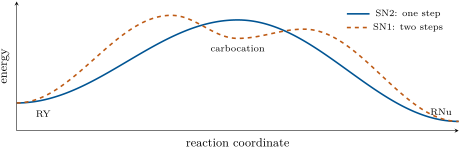
- Draw an energy profile of the reaction and mark the rate-determining step.
- Why would 1-chlorobutane hardly react in the same conditions?
Part IV — Activation energy.
- Write the Arrhenius law.
- Express from the two rate constants.
- Compute ().
- What does this energy measure, in the mechanism?
- Predict the rate constant at .
- State the activation energy of the solvolysis, to two significant figures.
Solution
Solution of Problem 19.1.
1. Each molecule that reacts gives one and one ; the conductivity is the sum of the ionic contributions, proportional to the amount of ions. 2. . 3. : plot against . 4. 0.693, 0.603, 0.513, 0.423, 0.333, 0.153, , . 5. Yes, slope per minute throughout: first order. 6. Any order in water: its concentration is constant (degeneracy of the order). 7. . 8. , . 9. , . 10. : 0.693 at , 0.109 at , and so on: slope per minute, . 11. . 12. At : , measured 1.654. 13. SN1: tertiary substrate, protic solvent, neutral nucleophile. 14. As in Exercise 19.5, with Cl. 15. The slow ionisation involves only the substrate: . 16. Hydroxide could only act in the fast capture step, after the rate-determining ionisation; the rate does not depend on it. 17. The carbocation is planar and achiral; water adds on both faces equally: racemic alcohol. 18. A high first barrier (ionisation) to the carbocation in a shallow well, then a low barrier to capture: the first step is rate-determining. 19. It would form a primary carbocation (too unstable), and water is too weak a nucleophile for a fast SN2. 20. . 21. . 22. . 23. The height of the barrier of the ionisation, the rate-determining step. 24. . 25. .