
All books

Professional

Apps About Coach Log in Start reading

Chemistry · Glossary

What is Split-valence, polarisation and diffuse functions?

Also known as: split-valence basis set · polarisation function · diffuse function

Definition 3.10 University Chemistry — Year 3 · Chapter 3 — Computational Chemistry: Hartree–Fock and DFT

A split-valence basis set describes each valence orbital by two (or more) functions of different sizes, so that the orbital can grow or shrink in a molecule. A polarisation function has a higher ll than the occupied orbitals (pp on H, dd on C) and lets the density shift off the atom; a diffuse function has a small exponent and describes anions and weak interactions far from the nuclei.
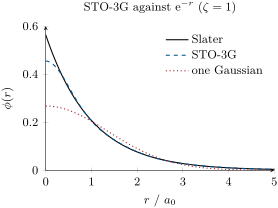
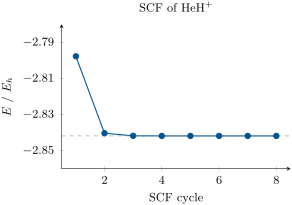
Left: the STO-3G contraction (dashed) reproduces the 1s Slater function closely except at the nucleus; a single Gaussian (dotted) does not. Right: the energy of HeH+ at 1.4632\,a_0 during the self-consistent-field iterations (STO-3G); it converges from above to -2.8418\,E_ h within a few cycles, each iterate obeying the variational principle. Left: the STO-3G contraction (dashed) reproduces the 1s Slater function closely except at the nucleus; a single Gaussian (dotted) does not. Right: the energy of HeH+ at 1.4632\,a_0 during the self-consistent-field iterations (STO-3G); it converges from above to -2.8418\,E_ h within a few cycles, each iterate obeying the variational principle.
Left: the STO-3G contraction (dashed) reproduces the 1s1s Slater function closely except at the nucleus; a single Gaussian (dotted) does not. Right: the energy of HeHX+\ce{HeH+} at 1.4632 a01.4632\,a_0 during the self-consistent-field iterations (STO-3G); it converges from above to −2.8418 Eh-2.8418\,E_\mathrm{h} within a few cycles, each iterate obeying the variational principle.
Read in context →