University Chemistry — Year 1 · Bachelor Year 1
16Stereochemistry in Depth
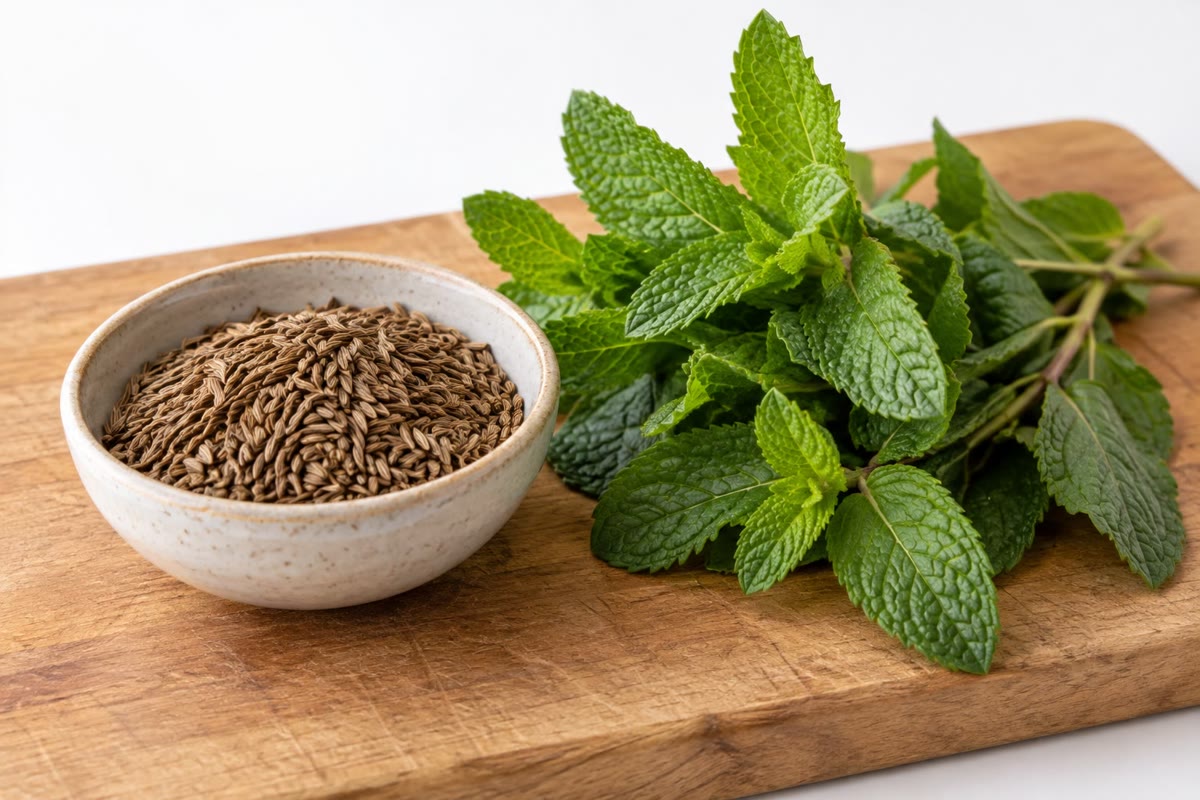
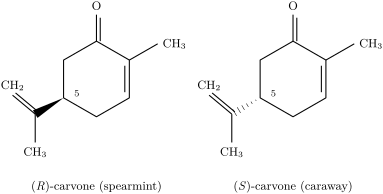
Crush a few caraway seeds, then a spearmint leaf: two quite different smells. The main odorant of each is carvone, , the same atoms joined in the same order — but the two carvones are mirror images of each other, as a left hand is of a right hand, and the receptors of the nose, themselves built of mirror-asymmetric molecules, tell them apart. Medicines, flavours and the molecules of life are all built in three dimensions, and a structural formula that ignores the third dimension misses half the story. This chapter gives the tools to draw molecules in space, to name each arrangement without ambiguity, to follow the rotations that molecules perform constantly, and to measure the one physical property that tells mirror images apart.
You already know
The school volume (grade 12) introduced chiral molecules, the asymmetric carbon, enantiomers, / isomers and the conformations of ethane. The tetrahedral arrangement of four bonds around carbon and the / description of single and double bonds come from Chapter 3.
16.1 Isomers and representations
Definition 16.1 (Constitution, configuration, conformation)
Two compounds of the same formula whose atoms are joined in a different order are constitutional isomers. Compounds with the same constitution whose atoms differ only in their arrangement in space are stereoisomers. The arrangement that can be changed only by breaking bonds is the configuration of a stereoisomer; an arrangement obtained by rotation about single bonds, without breaking any, is a conformation.
At room temperature, rotations about single bonds take place billions of times a second: conformations interconvert and cannot be isolated, while configurations are stable and give distinct compounds.
Definition 16.2 (Representations)
In the Cram representation two bonds are drawn in the plane of the page, a solid wedge points towards the reader and a hashed wedge away. A Newman projection views a molecule along one C–C bond: the front carbon is a point where its three other bonds meet, the rear carbon a circle from whose rim its bonds emerge. In a Fischer projection the carbon chain is vertical, horizontal bonds point towards the reader and vertical bonds away; each crossing is a stereogenic carbon.
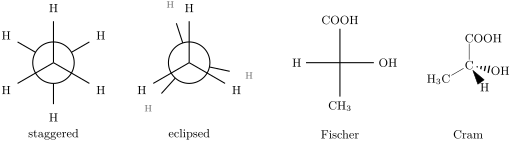
Method 16.3 (From Cram to Newman)
- Choose the bond to look along and the end nearer to the eye.
- Draw the three bonds of the front carbon from the centre, keeping their order (clockwise or anticlockwise) as seen from the eye.
- Draw the rear carbon’s bonds from the circle, with their order as seen from the same side.
- Check: rotating the rear carbon by passes from staggered to eclipsed; by , from one staggered conformation to the next.
16.2 Configuration: the CIP rules
Definition 16.4 (CIP rules, descriptors)
The CIP rules (Cahn–Ingold–Prelog) rank the four substituents of a stereogenic centre: higher atomic number first; on a tie, compare the sets of atoms attached next, and so on outwards; a double bond counts as two single bonds to duplicated atoms. With the lowest-ranked substituent pointing away from the eye, the sequence turning clockwise defines the descriptor (R), and anticlockwise (S). For a double bond with two substituents on each carbon, (Z) means the two higher-ranked ones are on the same side and (E) on opposite sides.
Method 16.5 (Assigning (R) or (S))
- Rank the four substituents by the CIP rules.
- If the lowest-ranked one points away from you (hashed wedge, or a vertical bond of a Fischer projection), read the turn of directly.
- If it points towards you (solid wedge, horizontal Fischer bond), read the turn and reverse the descriptor.
- Exchanging any two substituents reverses the descriptor: a quick check.
In lactic acid, (O; then C(O,O,O) beats C(H,H,H)). In the Fischer projection above, H is horizontal (towards us) and turns anticlockwise: reversed, the centre is (R).
16.3 Chirality and its consequences
Definition 16.6 (Stereogenic centre, chirality)
An object is chiral if it cannot be superposed on its mirror image, achiral otherwise; the property is chirality. A stereogenic centre is an atom at which exchanging two substituents gives a stereoisomer; a tetrahedral carbon with four different substituents is one.
A molecule with a plane of symmetry or a centre of symmetry is achiral; a molecule with neither is chiral in practice. The exact criterion, in terms of symmetry operations, is given in the Year 3 volume.
Definition 16.7 (Enantiomers, diastereomers, meso compound, racemic mixture)
Two stereoisomers that are mirror images of each other are enantiomers; stereoisomers that are not are diastereomers. A meso compound has stereogenic centres but is achiral. An equimolar mixture of two enantiomers is a racemic mixture.
Proposition 16.8 (Number of stereoisomers)
A molecule with stereogenic centres (and no other stereogenic unit) has at most stereoisomers, in at most pairs of enantiomers; meso forms make the number smaller.
Proof. Each centre is (R) or (S) independently: combinations. The mirror image changes every descriptor, so the combinations pair up into enantiomers, pairs. If a combination is its own mirror image after a rotation of the molecule (a meso form), its pair collapses into one compound. ∎
Tartaric acid, , has two equivalent centres: (R,R) and (S,S) are enantiomers, while (R,S) has a mirror plane between the two carbons and is meso: three stereoisomers, not four.
Proposition 16.9 (Properties of enantiomers)
Two enantiomers have the same melting and boiling points, solubilities in achiral solvents, spectra and reactivity towards achiral reagents; they differ in their action on polarised light and in their interactions with other chiral molecules. Diastereomers differ in all their properties.
Proof. Every property that depends only on distances and angles inside the molecule, or between it and achiral partners, is the same for an object and its mirror image, since a reflection preserves distances and angles. A chiral partner (a receptor, a chiral reagent, the helical path of polarised light described below) makes pairs that are diastereomeric, no longer mirror images, which therefore differ. Diastereomers are not related by any reflection: their internal distances differ. ∎
History — A tetrahedral carbon
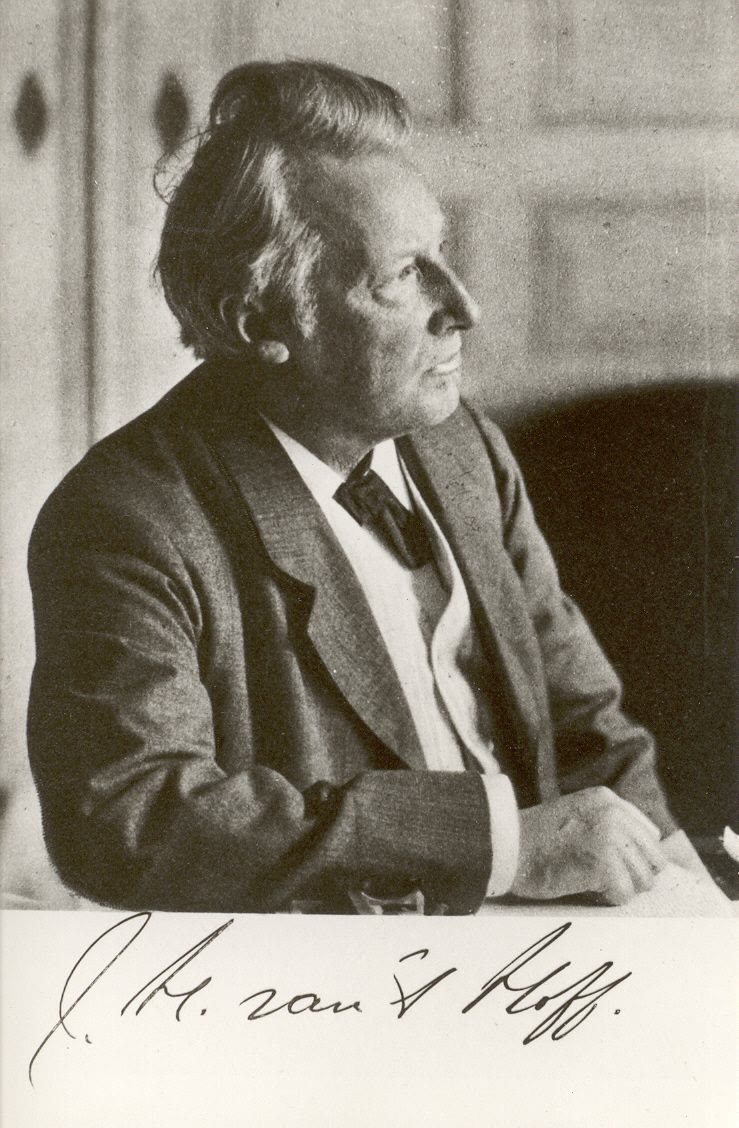
Jacobus Henricus van ’t Hoff proposed, as a young chemist, that the four bonds of a carbon atom point to the corners of a tetrahedron. A carbon with four different substituents then exists as two mirror-image arrangements, which explained why some compounds come in two forms that differ only in the way they rotate polarised light. The idea is the starting point of every drawing in this chapter. (Photograph published in 1911, public domain, Wikimedia Commons.)
16.4 Conformations
Definition 16.10 (Torsion angle and conformations)
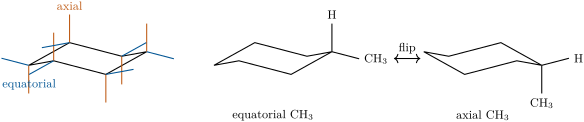
For four atoms A–B–C–D, the torsion angle about B–C is the angle between the planes ABC and BCD, read on a Newman projection along B–C. A conformation is an eclipsed conformation when the bonds of the front and rear carbons are aligned in projection, a staggered conformation when they alternate. In butane, viewed along C2–C3, the staggered conformation with the two methyl groups at is the anti conformation, those at are gauche conformations. In cyclohexane, the strain-free puckered ring is the chair; each carbon carries one axial bond, parallel to the ring’s axis, and one equatorial bond, roughly in the ring’s mean plane. The ring flip converts one chair into the other, every axial bond becoming equatorial and the reverse.
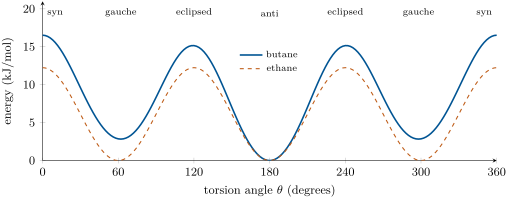
The barriers are small compared with the thermal energy available in collisions ( at room temperature, and much more in the tail of the distribution, Chapter 9): rotation is fast, and butane is a mixture of anti and gauche molecules that cannot be separated.
Method 16.11 (Drawing a chair)
- Draw two parallel lines slanting slightly downwards to the right, offset; join their ends with a V at the left and an inverted V at the right to close the six-membered ring.
- Axial bonds are vertical: up on the carbons that point up, down on those that point down, alternating round the ring.
- Equatorial bonds are parallel to the ring bonds once removed, and point outwards.
- To flip the ring, draw the other chair; a substituent axial on one is equatorial on the other.
Proposition 16.12 (Equatorial substituents are preferred)
In a monosubstituted cyclohexane the chair with the substituent equatorial is the more stable. For a methyl group, the axial position adds two gauche interactions with ring carbons, each worth that of butane (), about in all: an estimate of the energy difference.
Proof. Viewed along the C1–C2 bond, an axial methyl on C1 is gauche to C3 of the ring; viewed along C1–C6, gauche to C5: two gauche butane-like interactions, which are also seen as the crowding of the methyl with the axial hydrogens on C3 and C5 (the 1,3-diaxial interactions). An equatorial methyl is anti to C3 and C5. Each gauche interaction costs what it costs in butane, in the torsional potential of the figure. ∎
With , the ratio of equatorial to axial chairs at is : about equatorial (Exercise 16.9). Large groups, such as tert-butyl, lock the ring in the chair where they are equatorial.
16.5 Optical activity
Definition 16.13 (Optical activity, specific rotation)
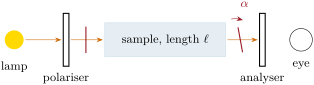
A substance shows optical activity if it rotates the plane of polarisation of linearly polarised light passing through it. Seen by an observer facing the light, a dextrorotatory substance, written , rotates it clockwise, a laevorotatory one, , anticlockwise. The specific rotation is , where is the measured angle in degrees, the path length in decimetres and the mass concentration in ; it depends on the wavelength (usually the yellow sodium line), the temperature and the solvent.
Proposition 16.14 (Biot’s law)
For a dilute solution of several optically active solutes, the angle of rotation is additive, (Biot’s law). Two enantiomers have opposite specific rotations; a racemic mixture does not rotate light.
Proof. Each solute contributes independently in dilute solution, in proportion to the number of molecules crossed, that is to ; this is the experimental content of the law. A reflection changes clockwise into anticlockwise: the mirror-image molecule rotates the plane by the opposite angle, and in a racemic mixture the two contributions cancel. ∎
For a mixture of two enantiomers at total concentration , the fraction of the form gives : measuring gives the composition. Optical rotation is not linked in any simple way to the descriptor: an (R) compound may be or ; spearmint’s (R)-carvone is laevorotatory.
16.6 Exercises
Exercise 16.1 ★
Classify each pair as constitutional isomers, enantiomers, diastereomers or two conformations of one compound: butan-1-ol and butan-2-ol; (R)- and (S)-butan-2-ol; (Z)- and (E)-but-2-ene; the anti and gauche conformations of butane; (R,R)- and (R,S)-tartaric acid.
Solution
Solution of Exercise 16.1.
Constitutional isomers; enantiomers; diastereomers (stereoisomers that are not mirror images); two conformations of one compound; diastereomers ((R,S) is the meso form).
Exercise 16.2 ★
Rank by the CIP rules: , , , ; then , , , ; then , , , .
Solution
Solution of Exercise 16.2.
(O, N, C, H). (O,O,O) (O,O,H) (O,H,H) (C,C,H). (Cl,Cl,Cl) (Cl,H,H): the first atom decides before its neighbours.
Exercise 16.3 ★
How many stereoisomers have 2,3-dichlorobutane, 2-bromo-3-chlorobutane and pentane-2,4-diol? Identify the meso forms.
Solution
Solution of Exercise 16.3.
2,3-Dichlorobutane: two equivalent centres, (R,R), (S,S) and the meso (R,S): three. 2-Bromo-3-chlorobutane: two different centres, four stereoisomers, no meso form. Pentane-2,4-diol: three, (2R,4S) being meso.
Exercise 16.4 ★
Rank the four substituents of C5 of carvone by the CIP rules and check the descriptors given in the figure of the two carvones (solid wedge: the isopropenyl group towards the reader, H away).
Solution
Solution of Exercise 16.4.
On C5: isopropenyl (C,C,C, the double bond counting twice) C6 C4 H. C6 and C4 both carry (C,H,H); one step further C6 leads to the carbonyl carbon (O,O,C) and C4 to C3 (C,C,H): C6 wins. With the isopropenyl group in front and H behind, the order isopropenyl C6 C4 turns clockwise as drawn: (R), spearmint carvone; the hashed one is (S).
Exercise 16.5 ★★
Draw the Newman projections of butane along C2–C3 at , 60, 120 and and read their energies on the curve. What fraction of the molecules would be gauche if the gauche and anti energies were equal?
Solution
Solution of Exercise 16.5.
: methyls eclipsed, ; : gauche, about (minimum 2.8 at ); : methyl eclipsing H, ; : anti, 0. With equal energies, two gauche conformations for one anti: two thirds gauche.
Exercise 16.6 ★★
Draw the Fischer projection of (S)-alanine, , with the acid group at the top. On which side is the amino group?
Solution
Solution of Exercise 16.6.
Chain vertical with on top and at the bottom; ranks . Putting on the left and H on the right, turns clockwise as seen; H is horizontal (towards the reader), so the descriptor is reversed: (S). The amino group is on the left.
Exercise 16.7 ★★
Show that cis-1,2-dimethylcyclohexane has one methyl axial and one equatorial in both chairs, whereas the trans isomer has a chair with both equatorial. Which isomer is more stable? Use the estimate of the chapter.
Solution
Solution of Exercise 16.7.
cis: on adjacent carbons one bond up and one down among the axial and equatorial positions gives axial–equatorial in both chairs. trans: diequatorial or diaxial. In the diequatorial chair the two methyls are gauche to each other (one interaction); the cis isomer has that interaction plus an axial methyl, about more. The trans isomer is the more stable.
Exercise 16.8 ★★
A solution of a chiral compound at in a tube rotates light by . Compute . What would a tube give? And the enantiomer at the same concentration?
Solution
Solution of Exercise 16.8.
. A tube: . The enantiomer: in the tube.
Exercise 16.9 ★★
Compute, with and the Boltzmann ratio , the fraction of methylcyclohexane chairs with an equatorial methyl at and at .
Solution
Solution of Exercise 16.9.
: , fraction . : , .
Exercise 16.10 ★★★
Explain why ethane has a single kind of staggered conformation and butane two (anti and gauche), and why gauche is less stable. Using the energies of the figure, estimate the anti : gauche population ratio of butane at (two gauche conformations, one anti).
Solution
Solution of Exercise 16.10.
In ethane all six hydrogens are alike: every staggered conformation is the same. In butane the rear methyl can stand opposite the front one (anti) or beside it (, gauche), where the two methyls crowd each other. Populations: anti 1, gauche : about anti and gauche.
Exercise 16.11 ★★★
Consider 2,3,4-trihydroxypentanedioic acid, . Count its stereogenic centres, show that the central carbon is stereogenic only when the two outer ones have opposite descriptors (pseudo-asymmetric), and count the stereoisomers (meso included).
Solution
Solution of Exercise 16.11.
C2 and C4 are stereogenic. C3 carries H, OH and two branches that are identical in constitution; they differ only when C2 and C4 have opposite descriptors, and only then is C3 stereogenic (pseudo-asymmetric). Isomers: (2R,4R) and (2S,4S), a pair of enantiomers (C3 not stereogenic); (2R,4S) with the two arrangements at C3, two meso forms. Four in all.
Exercise 16.12 ★★★
A sample of one enantiomer of a compound ( for the pure compound in the conditions used) has partly racemised: at in a tube it gives . Compute the fractions of the two enantiomers.
Solution
Solution of Exercise 16.12.
, and : , of the enantiomer and of the .
16.7 Problem: Menthol, the Cool Molecule
Problem 16.1
Weekend problem — the three stereocentres of menthol, its eight stereoisomers, the all-equatorial chair, Biot’s law, and the percentage of (−)-menthol in a partly racemised sample
Menthol, 2-isopropyl-5-methylcyclohexan-1-ol, gives mint its cooling feel. The natural compound is -menthol, of configuration (1R,2S,5R). A laboratory measures with a polarimeter (sodium line, , ethanol, ): its reference sample of pure -menthol at gives ; a sample to be tested, at the same concentration, gives .
Part I — Stereocentres.
- Draw the constitution of menthol and mark the stereogenic carbons.
- How many stereoisomers can there be? How many pairs of enantiomers?
- Why is there no meso form?
- Rank the substituents of C1 by the CIP rules.
- Rank the substituents of C2.
- Rank the substituents of C5.
- Write the configuration of the enantiomer of -menthol.
Part II — The chair.
- Draw a chair of cyclohexane and place the three substituents of -menthol all equatorial. Check that this corresponds to the relative arrangement (1,2-trans and 1,5-cis) of menthol.
- What happens to the three substituents in the flipped chair?
- Using the estimate of the chapter for one axial methyl, explain why menthol is almost entirely in one chair.
- Neomenthol differs from menthol only at C1. Is it an enantiomer or a diastereomer of menthol?
- In the best chair of neomenthol, which group is axial?
- Why do menthol and neomenthol have different boiling points while the two enantiomers of menthol do not?
Part III — Optical rotation.
- Compute of the reference sample. Compare with the range to given by a handbook for -menthol.
- What would be of -menthol? Of racemic menthol?
- Compute of the tested sample.
- Write Biot’s law for a mixture of the two enantiomers, with the fraction of -menthol.
- Express as a function of the measured and reference rotations.
- Could a chiral impurity of another compound distort the measurement? Give a check.
Part IV — The composition.
- Compute the fraction of -menthol in the tested sample.
- A second supplier’s sample gives in the same conditions. Compute its composition.
- Which sample is closer to natural menthol?
- With a tube, what angle would the tested sample give, and why is a longer tube better?
- State the percentage of -menthol in the tested sample, to three significant figures.
Solution
Solution of Problem 16.1.
1. Cyclohexane ring: C1 carries OH, C2 the isopropyl group, C5 the methyl; C1, C2 and C5 are stereogenic. 2. , four pairs of enantiomers. 3. No arrangement has a mirror plane: the three substituents are all different. 4. C2 (C,C,H) C6 (C,H,H) H. 5. C1 (O,C,H) isopropyl (C,C,H) C3 (C,H,H) H. 6. C6 and C4 both (C,H,H); next, C6 leads to C1 (O,C,H), C4 to C3 (C,H,H): C6 C4 H. 7. (1S,2R,5S). 8. In a chair, two equatorial bonds on adjacent carbons (C1, C2) point one up and one down: trans; on carbons 1 and 3 of the ring (C1 and C5, through C6) both equatorial bonds point the same way: cis. That is the arrangement of menthol. 9. All three become axial. 10. In the flipped chair the methyl alone would cost about and the larger isopropyl group more; the OH adds a smaller cost of its own, and the axial OH and methyl, on carbons 1 and 3 and on the same face, would also crowd each other. That is well over , a ratio of more than to one: menthol is almost entirely in the all-equatorial chair. 11. A diastereomer: only one of three centres differs. 12. With isopropyl and methyl equatorial, the OH is axial. 13. Diastereomers differ in all their properties (here the hydrogen bonding of an axial or equatorial OH); enantiomers differ only towards chiral partners. 14. , inside the handbook range.
15. ; . 16. . 17. . 18. at equal and . 19. Yes: any other optically active compound adds its own term (Biot’s law). A check of chemical purity by another method (chromatography) is needed before reading the rotation as a composition. 20. . 21. . 22. The second (). 23. ; the same reading error is then a smaller fraction of the angle. 24. of -menthol (and of its enantiomer).