সব বই

পেশাদার

1 Markets I: The Ecosystem and Exchange-Traded Marketsবাজার অনলাইন 2 Markets II: Rates, FX and Creditবাজার অনলাইন 3 Markets III: Commodities, Energy and Cryptoবাজার অনলাইন 4 Quantitative Methodsপদ্ধতি অনলাইন 5 Derivatives and Volatilityডেরিভেটিভস অনলাইন 6 Rates, Credit, XVA and Riskসুদহার, ঋণ ও ঝুঁকি অনলাইন 7 Research Craft: Predictors, Backtests, Measurement, Portfoliosগবেষণা অনলাইন 8 Strategies I: Equities and Futuresকৌশল অনলাইন 9 Strategies II: Volatility, Relative Value, Macro and the Bank Desksকৌশল অনলাইন 10 Microstructure and Executionএক্সিকিউশন অনলাইন 11 Market Making and High-Frequency Tradingমার্কেট মেকিং অনলাইন 12 Machine Learning for Marketsমেশিন লার্নিং অনলাইন 13 Low-Latency Softwareপ্রযুক্তি অনলাইন 14 Networks, Hardware and Trading Infrastructureপ্রযুক্তি অনলাইন 15 Research, Data and Risk Platformsপ্রযুক্তি অনলাইন 16 The Desk and the Firmপ্রতিষ্ঠান অনলাইন 17 The Industry: Firms, Roles and Careersক্যারিয়ার অনলাইন 18 Interviews I: Maths, Probability and Speedক্যারিয়ার অনলাইন 19 Interviews II: Markets, Trading Games and the Final Roundক্যারিয়ার অনলাইন 20 Interviews III: Codeক্যারিয়ার অনলাইন
অ্যাপ পরিচিতি Coach সাইন ইন পড়া শুরু করো

বইগুলো এখনো বাংলা ভাষায় পাওয়া যায় না — ইংরেজি সংস্করণ দেখানো হচ্ছে।

Chemistry · পরিভাষা

Two fragmentations কী?

অন্য নাম: alpha-cleavage · McLafferty rearrangement

Definition 32.11 University Chemistry — Year 2 · অধ্যায় 32 — Mass Spectrometry and Atomic Spectroscopy

In an α\alpha-cleavage, a bond to the carbon next to a heteroatom or a carbonyl breaks, leaving a cation stabilised by the heteroatom’s lone pair (an acylium ion R−C≡O+\mathrm{R{-}C{\equiv}O^+} for a ketone, an iminium ion for an amine). The McLafferty rearrangement of a carbonyl compound transfers a hydrogen from the γ\gamma carbon to the carbonyl oxygen and breaks the α\alpha–β\beta bond, releasing an alkene and an enol radical cation.
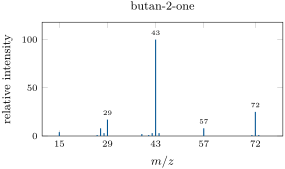
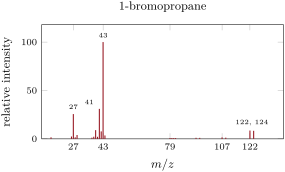
Electron-ionisation spectra (NIST WebBook data). Butan-2-one: molecular ion at 72; -cleavages give the acylium ions CH3CO+ (43, base peak) and C2H5CO+ (57). 1-Bromopropane: the molecular ion is a 1 : 1 pair at 122 and 124 (79Br, 81Br); losing the bromine atom leaves C3H7+ at 43, the base peak. Electron-ionisation spectra (NIST WebBook data). Butan-2-one: molecular ion at 72; -cleavages give the acylium ions CH3CO+ (43, base peak) and C2H5CO+ (57). 1-Bromopropane: the molecular ion is a 1 : 1 pair at 122 and 124 (79Br, 81Br); losing the bromine atom leaves C3H7+ at 43, the base peak.
Electron-ionisation spectra (NIST WebBook data). Butan-2-one: molecular ion at 72; α\alpha-cleavages give the acylium ions CHX3COX+\ce{CH3CO+} (43, base peak) and CX2HX5COX+\ce{C2H5CO+} (57). 1-Bromopropane: the molecular ion is a 1 : 1 pair at 122 and 124 (X79X2279Br\ce{^{79}Br}, X81X2281Br\ce{^{81}Br}); losing the bromine atom leaves CX3HX7X+\ce{C3H7+} at 43, the base peak.
The McLafferty rearrangement of pentan-2-one, drawn through its six-membered cyclic arrangement: the hydrogen on the  carbon moves to the oxygen, the – bond breaks, ethene leaves, and the enol radical cation of propanone remains at m/z 58.
The McLafferty rearrangement of pentan-2-one, drawn through its six-membered cyclic arrangement: the hydrogen on the γ\gamma carbon moves to the oxygen, the α\alpha–β\beta bond breaks, ethene leaves, and the enol radical cation of propanone remains at m/zm/z 58.
প্রসঙ্গসহ পড়ো →