University Chemistry — Year 2 · Bachelor Year 2
32Mass Spectrometry and Atomic Spectroscopy
Fireworks are red with strontium salts, green with barium salts, yellow with sodium: a flame turns atoms into light of colours that identify them. A mass spectrometer, more modestly in appearance, weighs single molecules, sorts them by their isotopes and breaks them into pieces whose masses tell how they were built. Both techniques answer the question “what is in this sample, and how much?” from very small amounts, the first for molecules, the second for elements.

You already know
The school volume: isotopes and their abundances. The Year 1 volume: energy levels and spectral lines, absorbance and the Beer–Lambert law, carbocations and radicals, the degree of unsaturation. Chapter 31: gas chromatography, which often feeds a mass spectrometer.
32.1 The mass spectrometer
Definition 32.1 (Mass spectrometry)
Mass spectrometry turns the molecules of a sample into gaseous ions, separates the ions according to their mass-to-charge ratio (the mass in unified atomic mass units divided by the number of charges) and counts them. The mass spectrum plots the abundance of the ions against , usually as relative intensities; its most intense peak, set to 100, is the base peak.
A spectrometer has three parts. The source makes ions. In electron ionisation (EI) the vapour of the sample crosses a beam of electrons of , which knock an electron out of the molecules and leave them with excess energy, so that many break apart. In electrospray ionisation (ESI) a solution is sprayed from a charged needle; as the droplets evaporate, molecules leave them carrying an extra proton (or a sodium ion), intact: the method of choice for large, fragile molecules. The analyser then sorts the ions, and a detector counts them.
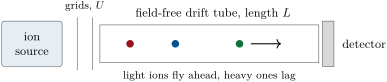
Proposition 32.2 (Time of flight)
An ion of mass and charge , accelerated from rest through a potential difference , crosses a field-free tube of length in
the flight time grows as the square root of .
Proof. Energy conservation in the accelerating field gives , so , and the tube is crossed at constant speed: . ∎
Other analysers sort ions differently: a quadrupole lets through only the ions of one at a time, selected by oscillating voltages on four rods; a magnetic sector bends the ions on circles whose radius depends on their momentum. In all of them only is measured; most ions made by EI carry one charge, so is simply their mass.
32.2 The molecular ion
Definition 32.3 (Molecular and fragment ions)
The molecular ion is the radical cation formed when a molecule loses one electron; its is the molar mass of the molecule made of the most abundant isotopes. A fragment ion comes from the molecular ion by the breaking of bonds.
The molecular ion gives the molecular mass, the first fact about an unknown. It is sometimes weak or absent in EI, when the molecular ion breaks too easily; electrospray, which gives at one unit above, then confirms it.
Definition 32.4 (Nitrogen rule)
The nitrogen rule states that a molecule has an odd nominal mass (the sum of the mass numbers of its most abundant isotopes) if and only if it contains an odd number of nitrogen atoms.
Proposition 32.5 (Validity of the nitrogen rule)
The nitrogen rule holds for every molecule without unpaired electrons built from C, H, N, O, S and the halogens.
Proof. The nominal masses are even for C (12), N (14), O (16) and S (32), odd for H (1) and the halogens (19, 35, 79, 127). The valences are even for C, O and S, odd for H, N and the halogens. In a molecule without unpaired electrons, every bond uses one valence of each of its two atoms, so the sum of all valences is even, and the number of atoms of odd valence, , is even. The parity of the nominal mass is that of , which is therefore that of . ∎
Definition 32.6 (Isotope pattern)
The isotope pattern of an ion is the group of peaks at , , , … produced by the molecules containing heavier isotopes, with intensities in proportion to the abundances of those isotopic forms.
Proposition 32.7 (The peak)
For an ion with carbon atoms and no other element with a significant isotope,
where and are the amount fractions of the two carbon isotopes.
Proof. The probability that all carbons are is ; that exactly one is is (binomial law). The ratio is , and the other contributions (two , , ) are smaller by a factor of the order of or below. ∎
Proposition 32.8 (Chlorine and bromine)
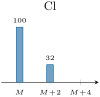
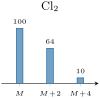
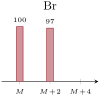
For an ion with chlorine and bromine atoms, the intensities of , , , … are the coefficients of the expansion of in powers of , each power of standing for 2 mass units. With , , and , one chlorine gives and one bromine .
Proof. Each halogen atom independently is the light isotope or the heavy one, which adds 2 to the mass. The probability of a given number of heavy atoms is the coefficient of in the product of one factor per atom, which is the expansion stated (the binomial law, per element). ∎
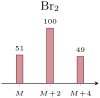
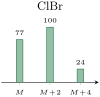
Definition 32.9 (Exact mass)
The monoisotopic mass of an ion is the sum of the exact masses of its most abundant isotopes ( = 12 exactly, = 1.007825, = 15.994915, = 14.003074 u). High-resolution mass spectrometry measures to a few thousandths of a unit or better, enough to tell ions of the same nominal mass but different formulas apart.
Proposition 32.10 (Resolving power)
Two ions of masses and are separated by an analyser of resolving power at least . At nominal mass 28, separating (27.9949) from (28.0061) needs ; separating from (28.0313), .
Proof. The resolving power is defined as for the smallest the analyser separates. The exact masses follow from the isotopic masses: , , ; then and . ∎
32.3 Fragmentation
The molecular ion made by EI carries far more energy than any bond needs to break, and it breaks along the paths that give the most stable products: stabilised cations, small stable neutral molecules or radicals. The fragments are read as losses from (15 for , 29 for or , 18 for water, 28 for CO or ethene) and as characteristic ions.
Definition 32.11 (Two fragmentations)
In an -cleavage, a bond to the carbon next to a heteroatom or a carbonyl breaks, leaving a cation stabilised by the heteroatom’s lone pair (an acylium ion for a ketone, an iminium ion for an amine). The McLafferty rearrangement of a carbonyl compound transfers a hydrogen from the carbon to the carbonyl oxygen and breaks the – bond, releasing an alkene and an enol radical cation.
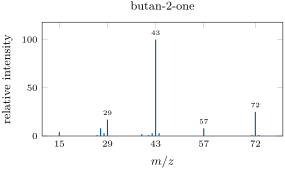
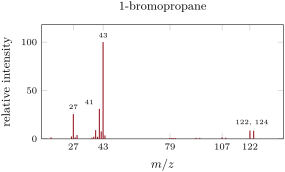

Proposition 32.12 (McLafferty requirement)
A McLafferty rearrangement requires a hydrogen on the carbon. It releases an alkene and leaves a radical cation whose mass has the parity of the molecular mass (even for a compound without nitrogen).
Argument. The hydrogen is transferred through a six-membered cyclic arrangement of the oxygen, the carbonyl carbon, the , and carbons and the hydrogen itself: only a hydrogen reaches the oxygen without strain. The ion formed keeps the carbonyl group, the carbon and the transferred hydrogen; what leaves is an alkene, a neutral molecule of even mass, so the ion keeps the parity of , which distinguishes it from the odd-mass cations made by simple cleavages. ∎
Method 32.13 (Reading a mass spectrum)
- Find the molecular ion (highest of the main cluster, with sensible losses below it).
- Read its isotope pattern: Cl, Br, S; the peak gives the number of carbons.
- Apply the nitrogen rule; propose formulas and their degree of unsaturation.
- Read the losses from and the characteristic ions (43 or , 77 , 91 , 105 ); look for even-mass McLafferty ions.
- Propose structures; check that every important peak is explained.
32.4 Atomic spectroscopy
Atoms have no vibrations or rotations; their spectra are sharp lines, one per transition between electronic levels, at wavelengths characteristic of the element. The yellow of a sodium flame is the pair of lines at and ; the crimson of lithium, a line at ; the strongest line of strontium atoms is at and that of barium ions at , in the blue: the reds and greens of fireworks come mostly from molecules of these metals, not from their atoms.
Definition 32.14 (Atomic spectrometries)
In atomic emission spectrometry the sample is atomised and excited in a flame or a plasma, and the intensity of an emission line of the element is measured. In atomic absorption spectrometry (AAS) the sample is atomised in a flame or a graphite furnace and the absorbance of the atoms is measured at a resonance line, emitted by a hollow-cathode lamp whose cathode is made of the element itself. In an inductively coupled plasma (ICP), argon heated by a radio-frequency field to several thousand kelvin atomises and ionises the sample; the plasma feeds an emission spectrometer (ICP-OES) or a mass spectrometer (ICP-MS).

Proposition 32.15 (Atomic absorption is quantitative)
Over a range of concentrations, the absorbance measured at a resonance line is proportional to the concentration of the element in the solution sprayed into the flame.
Proof. Admitted at this level. ∎
This is the Beer–Lambert law of the Year 1 volume applied to free atoms: the flame converts a constant fraction of the solution into atoms, and the lamp line, narrower than the absorption line, behaves as monochromatic light. At high concentration the line saturates and the calibration curve bends, which is why the working range is checked.
Method 32.16 (Calibrating an atomic absorption measurement)
- Prepare a blank and four or five standards covering the expected range, in the same acid matrix as the samples.
- Measure their absorbances at the chosen line; fit (or ); check the linearity.
- Measure the samples, diluted if needed to fall inside the range; compute .
- Re-measure a standard at the end to check the drift; correct for every dilution.
ICP-MS reaches the lowest concentrations, but its ions can collide in mass with others of the same nominal mass: from the plasma gas falls on , and on . A high-resolution analyser, a collision cell or another isotope of the analyte removes the interference. Detection limits, and how to measure them, are the subject of Chapter 34.
History — Weighing atoms, seeing elements
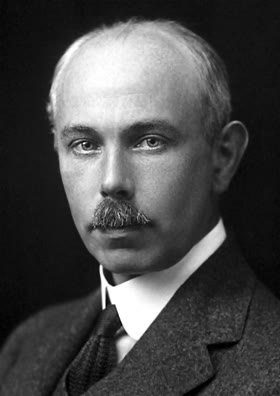
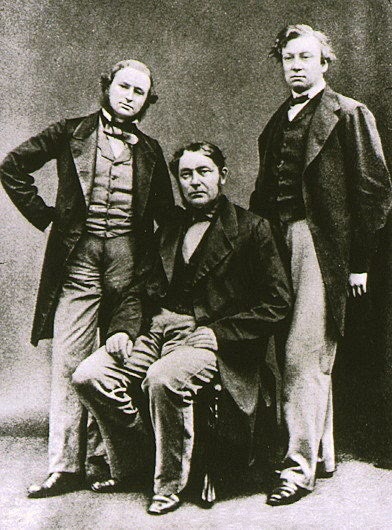
Gustav Kirchhoff and Robert Bunsen showed around 1860 that each element gives its own lines in a flame, and discovered caesium and rubidium by their unknown lines. Francis Aston’s mass spectrograph, from 1919, showed that most elements are mixtures of isotopes; he received the 1922 Nobel Prize in Chemistry. (Photographs: Aston, unknown author, public domain; Kirchhoff, Bunsen and Henry Roscoe in 1862, from Roscoe’s collection, public domain; Wikimedia Commons.)
32.5 Exercises
Exercise 32.1 ★
Give the of: the molecular ion of benzene ; an ion of mass carrying two charges; the protonated molecule of caffeine (, nominal mass 194) formed by electrospray.
Solution
Solution of Exercise 32.1.
78; ; , .
Exercise 32.2 ★
A compound of C, H, N and O has a molecular ion at 73. What can be said of its nitrogen atoms? Propose a formula.
Solution
Solution of Exercise 32.2.
Odd mass: an odd number of nitrogen atoms, one for so small a molecule. (propanamide, 73) or (butan-1-amine, 73).
Exercise 32.3 ★
A molecular-ion cluster shows two peaks two units apart, of nearly equal height. Another shows two peaks two units apart in the ratio 3 : 1. Which halogens?
Solution
Solution of Exercise 32.3.
Nearly equal: one bromine. 3 : 1: one chlorine.
Exercise 32.4 ★
A salt colours a flame yellow; another crimson. Identify the elements and give the wavelengths of their lines.
Solution
Solution of Exercise 32.4.
Yellow: sodium, and . Crimson: lithium, .
Exercise 32.5 ★★
A hydrocarbon has at 100 % and at 6.7 %. How many carbon atoms does it contain?
Solution
Solution of Exercise 32.5.
.
Exercise 32.6 ★★
Compute the exact masses of , and and the resolving power needed to separate each pair.
Solution
Solution of Exercise 32.6.
: 27.9949; : 28.0061; : 28.0313 u. Resolving powers: / ; / ; / .
Exercise 32.7 ★★
The EI spectrum of pentan-3-one shows peaks at 86, 57 (base peak) and 29. Assign them.
Solution
Solution of Exercise 32.7.
86: the molecular ion of . 57: , an acylium ion from -cleavage (loss of an ethyl radical, 29). 29: .
Exercise 32.8 ★★
The spectrum of pentan-2-one shows peaks at 86, 71, 58 and 43 (base peak). Assign them, and explain why pentan-3-one shows only a small peak at 58.
Solution
Solution of Exercise 32.8.
86: . 71: , the acylium . 43: (loss of the propyl radical). 58: McLafferty rearrangement, through a hydrogen of the propyl chain’s carbon, loss of ethene. In pentan-3-one the ethyl groups have no carbon: no McLafferty ion; its small peak at 58 is the isotope peak of the ion at 57 (three carbons, about 3.3 %).
Exercise 32.9 ★★
Copper standards at 1.0, 2.0, 3.0 and give absorbances 0.052, 0.104, 0.155 and 0.207; a sample gives 0.128 (exercise data). Compute its copper concentration.
Solution
Solution of Exercise 32.9.
A line through the origin: slope . Sample: of copper.
Exercise 32.10 ★★★
In a time-of-flight analyser, and . Compute the flight time of a singly charged ion of mass , and the time separating it from an ion of .
Solution
Solution of Exercise 32.10.
. For 1001 u, grows by the factor : .
Exercise 32.11 ★★★
Compute the molecular-ion cluster of dichloromethane, : values and relative intensities.
Solution
Solution of Exercise 32.11.
Two chlorines: gives , , : 84, 86 and 88 in the ratio 100 : 64 : 10.
Exercise 32.12 ★★★
In ICP-MS, interferes with . Compute the resolving power needed to separate them, and propose another way out.
Solution
Solution of Exercise 32.12.
: ; : 55.9349; . Otherwise measure another isotope of iron, , or remove in a collision cell before the analyser.
32.6 Problem: An Unknown Halide
Problem 32.1
Weekend problem — a molecular-ion cluster with chlorine and bromine, the number of carbons, the fragments, and a structure checked against every peak
A colourless liquid, eluted as one peak by gas chromatography, gives the EI mass spectrum below (NIST WebBook data). Main peaks (: relative intensity): 156: 14.5; 157: 0.5; 158: 18.6; 159: 0.6; 160: 4.4; 107: 6.7; 109: 6.3; 93: 3.3; 95: 2.9; 77: 59; 79: 18.7; 76: 39.5; 49: 12.9; 51: 4.3; 41: 100; 39: 26.2; 27: 24.6. Isotopic abundances: 0.758, 0.242, 0.5069, 0.4931, 0.989, 0.011.
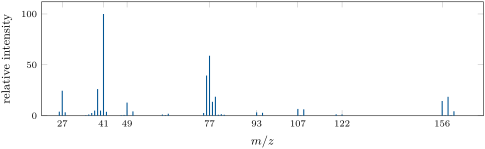
Part I — The molecular ion.
- Which peaks form the molecular-ion cluster? Why is it not a single peak?
- Which halogens does a three-peak cluster spaced by 2 suggest?
- What is the nominal mass of the lightest isotopic form?
- What does the nitrogen rule say?
- Subtract one and one : what remains, and which hydrocarbon fragment has that mass?
- Propose a molecular formula and give its degree of unsaturation.
Part II — Carbons and exact mass.
- From the 157/156 ratio, estimate the number of carbons.
- Why is that estimate rough here?
- Which isotopic forms contribute to the peak at 158?
- Compute the monoisotopic mass of the molecular ion.
- also has nominal mass 156 (exact 156.151). What resolving power separates the two?
- Would the molecular ion of a compound with a C=C bond and the same halogens have a different nominal mass?
Part III — Fragments.
- The pair 77/79 is in the ratio 3 : 1. Which atom has been lost, and what is the ion?
- Explain the peak at 76.
- Assign the base peak at 41.
- Assign the pair 49/51.
- Assign the pairs 93/95 and 107/109.
- Why is a bromine atom lost more easily than a chlorine atom?
- 1-Bromo-1-chloropropane would give at 127, 129 and 131. Does the spectrum support it?
Part IV — The structure.
- Propose the structure.
- Check that it explains each peak listed.
- Can a McLafferty rearrangement occur? Why?
- Draw the isomer that would give a strong peak at 63/65 and none at 49/51.
- Which isotopic forms make the peak at 160?
- From the isotopic abundances, compute the ratio of the , and peaks for one chlorine and one bromine, and compare it with the spectrum.
Solution
Solution of Problem 32.1.
1. 156, 158 and 160 (with 157 and 159): the molecule exists in several isotopic forms. 2. Three peaks two units apart, the middle one the largest: one chlorine and one bromine. 3. 156. 4. Even mass: no nitrogen, or an even number. 5. : . 6. ; degree of unsaturation : no ring, no double bond. 7. , carbons. 8. The peak at 157 is given to 0.1 on a scale where it is 0.5: a 20 % uncertainty. 9. and . 10. . 11. . 12. Yes: two hydrogens fewer, 154. 13. A bromine atom (79 or 81) is lost: , 77 with , 79 with , 3 : 1. 14. Loss of HBr: the radical cation , even mass. 15. , the allyl cation, after the loss of both halogens (Br, then HCl). 16. (49 and 51, 3 : 1). 17. (93 and 95) and (107 and 109), each 1 : 1: bromine on one end of the chain, the second from the loss of . 18. The bond is weaker than the bond, and the better leaving radical. 19. No: no peaks at 127–131; and show each halogen on a terminal . 20. , 1-bromo-3-chloropropane. 21. 156/158/160: M; 77/79: M Br; 76: M HBr; 107/109: M ; 93/95: ; 49/51: ; 41: ; 39, 27: , . 22. No: there is no carbonyl group. 23. 1-Bromo-2-chloropropane, : losing gives at 63/65. 24. . 25. : ; : ; : . Ratio , about 3 : 4 : 1; the spectrum gives .