সব বই

পেশাদার

1 Markets I: The Ecosystem and Exchange-Traded Marketsবাজার অনলাইন 2 Markets II: Rates, FX and Creditবাজার অনলাইন 3 Markets III: Commodities, Energy and Cryptoবাজার অনলাইন 4 Quantitative Methodsপদ্ধতি অনলাইন 5 Derivatives and Volatilityডেরিভেটিভস অনলাইন 6 Rates, Credit, XVA and Riskসুদহার, ঋণ ও ঝুঁকি অনলাইন 7 Research Craft: Predictors, Backtests, Measurement, Portfoliosগবেষণা অনলাইন 8 Strategies I: Equities and Futuresকৌশল অনলাইন 9 Strategies II: Volatility, Relative Value, Macro and the Bank Desksকৌশল অনলাইন 10 Microstructure and Executionএক্সিকিউশন অনলাইন 11 Market Making and High-Frequency Tradingমার্কেট মেকিং অনলাইন 12 Machine Learning for Marketsমেশিন লার্নিং অনলাইন 13 Low-Latency Softwareপ্রযুক্তি অনলাইন 14 Networks, Hardware and Trading Infrastructureপ্রযুক্তি অনলাইন 15 Research, Data and Risk Platformsপ্রযুক্তি অনলাইন 16 The Desk and the Firmপ্রতিষ্ঠান অনলাইন 17 The Industry: Firms, Roles and Careersক্যারিয়ার অনলাইন 18 Interviews I: Maths, Probability and Speedক্যারিয়ার অনলাইন 19 Interviews II: Markets, Trading Games and the Final Roundক্যারিয়ার অনলাইন 20 Interviews III: Codeক্যারিয়ার অনলাইন
অ্যাপ পরিচিতি Coach সাইন ইন পড়া শুরু করো

বইগুলো এখনো বাংলা ভাষায় পাওয়া যায় না — ইংরেজি সংস্করণ দেখানো হচ্ছে।

Earth and Space Sciences · পরিভাষা

Clay mineral, kaolinite, illite, smectite, chlorite কী?

অন্য নাম: clay mineral · kaolinite · illite · smectite · chlorite

Definition 19.10 University Earth and Space Sciences — Year 1 · অধ্যায় 19 — Weathering and Clays

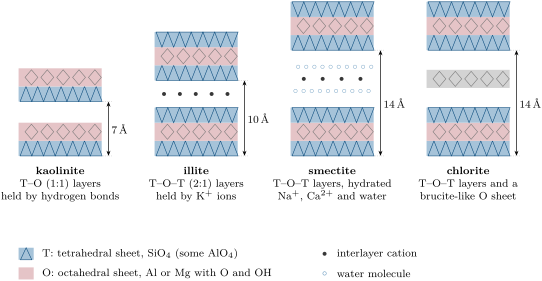
A clay mineral is a hydrous aluminium phyllosilicate, usually in grains a few micrometres across or less, built of layers that combine a tetrahedral sheet (T) of SiOX4\ce{SiO4} tetrahedra sharing three corners and an octahedral sheet (O) of aluminium or magnesium surrounded by oxygen and hydroxyl. In kaolinite, AlX2SiX2OX5(OH)X4\ce{Al2Si2O5(OH)4}, each layer is one T and one O sheet (a 1:1 or T–O layer), uncharged, and the layers are held by hydrogen bonds. In the 2:1 or T–O–T clay minerals an O sheet lies between two T sheets pointing toward it: illite is a non-expanding 2:1 clay mineral with potassium ions between the layers, like a mica with less potassium; a smectite is a 2:1 clay mineral with hydrated, exchangeable cations and water between its layers, which can take up more water and swell; a chlorite is a 2:1 mineral whose negatively charged layers alternate with positively charged octahedral sheets of brucite type, (Mg, Fe)(OH)X2\ce{(Mg,Fe)(OH)2} with some aluminium.

The four families of clay minerals (schematic, two layers of each). The vertical scale is proportional to the basal spacing, the repeat distance from one layer to the next measured by X-ray diffraction: 7\, Å for kaolinite, 10\, Å for illite, about 14\, Å for an air-dried smectite and for chlorite.
The four families of clay minerals (schematic, two layers of each). The vertical scale is proportional to the basal spacing, the repeat distance from one layer to the next measured by X-ray diffraction: 7 A˚7\,\text{Å} for kaolinite, 10 A˚10\,\text{Å} for illite, about 14 A˚14\,\text{Å} for an air-dried smectite and for chlorite.
minerallayerinterlayerair-driedglycolheatedCECtypical setting
kaoliniteT–Onone7 A˚7\,\text{Å}7 A˚7\,\text{Å}destroyed at 550 ∘C550\,{}^{\circ}\mathrm{C}3–15feldspars leached by acid water; intense tropical weathering
illiteT–O–TKX+\ce{K+}10 A˚10\,\text{Å}10 A˚10\,\text{Å}10 A˚10\,\text{Å}10–40alkaline water rich in K; from feldspars and micas; the main clay of mudstones
smectiteT–O–Thydrated NaX+\ce{Na+}, CaX2+\ce{Ca^2+}about 14 A˚14\,\text{Å}17 A˚17\,\text{Å}10 A˚10\,\text{Å} at 400 ∘C400\,{}^{\circ}\mathrm{C}70–100weathered basic rocks; poorly drained ground, K scarce
chloriteT–O–Tbrucite-like sheet14 A˚14\,\text{Å}14 A˚14\,\text{Å}14 A˚14\,\text{Å}–low-grade metamorphic and altered igneous rocks; mudstones
Table 19.1. The four clay-mineral families: structure, basal spacing measured on oriented mounts air-dried, after solvation with ethylene glycol and after heating, cation-exchange capacity (CEC, milliequivalents per 100 g100\,\mathrm{g}; the value for smectite is that of montmorillonite) and where they typically form.
প্রসঙ্গসহ পড়ো →