University Earth and Space Sciences — Year 1 · Bachelor Year 1
19Weathering and Clays
The lettering of an old gravestone fades, the sharp edges of the letters rounding off into shallow grooves, faster on a stone of marble than on one of slate. A granite outcrop that looks as hard as anything on Earth crumbles at its surface into a gritty sand, which runs through the fingers as loose grains of glassy quartz, chalky feldspar and flakes of mica. Under the forests of the humid tropics, the solid rock may lie far down, below a red earth that keeps the outlines of the rock’s minerals but can be cut with a spade. All three are the work of water at the Earth’s surface. This chapter writes that work as chemistry: which minerals give way first, what they become, why some elements leave with the water and others stay, how the climate sets the outcome, and how the slow decay of silicate rock draws carbon dioxide out of the air.
You already know
Weathering breaks rocks down where they lie (Book 1, grade 5). Chemical weathering transforms the minerals; the hydrolysis of a feldspar gives a clay mineral, kaolinite, and sends potassium and silica to the rivers; a laterite is the red, iron- and aluminium-rich product of hot, wet climates (Book 2, grade 10). Silicates are classified by how their tetrahedra share corners, a phyllosilicate forming sheets; feldspars are framework silicates of sodium, potassium and calcium, micas sheet silicates with potassium between the sheets (Definition 7.3, Definition 7.10). The ionic radius of an ion depends on its charge and on its coordination (Chapter 7). Minerals crystallise from a cooling magma in the order of Bowen’s reaction series, olivine first and quartz last (Book 2, grade 11). An acid releases hydrogen ions; carbon dioxide dissolved in water forms carbonic acid; an oxidation is a loss of electrons; a balanced equation conserves each element and the charge (the chemistry books). A soil is a living layer organised into horizons (the biology books).
19.1 Physical and chemical weathering
A rock formed at depth, at high temperature and pressure and without free water or oxygen, is out of equilibrium at the surface. It adjusts in two ways, which work together.
Definition 19.1 (Physical weathering, chemical weathering)
Physical weathering is the breakdown of a rock in place into smaller fragments without change of its minerals. Chemical weathering is the transformation of the minerals of a rock in place by reaction with water and the substances it carries, mainly hydrogen ions, dissolved carbon dioxide and oxygen: some minerals dissolve, others are replaced by new minerals stable at the surface, and part of the rock leaves in solution.
Frost. Water at has the density , ice : water expands by when it freezes. The old picture of frost weathering is water freezing in a sealed crack and forcing it open, again at each thaw and freeze. A model of cracks in granite and marble, built on fracture mechanics and on what is known of freezing soils, puts the weight elsewhere: water is drawn through the pores toward ice already in a crack, as it is toward the ice lenses of a freezing soil, and the ice grows and wedges the crack as long as the freezing lasts. Sustained freezing is most effective between about and : closer to zero the ice cannot build up enough pressure, and colder the water can no longer move to it.
Heating, unloading and salt. Repeated heating and cooling fatigue a rock whose minerals expand by different amounts; a granite brought to the surface by erosion, relieved of the weight above it, expands and splits into sheets parallel to the surface; salts crystallising from evaporating water, in deserts and on coasts, pry grains apart.
Physical weathering does more than break rock: it opens it to water.
Proposition 19.2 (The surface opened by fragmentation)
A cube of side cut into cubes of side has times the surface area. More generally, a mass of grains of density , all cubes of side , has the surface area : the specific surface is inversely proportional to the grain size.
Proof. A cube of side has the area and the mass , so the specific surface of each grain, and of any number of them, is . Cutting a cube of side into cubes of side keeps the mass and divides by , which multiplies the area by . ∎
A block of feldspar of density about has a specific surface of as centimetre fragments, and as micrometre grains, ten thousand times more. Chemical reactions proceed at surfaces, so a rock shattered by frost or opened along its joints weathers chemically much faster than the same rock intact.
The chemical reactions. Calcite dissolves completely in water that carries carbon dioxide, which is why marble gravestones lose their lettering (Book 2, grade 10). Iron(II) of the dark silicates is oxidised to iron(III), which stays as yellow-brown and red oxides. Most important by far, because silicates make most of the crust, is hydrolysis. The hydrogen ions come from carbon dioxide, dissolved from the air and breathed out by roots and decomposers into the soil, and from the organic acids of decaying plants: unpolluted surface and soil waters have a pH between 5.5 and 7, and the water of the organic layer of some forest soils as low as 3.5. Water, temperature, surface area and acidity are thus the four controls of chemical weathering, and a warm, wet climate with a thick soil provides all four.
19.2 The hydrolysis of silicates
Definition 19.3 (Hydrolysis of a silicate)
The hydrolysis of a silicate is its reaction with water and hydrogen ions in which the hydrogen ions replace the metal cations, which go into solution, part or all of the silicon leaves as dissolved silicic acid , and the rest of the mineral is rebuilt into a new solid, a clay mineral or a hydroxide. The dissolution is incongruent: the solid left does not have the composition of the mineral attacked.
Aluminium is the key to writing the reaction: at the pH of soils and rivers it is almost insoluble, and the solid product keeps it all. Everything else follows from that.
Method 19.4 (Balancing a hydrolysis reaction)
Given the mineral attacked and the solid product:
- Take one formula unit of the product, and as much of the mineral as brings the same number of aluminium atoms.
- The silicon of the mineral not used by the product leaves as ; the metal cations not used by the product leave as ions.
- Balance the charge of these cations with hydrogen ions on the left.
- Balance the oxygen with water on the left.
- Check the hydrogen: it must balance by itself. If it does not, a formula is wrong.
- If a whole-number equation is wanted, multiply through.
Proposition 19.5 (Hydrolysis of the feldspars)
With the smectite beidellite (interlayer water left out), kaolinite and gibbsite as products,
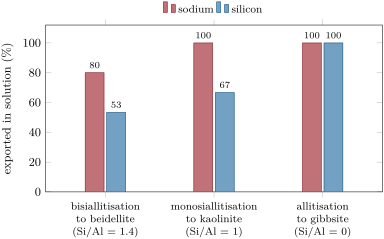
The albite loses of its sodium and of its silicon to the solution in the first reaction, all its sodium and of its silicon in the second, all of both in the third. The anorthite loses all its calcium and none of its silicon.
Proof. Apply the method. First reaction: two beidellite units hold aluminium, the aluminium of 5 albite; the 15 silicon of the albite minus the of the product leave 8 ; the 5 sodium minus 1 leave 4 , balanced by 4 ; oxygen, on the left and on the right, gives ; hydrogen, and , checks. Second: 2 albite give the 2 aluminium of kaolinite, , 2 and 2 ; oxygen gives ; hydrogen . Third: one albite, three silicic acids, one and one ; oxygen gives ; hydrogen . Fourth: the 2 aluminium and 2 silicon of anorthite are exactly those of kaolinite, no silicic acid leaves, needs 2 ; oxygen gives ; hydrogen . The fractions exported are the ions in solution over the atoms in the mineral: and , then and , then and . ∎
The same albite can thus give three different solids, and which one it gives depends on how much water passes through the rock and carries the products away: little water, and much of the silica and some of the cations stay to build a smectite; more, and only enough silica for kaolinite stays; a great deal, and the silica leaves entirely.
Definition 19.6 (Bisiallitisation, monosiallitisation, allitisation)
The degree of the hydrolysis of silicates is named after its product. Bisiallitisation forms 2:1 clay minerals, such as smectites, with about two silicon atoms per aluminium; part of the cations stays in them. Monosiallitisation forms 1:1 clay minerals, kaolinite, with one silicon per aluminium; all the alkali and alkaline-earth cations leave. Allitisation removes the silicon entirely and leaves aluminium hydroxide, gibbsite.
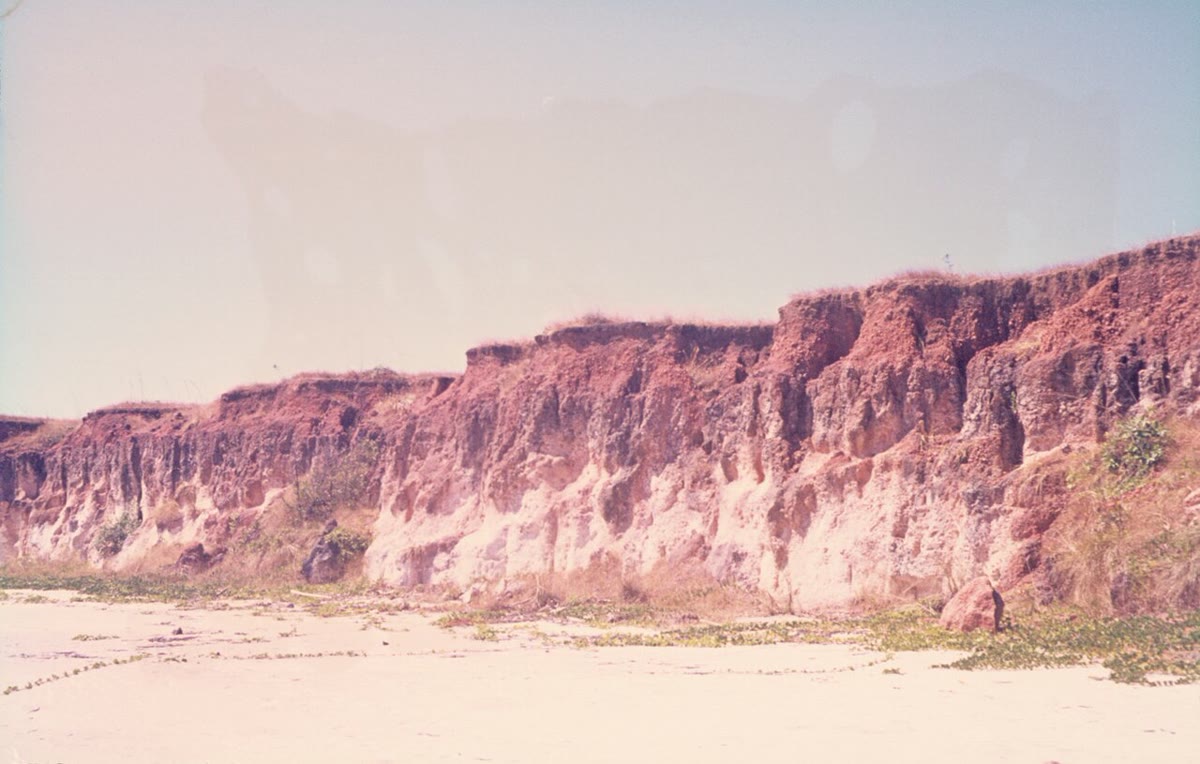
The degree reached is a matter of climate first, through the rain and the temperature, and then of the drainage of the profile. Where the water is little renewed, a granite loses much of its sodium and calcium, potassium more slowly, and only part of its silica: its feldspars turn into 2:1 clays, and much quartz is left; the rock falls apart into a sand of quartz, mica and half-weathered feldspar mixed with clay. Under the heavy rains of the humid tropics, more than a year, the cations and the silica are leached far more, and kaolinite, Si/Al = 1, forms. Where the leaching is most intense, even the silica of kaolinite goes, and gibbsite remains.
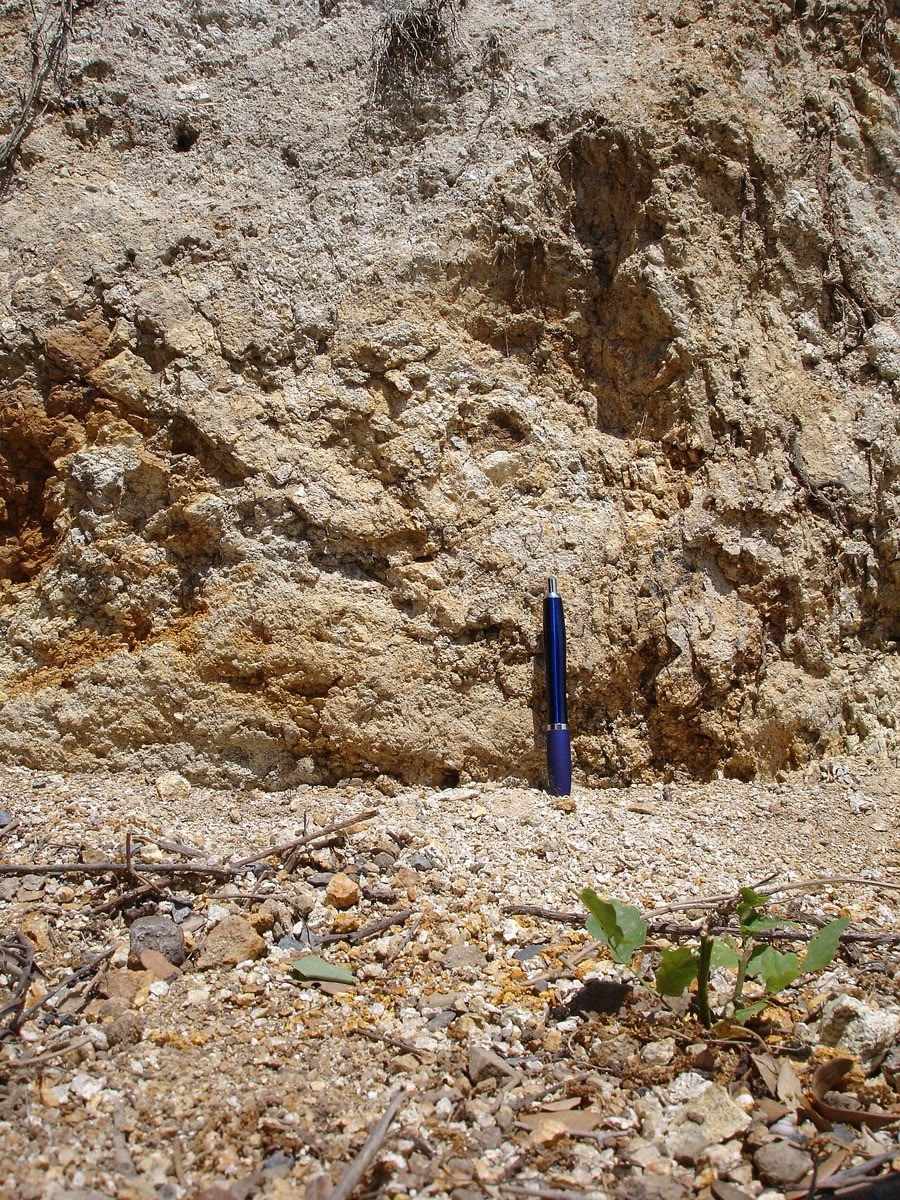
Which minerals go first. In 1938 Samuel Goldich, comparing weathered profiles with their parent rocks, proposed a series of the minerals from the least to the most stable in weathering, and found that it follows the order in which they crystallise from a magma: olivine and calcium-rich plagioclase first, quartz last. The minerals formed at the highest temperatures are the furthest from equilibrium at the surface. A modern list, from the least to the most resistant, reads: pyrite, calcite, dolomite, olivine, calcium plagioclase, pyroxenes, intermediate plagioclase, amphiboles, biotite, potassium feldspar, muscovite, smectite, quartz, kaolinite, and the oxides gibbsite and hematite. Laboratory measurements of dissolution rates confirm the ranking; it remains a ranking, not a law, since the rate of each mineral also depends on the water around it. The end products of weathering, kaolinite, gibbsite and hematite, are the most resistant of all: they are already stable at the surface.
The balance of a weathering profile. Weathering removes matter, so a concentration measured in a weathered rock does not tell how much was lost: the loss of other elements concentrates those that stay. An element that does not move gives the reference.
Proposition 19.7 (Mass balance with an immobile element)
Let be an element that weathering does not move, with mass fractions in the parent rock and in the weathered rock. Then a mass of parent rock becomes the mass of weathered rock, and the fraction of any other element lost is
Proof. The mass of is conserved: , which gives . The mass of goes from to , a fraction of it remaining; is one minus this fraction. ∎
Titanium and zirconium are the usual choices, for a reason the next section gives.
19.3 Which elements leave: the ionic potential
Sodium, potassium and calcium leave with the water; aluminium, iron(III) and titanium stay; silicon is in between. The difference lies in how each ion behaves in water.
Definition 19.8 (Ionic potential)
The ionic potential of an ion is the ratio of its charge number to its ionic radius , here in ångströms (for the same coordination for all ions, sixfold in what follows).
Proposition 19.9 (The three fields of the ionic potential)
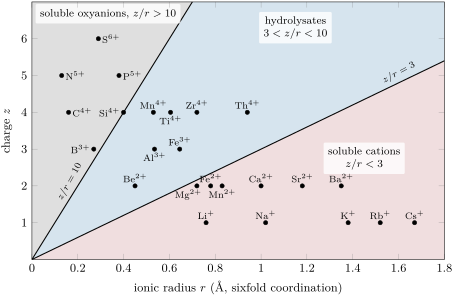
In the water of weathering, ions with stay in solution as hydrated cations and are carried away (soluble cations); ions with bind the hydroxide ions of water and precipitate as hydroxides or oxides where they are released (hydrolysates); ions with bind oxygen so strongly that they repel the hydrogen ions and travel as soluble oxyanions, such as carbonate, sulfate, phosphate and nitrate. Silicon, at , lies on the boundary, and is leached in part, more the more intense the weathering.
Proof. Admitted at this level. ∎
The rule is empirical, due to Victor Moritz Goldschmidt in the 1930s, and its boundaries are approximate; the chemistry behind it, the attraction between a cation and the oxygen of the water molecules around it, belongs to the chemistry books. A small, highly charged cation pulls the electrons of its water molecules so hard that they lose a hydrogen ion and become hydroxide: moderately, and the hydroxide precipitates; extremely, and even the hydroxide loses its hydrogen, leaving an oxyanion.
The diagram below reads the weathering of a rock at a glance. Sodium (), potassium (0.72), calcium (2.0) and magnesium (2.8) leave: they are the cations of river and sea water. Aluminium (5.6), iron(III) (4.7), titanium (6.6) and zirconium (5.6) stay, and accumulate in the most weathered profiles; titanium and zirconium, which in addition sit in minerals that hardly weather, are the immobile references of Proposition 19.7. Silicon (10.0) is the element whose partial loss defines the degrees of hydrolysis.
Oxidation moves an ion across the boundary. Iron(II), with , is a soluble cation; iron(III), at 4.7, a hydrolysate. In a waterlogged soil without oxygen, iron dissolves as and is carried away, leaving grey soil; where the water meets air, at a spring or in a well-drained soil, the iron is oxidised and precipitates at once as red and brown oxides. Manganese behaves the same way, (2.4) against (7.5).
19.4 Clay minerals
Definition 19.10 (Clay mineral, kaolinite, illite, smectite, chlorite)
A clay mineral is a hydrous aluminium phyllosilicate, usually in grains a few micrometres across or less, built of layers that combine a tetrahedral sheet (T) of tetrahedra sharing three corners and an octahedral sheet (O) of aluminium or magnesium surrounded by oxygen and hydroxyl. In kaolinite, , each layer is one T and one O sheet (a 1:1 or T–O layer), uncharged, and the layers are held by hydrogen bonds. In the 2:1 or T–O–T clay minerals an O sheet lies between two T sheets pointing toward it: illite is a non-expanding 2:1 clay mineral with potassium ions between the layers, like a mica with less potassium; a smectite is a 2:1 clay mineral with hydrated, exchangeable cations and water between its layers, which can take up more water and swell; a chlorite is a 2:1 mineral whose negatively charged layers alternate with positively charged octahedral sheets of brucite type, with some aluminium.
The charge of a layer decides how the layers stack, and the charge comes from substitutions in the sheets (Definition 7.5).
Proposition 19.11 (Charge of a 2:1 layer)
A 2:1 layer of formula , with aluminium for silicon in its tetrahedral sheets and magnesium for aluminium in its octahedral sheet, carries the charge per formula unit.
Proof. Add the charges: from the tetrahedral cations, from the octahedral ones, from the oxygens and from the hydroxyls: . ∎
Without substitution () the layer is neutral, as in , the mineral pyrophyllite, and the layers are held only by weak forces. In muscovite, , a charge of is balanced by one potassium ion that locks the layers together; illite is close to it, with a little less. In the beidellite of Proposition 19.5, : the charge is balanced by sodium. A smaller charge holds the layers less tightly, and between them water and hydrated cations can enter: this is why smectites, with charges of about 0.3 to 0.5 per formula unit, as in the montmorillonite and beidellite formulas, swell, while illite does not. The interlayer cations of a smectite are exchangeable, and the exchange capacity of the common clay minerals follows their structure: 3 to 15 milliequivalents per for kaolinite, whose layers carry no charge, 10 to 40 for illite, 70 to 100 for montmorillonite, a smectite. Potassium, which locks the layers of a mica, favours illite; smectites form where potassium is scarce and calcium and magnesium are available.
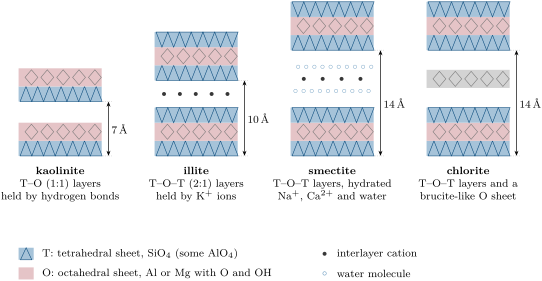
| mineral | layer | interlayer | air-dried | glycol | heated | CEC | typical setting |
|---|---|---|---|---|---|---|---|
| kaolinite | T–O | none | destroyed at | 3–15 | feldspars leached by acid water; intense tropical weathering | ||
| illite | T–O–T | 10–40 | alkaline water rich in K; from feldspars and micas; the main clay of mudstones | ||||
| smectite | T–O–T | hydrated , | about | at | 70–100 | weathered basic rocks; poorly drained ground, K scarce | |
| chlorite | T–O–T | brucite-like sheet | – | low-grade metamorphic and altered igneous rocks; mudstones |
In the lab — Identifying clay minerals by X-ray diffraction
Clay minerals are too fine to be told apart under the optical microscope. In the laboratory, the finest fraction of a soil or a mudstone is separated by letting the coarser grains settle out of water, and a drop of the suspension is dried on a glass slide, where the flakes lie flat: an oriented mount. X-rays reflected by the stacked layers give strong peaks at the angles set by the basal spacing, by Bragg’s law of diffraction (physics). The slide is run three or four times: air-dried; after a night in ethylene-glycol vapour, which enters the interlayers of smectites and swells them to while leaving the other minerals unchanged; after heating to , which drives the water out of smectites and collapses them to ; and after heating to , which destroys kaolinite but leaves illite and chlorite. Table 19.1 is the key to reading the four runs; mixtures and interlayered minerals, very common in soils, need more.
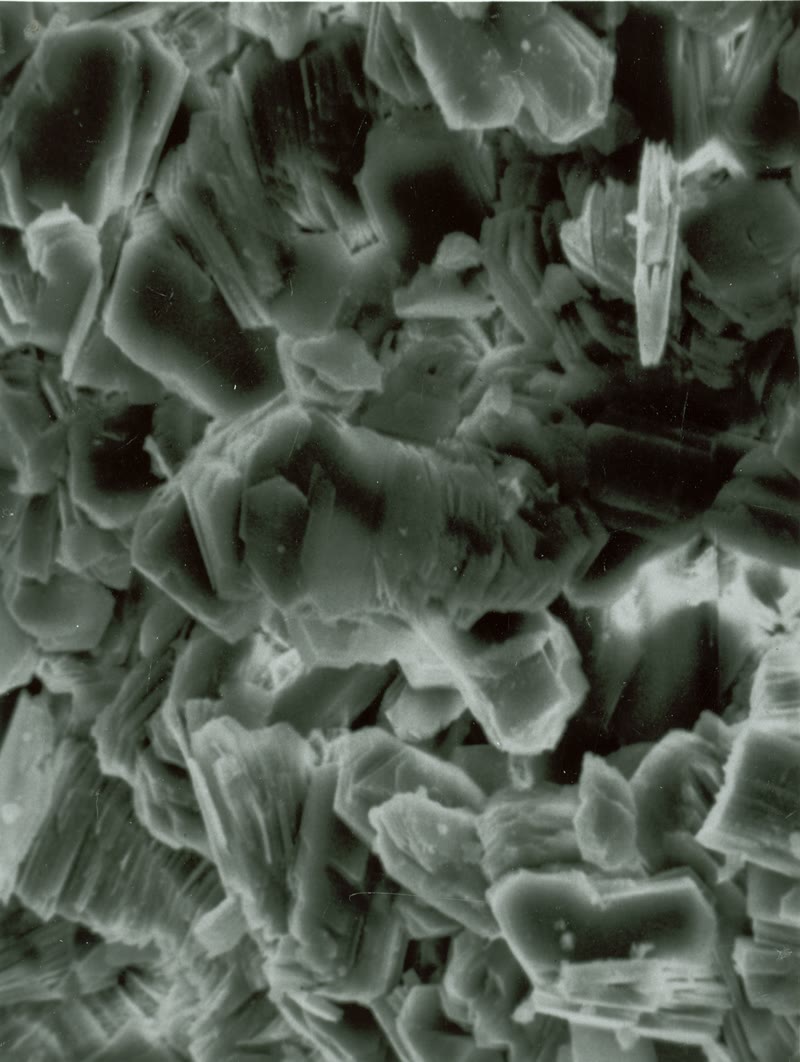
Laterites. Where hydrolysis reaches its last degrees for a long time, the profile thickens and its top concentrates everything that does not leave.
Definition 19.12 (Laterite)
A laterite is the iron- and aluminium-rich product of intense and prolonged hydrolysis under hot, wet climates: a red to brown material, soft or hardened, made of kaolinite and iron oxides and hydroxides, with gibbsite where allitisation is reached, from which nearly all the alkali and alkaline-earth cations and much of the silica have been removed.
A laterite rich enough in gibbsite or boehmite, the aluminium hydroxides, is a bauxite, the ore of nine-tenths of the aluminium: allitisation is the step that makes the ore. Most bauxites are residual, the rock from which everything but the alumina has been leached; most of those made of gibbsite lie in the tropics, and many are probably still forming.
History — A word from the field
In 1807 Francis Buchanan, travelling in Malabar, in southern India, described a material full of cavities and rich in red and yellow ochres of iron, spread over the granite in great masses. Dug out of the ground it was so soft that a knife cut it, and the inhabitants shaped it into blocks; in the air it soon became as hard as brick, and lasted better than any brick he had seen. The local languages called it brick-stone; he proposed the name laterite, which geology kept for the red products of tropical weathering.
19.5 Silicate weathering and carbon dioxide
The hydrogen ions of hydrolysis come mostly from carbon dioxide, so writing them as carbonic acid shows what weathering does to the air. For a calcium silicate, written for simplicity,
and in the ocean, where organisms build shells of calcium carbonate,
Proposition 19.13 (Weathering and carbon dioxide)
(a) Weathering a silicate consumes two moles of carbon dioxide, turned into bicarbonate, for each mole of calcium or magnesium released; when the calcium or magnesium is precipitated as carbonate, one of the two returns to the air, and one mole is stored as carbonate rock. (b) Weathering a carbonate rock and precipitating its carbonate again stores none.
Proof. (a) Adding the two equations above gives : one per calcium leaves the air for good; the first equation alone shows the two consumed. For magnesium the same holds, with for . (b) The dissolution of calcite, , is exactly the reverse of the precipitation: the sum of the two is zero. ∎
With a feldspar, the carbonic acid replaces the hydrogen ions of Proposition 19.5: each consumed is one turned into . The anorthite of a basalt or a gabbro thus consumes two moles of carbon dioxide per mole while turning into kaolinite,
and stores one in the long term. Sodium and potassium form no carbonate on the sea floor, and the long-term storage is counted from the calcium and magnesium released.
Rivers carry the bicarbonate to the sea, and their chemistry measures the flux. From the chemistry of the world’s large rivers, the carbon dioxide consumed by the weathering of continental silicates has been estimated at to a year, about 0.14 to 0.16 billion tonnes of carbon, of which the weathering of basalts alone accounts for 30 to . The flux is small next to the exchanges of carbon between the air, the oceans and living things, but it does not reverse: over millions of years it is the main way carbon dioxide supplied by volcanoes leaves the atmosphere. Because weathering runs faster when it is warmer and wetter, it ties the carbon dioxide of the air to the climate, which in turn depends on the carbon dioxide through the greenhouse effect: a negative feedback that steadies the temperature of the Earth over geological time, studied in the Year 2 volume.
19.6 Exercises
Exercise 19.1 ★
Using the radii , , and , compute the ionic potential of each ion and name its field. Why does a waterlogged soil lose its iron while a well-drained one keeps it?
Solution
Solution of Exercise 19.1.
: ; : ; both below 3, soluble cations. : ; : ; both between 3 and 10, hydrolysates. In a waterlogged soil, without oxygen, iron is released as , which stays in solution and is carried away by the water; in a well-drained soil, oxygen turns it into , which precipitates at once as oxides and hydroxides and stays.
Exercise 19.2 ★
Four clay fractions are X-rayed as oriented mounts. A: a peak at , moved to by ethylene glycol and to by heating to . B: a peak at , unchanged by glycol, gone after heating to . C: a peak at that no treatment moves. D: a peak at that no treatment moves. Identify each mineral.
Exercise 19.3 ★
Balance, with Method 19.4, the hydrolysis of orthoclase into kaolinite. What fraction of its potassium and of its silicon leaves in solution?
Solution
Solution of Exercise 19.3.
Two orthoclase bring the 2 aluminium of one kaolinite; silicon leave as ; 2 leave, balanced by 2 ; oxygen, , gives :
Hydrogen checks: . All the potassium leaves, and of the silicon.
Exercise 19.4 ★
(a) What volume of ice does of water at give? (b) Within what range of temperature does ice growing in cracks split rock most effectively, and why does neither a lighter nor a harder frost do as well? (c) A cube of granite of side is split by frost into cubes of side : by what factor has its surface area grown?
Solution
Solution of Exercise 19.4.
(a) The mass does not change: . (b) Between about and . Just below zero the ice cannot build up enough pressure to wedge the crack; in a harder frost the water no longer moves through the pores toward the ice, which stops growing. (c) By Proposition 19.2 with , the area is multiplied by 100: from to .
Exercise 19.5 ★★
Compute the specific surface of feldspar grains of density , treated as cubes, for sizes of , and . Why does the grain size matter so much for the rate of chemical weathering, and why does physical weathering speed up chemical weathering?
Solution
Solution of Exercise 19.5.
: for , ; for , ; for , , or . Chemical reactions take place at the surface of the grains, so their rate per kilogram of rock grows with the specific surface, ten thousand times from the centimetre to the micrometre. Physical weathering cuts the rock into ever smaller pieces and opens cracks through which water enters: it multiplies the surface on which chemical weathering can act.
Exercise 19.6 ★★
A tonne of albite () is turned into kaolinite (). Compute the mass of kaolinite formed, the mass of silica exported, counted as (), and the mass of sodium exported.
Solution
Solution of Exercise 19.6.
A tonne of albite is . By Proposition 19.5, two moles give one of kaolinite: . Two of the three silicon atoms leave: of , . All the sodium leaves: . Less than half the mass of the feldspar remains as clay.
Exercise 19.7 ★★
A granite contains, by mass, , , and ; its saprolite contains , , and . Taking titanium as immobile, find the mass of saprolite left by a kilogram of granite and the fraction of sodium, silicon and aluminium lost. Which degree of hydrolysis is under way?
Solution
Solution of Exercise 19.7.
By Proposition 19.7, a kilogram of granite leaves of saprolite. Fraction lost: sodium ; silicon ; aluminium . Aluminium is practically kept, the sodium has almost entirely gone, and nearly of the silicon too, although much of what remains is held in quartz: the feldspars are being turned into kaolinite, monosiallitisation.
Exercise 19.8 ★★
Using Proposition 19.11, compute the layer charge of pyrophyllite , of muscovite without its potassium, of the beidellite layer and of a montmorillonite layer . Which of them can swell, and why?
Solution
Solution of Exercise 19.8.
Pyrophyllite: , charge 0. Muscovite layer: , charge . Beidellite layer: , charge . Montmorillonite layer: , charge . The two smectite layers, beidellite and montmorillonite, can swell: their small charge is balanced by few interlayer cations, which hold the layers loosely and draw water in as they hydrate. Pyrophyllite has no interlayer cations to hydrate, and the charge of muscovite is balanced by potassium ions that lock the layers.
Exercise 19.9 ★★
Forsterite weathers by . (a) Check the equation. (b) For a tonne of forsterite, compute the carbon dioxide consumed and the carbon dioxide stored in the long term according to Proposition 19.13. (c) What would the same calculation give for a tonne of calcite?
Solution
Solution of Exercise 19.9.
(a) Mg: 2 and 2; Si: 1 and 1; C: 4 and 4; O: and ; H: 8 and ; charge: 0 and . (b) The molar mass of forsterite is , so a tonne is . It consumes of , ; with two magnesium per formula unit, Proposition 19.13 stores moles, , half the amount consumed. (c) A tonne of calcite, , consumes of () on dissolving, and gives all of it back when the carbonate precipitates again: nothing is stored.
Exercise 19.10 ★★★
(a) Between which radii is an ion of charge 3 a hydrolysate? (b) Boron, , has a radius of : in which form does it travel in water? (c) has a radius of , of . Explain why black crusts of manganese oxide form where spring water, poor in oxygen, comes out into the air. (d) Why can silicon be neither fully leached nor fully kept?
Solution
Solution of Exercise 19.10.
(a) gives . (b) : boron travels as an oxyanion, borate. (c) , a soluble cation; , a hydrolysate. In water poor in oxygen manganese is dissolved as ; where the spring meets the air, it is oxidised to , which precipitates at once as a black oxide on the rock. (d) Its ionic potential, , lies on the boundary between hydrolysates and oxyanions: silicon is neither held like aluminium nor carried off like sulfur, and the fraction leached depends on how much water passes, the basis of the three degrees of hydrolysis.
Exercise 19.11 ★★★
The weathering of continental silicates consumes to of carbon dioxide a year, of it from basalts. (a) Convert the range into tonnes of carbon and of carbon dioxide a year. (b) What share do basalts take? (c) If all of this came from calcium and magnesium silicates, how much carbon would be stored in the long term each year? Why is the real long-term figure smaller?
Solution
Solution of Exercise 19.11.
(a) With of carbon, to is 0.141 to 0.163 billion tonnes of carbon a year; with , 0.515 to 0.599 billion tonnes of carbon dioxide. (b) to . (c) Half the carbon dioxide consumed is stored when the calcium and magnesium precipitate as carbonate: 0.070 to 0.082 billion tonnes of carbon a year. The real figure is smaller, because part of the bicarbonate goes with sodium and potassium, which form no carbonate on the sea floor.
Exercise 19.12 ★★★
Three clay fractions, freed of quartz and iron oxides, are analysed (mass per cent): A, and ; B, 60 and 25; C, 2 and 63 ( , ). Compute the molar ratio Si/Al of each, identify the degree of hydrolysis it records, and place the three soils on a line from the least to the most intense leaching.
Solution
Solution of Exercise 19.12.
Si/Al . A: , the ratio of kaolinite, monosiallitisation. B: , a 2:1 clay mineral, bisiallitisation. C: , nearly no silicon left, gibbsite, allitisation. From the least to the most intense leaching, that is toward the hottest and wettest climate: B, A, C.
19.7 Problem: From granite to clay
Problem 19.1
Weekend problem — the feldspars of a granite and a gabbro, from the balanced reactions to the carbon dioxide a river carries away
The feldspars are albite (, density ) and anorthite (, density ). Kaolinite has the molar mass and the density ; gibbsite , . Take , , , Na and Ca .
Part I — The reactions.
- Balance the hydrolysis of albite into kaolinite.
- Balance the hydrolysis of anorthite into kaolinite. What is special about it?
- Balance the hydrolysis of anorthite into gibbsite.
- Balance the hydrolysis of albite into beidellite , and check the hydrogen.
- Rewrite the first two reactions with carbonic acid as the source of the hydrogen ions: .
- Which of these reactions are bisiallitisation, monosiallitisation and allitisation?
Part II — What stays, what leaves.
- How many moles are there in a tonne of albite, and in a tonne of anorthite?
- Compute the mass of kaolinite formed from a tonne of each.
- Compute the masses of silica (as ), sodium and calcium exported in solution.
- Compute the volume of a tonne of each feldspar and of the kaolinite it gives. By what fraction does the volume of solid shrink?
- A saprolite keeps the shape of the rock it replaces. What fills the space left in a weathered granite rich in albite? Why does a weathered gabbro rich in anorthite stay denser?
- With the ionic-potential diagram, explain which of the elements of the two feldspars leave and which stay.
Part III — Carbon dioxide.
- How many moles, and how many kilograms, of carbon dioxide are consumed when a tonne of albite turns into kaolinite?
- Same question for a tonne of anorthite.
- What mass of bicarbonate is exported by the anorthite?
- What happens to this bicarbonate in the ocean? How much of the carbon dioxide consumed returns to the air?
- Why is no long-term storage counted for the sodium of the albite?
- Compare with the dissolution of a tonne of calcite followed by its precipitation.
Part IV — A river.
- A river drains of granite and gneiss, with a mean discharge of ; the bicarbonate it carries from silicate weathering is . Compute the yearly flux of this bicarbonate, in moles, and per square kilometre.
- Express it as the moles of anorthite whose weathering into kaolinite would supply it, then as tonnes of anorthite a year and per square kilometre.
- If the rock contains the equivalent of of anorthite and has the density , at what rate, in metres per million years, is the fresh rock being consumed?
- How much carbon dioxide does this river remove from the air for good each year?
- Why is the rate of question 21 a lower bound for the lowering of the land surface?
- In kilograms, to three figures, how much carbon dioxide is drawn down for good by the weathering of one tonne of anorthite?
Solution
Solution of Problem 19.1.
1. .
2. . No silicon leaves: anorthite already has the one silicon per aluminium of kaolinite.
3. One gibbsite takes one aluminium, half an anorthite: doubling, . Oxygen: ; hydrogen: .
4. ; hydrogen, on the left and on the right, balances.
5. Each comes with one from one and one : and .
6. Albite to beidellite is bisiallitisation; albite and anorthite to kaolinite are monosiallitisation; anorthite to gibbsite is allitisation.
7. of albite; of anorthite.
8. Albite: of kaolinite, . Anorthite: , .
9. Albite: of , , and of sodium, . Anorthite: no silica, and of calcium, .
10. Albite: ; its kaolinite, : the solid loses of its volume. Anorthite: ; its kaolinite, : a loss of only .
11. The space left becomes pores, filled with water and air: a saprolite on an albite-rich granite is light, porous and crumbly, its quartz grains loose in a little clay. Anorthite turns into nearly its own volume of kaolinite, so the weathered gabbro keeps most of its solid matter.
12. Sodium () and calcium (2.0) are soluble cations and leave; aluminium (5.6) is a hydrolysate and stays entirely in the kaolinite; silicon (10.0), on the boundary, leaves in part from albite and not at all from anorthite, whose silicon kaolinite can hold.
13. One per albite: , .
14. Two per anorthite: , .
15. of bicarbonate.
16. Organisms precipitate it as calcium carbonate, : for each calcium, one of the two goes back to the air, or , and the other is buried in the carbonate.
17. Sodium forms no carbonate on the sea floor: its bicarbonate cannot be stored as carbonate rock, and the long-term storage is counted from calcium and magnesium only.
18. A tonne of calcite consumes of when it dissolves and gives it all back when it precipitates: nothing is stored, and only the weathering of calcium and magnesium silicates draws carbon dioxide down for good.
19. ; over a year of , , or per square kilometre.
20. Two bicarbonates per anorthite: a year, a year, or per square kilometre.
21. The fresh rock consumed is , or , per square kilometre and year: a layer thick a year, per million years.
22. One stored per calcium: , about a year.
23. It counts only the matter carried away in solution. The kaolinite and quartz left by weathering are also removed by erosion, as mud and sand in the river, and they are not counted; nor is the weathering of the other minerals of the rock. And if part of the bicarbonate comes from sodium or potassium feldspars, which give one bicarbonate per formula unit instead of two, more rock had to weather to supply it.
24. By Proposition 19.13, one mole of is stored per mole of anorthite: . The weathering of one tonne of anorthite draws down for good 158 kg of carbon dioxide.