 Coach
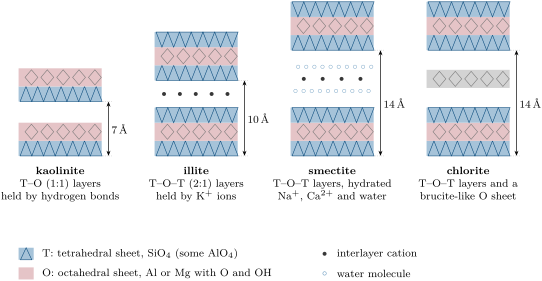
A clay mineral is a hydrous aluminium phyllosilicate, usually in grains a few micrometres across or less, built of layers that combine a tetrahedral sheet (T) of tetrahedra sharing three corners and an octahedral sheet (O) of aluminium or magnesium surrounded by oxygen and hydroxyl. In kaolinite, , each layer is one T and one O sheet (a 1:1 or T–O layer), uncharged, and the layers are held by hydrogen bonds. In the 2:1 or T–O–T clay minerals an O sheet lies between two T sheets pointing toward it: illite is a non-expanding 2:1 clay mineral with potassium ions between the layers, like a mica with less potassium; a smectite is a 2:1 clay mineral with hydrated, exchangeable cations and water between its layers, which can take up more water and swell; a chlorite is a 2:1 mineral whose negatively charged layers alternate with positively charged octahedral sheets of brucite type, with some aluminium.
| mineral | layer | interlayer | air-dried | glycol | heated | CEC | typical setting |
|---|---|---|---|---|---|---|---|
| kaolinite | T–O | none | destroyed at | 3–15 | feldspars leached by acid water; intense tropical weathering | ||
| illite | T–O–T | 10–40 | alkaline water rich in K; from feldspars and micas; the main clay of mudstones | ||||
| smectite | T–O–T | hydrated , | about | at | 70–100 | weathered basic rocks; poorly drained ground, K scarce | |
| chlorite | T–O–T | brucite-like sheet | – | low-grade metamorphic and altered igneous rocks; mudstones |