Coach
A hydrothermal fluid is a hot aqueous fluid, released by a magma, by metamorphic reactions, or heated sea water, meteoric water or basin brine, that dissolves, transports and deposits elements as it flows through rock. The main hydrothermal ore-deposit types are:
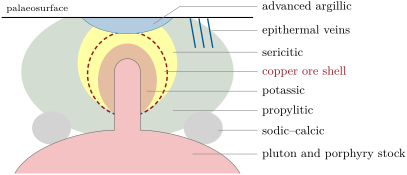
- the porphyry copper deposit: a large, low-grade body of veinlets and disseminated copper sulfides in and around a small porphyry stock, formed by magmatic fluids within a few kilometres of the surface above a subduction zone;
- the epithermal deposit: gold–silver veins and disseminations formed within about of the surface, at about 100 to , in volcanic arcs;
- the volcanogenic massive sulfide deposit (VMS): a lens of massive sulfides formed on or just below the sea floor, at a hydrothermal vent in a submarine volcanic setting;
- the sedimentary exhalative deposit (sedex): laminated zinc–lead sulfides in marine shales of a rift basin, precipitated on or just below the sea floor from basin brines rising along faults;
- the Mississippi Valley-type deposit (MVT): zinc–lead sulfides replacing platform carbonates, epigenetic and unrelated to igneous activity, deposited by basin brines;
- the orogenic gold deposit: gold-bearing quartz veins in metamorphic belts, along major faults, deposited by low-salinity, CO-rich fluids of metamorphic origin.