সব বই

পেশাদার

1 Markets I: The Ecosystem and Exchange-Traded Marketsবাজার অনলাইন 2 Markets II: Rates, FX and Creditবাজার অনলাইন 3 Markets III: Commodities, Energy and Cryptoবাজার অনলাইন 4 Quantitative Methodsপদ্ধতি অনলাইন 5 Derivatives and Volatilityডেরিভেটিভস অনলাইন 6 Rates, Credit, XVA and Riskসুদহার, ঋণ ও ঝুঁকি অনলাইন 7 Research Craft: Predictors, Backtests, Measurement, Portfoliosগবেষণা অনলাইন 8 Strategies I: Equities and Futuresকৌশল অনলাইন 9 Strategies II: Volatility, Relative Value, Macro and the Bank Desksকৌশল অনলাইন 10 Microstructure and Executionএক্সিকিউশন অনলাইন 11 Market Making and High-Frequency Tradingমার্কেট মেকিং অনলাইন 12 Machine Learning for Marketsমেশিন লার্নিং অনলাইন 13 Low-Latency Softwareপ্রযুক্তি অনলাইন 14 Networks, Hardware and Trading Infrastructureপ্রযুক্তি অনলাইন 15 Research, Data and Risk Platformsপ্রযুক্তি অনলাইন 16 The Desk and the Firmপ্রতিষ্ঠান অনলাইন 17 The Industry: Firms, Roles and Careersক্যারিয়ার অনলাইন 18 Interviews I: Maths, Probability and Speedক্যারিয়ার অনলাইন 19 Interviews II: Markets, Trading Games and the Final Roundক্যারিয়ার অনলাইন 20 Interviews III: Codeক্যারিয়ার অনলাইন
অ্যাপ পরিচিতি Coach সাইন ইন পড়া শুরু করো

বইগুলো এখনো বাংলা ভাষায় পাওয়া যায় না — ইংরেজি সংস্করণ দেখানো হচ্ছে।

Earth and Space Sciences · পরিভাষা

Hydrothermal fluid and hydrothermal deposit types কী?

অন্য নাম: hydrothermal fluid · porphyry copper deposit · epithermal deposit · volcanogenic massive sulfide deposit · sedimentary exhalative deposit · Mississippi Valley-type deposit · orogenic gold deposit

Definition 29.8 University Earth and Space Sciences — Year 2 · অধ্যায় 29 — Ore Deposits

A hydrothermal fluid is a hot aqueous fluid, released by a magma, by metamorphic reactions, or heated sea water, meteoric water or basin brine, that dissolves, transports and deposits elements as it flows through rock. The main hydrothermal ore-deposit types are:

  • the porphyry copper deposit: a large, low-grade body of veinlets and disseminated copper sulfides in and around a small porphyry stock, formed by magmatic fluids within a few kilometres of the surface above a subduction zone;
  • the epithermal deposit: gold–silver veins and disseminations formed within about 1.5 km1.5\,\mathrm{km} of the surface, at about 100 to 300 ∘C300\,{}^{\circ}\mathrm{C}, in volcanic arcs;
  • the volcanogenic massive sulfide deposit (VMS): a lens of massive sulfides formed on or just below the sea floor, at a hydrothermal vent in a submarine volcanic setting;
  • the sedimentary exhalative deposit (sedex): laminated zinc–lead sulfides in marine shales of a rift basin, precipitated on or just below the sea floor from basin brines rising along faults;
  • the Mississippi Valley-type deposit (MVT): zinc–lead sulfides replacing platform carbonates, epigenetic and unrelated to igneous activity, deposited by basin brines;
  • the orogenic gold deposit: gold-bearing quartz veins in metamorphic belts, along major faults, deposited by low-salinity, CO2_2-rich fluids of metamorphic origin.
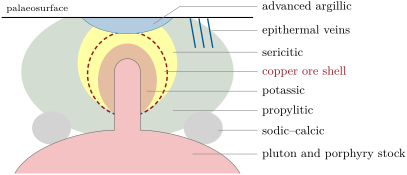
A porphyry copper system in section (a drawing, not to scale): the potassic zone in the core, deep and hot; the sericitic zone upward and outward, where pyrite is abundant; the copper ore shell between them; the propylitic halo at shallow to moderate depths around; sodic–calcic alteration on the deep flanks; an advanced argillic cap and, in some systems, epithermal veins near the surface.
প্রসঙ্গসহ পড়ো →