书籍暂未推出简体中文版——当前显示英文版。
University Earth and Space Sciences — Year 2 · 本科二年级
29Ore Deposits
Copper makes up about of the crust; it is mined from rock that holds about . Every copper mine therefore sits on rock some eighty times richer than the crust around it, and every ore deposit is the work of a natural concentrator: a magma that unmixed a sulfide liquid, a hot brine that dissolved metals and dropped them in a fracture, a river that sorted heavy grains from light ones, rain that leached the top of an orebody and redeposited its copper below. This chapter follows these concentrators, then measures their products — how much ore, at what grade — and ends with the way deposits are found.
You already know
From the school volumes: ore deposit and concentration factor, vein, placer, reserve and resource; hydrothermal circulation and black smokers at ridges. From the chemistry books: ore; solubility, complex ions and redox. From the Year 1 volume: the settling velocity of a grain and Stokes’s law; laterite; evaporite. From Chapter 3: chalcophile element, the mineral–melt partition coefficient. From Chapter 8: layered intrusion and cumulate. From Chapter 18: banded iron formation, craton. From the mathematics books: the normal and log-normal distributions, and the normal distribution function .
29.1 Ore, grade and concentration
Definition 29.1 (Gangue)
In an ore, the gangue is everything that has no economic value: the rock-forming, hydrothermal and weathering minerals that accompany the ore minerals and are separated from them and discarded during processing.
Most ore is gangue. In a porphyry copper deposit, the world’s main source of copper, more than of the ore is gangue, and the copper minerals make up the rest.
Definition 29.2 (Ore grade, cut-off grade, tonnage)
The ore grade of a volume of rock is the mass fraction of the valuable element or mineral in it: in per cent for base metals, in grams per tonne for gold, silver and the platinum-group elements. The cut-off grade is the lowest grade at which a block of rock is counted as ore; below it, the block is waste. The tonnage of a deposit is the mass of rock above the cut-off grade; with its mean grade it gives the contained metal, .
The tonnage and the grade of a deposit are therefore not two facts about the rock but two answers to one question, asked at a given cut-off. Batu Hijau, a porphyry copper–gold deposit in Indonesia, is reported as at copper above a cut-off, and as at in a world compilation that takes the lowest available cut-off: lowering the cut-off nearly doubles the tonnage and lowers the mean grade. In a sedimentary zinc–lead deposit, the Tom deposit in Canada, a decrease of the cut-off grade by about one per cent zinc plus lead would multiply the reserves by five.
Definition 29.3 (Concentration factor)
The concentration factor of an element in an ore is the ratio of its grade to its abundance in a reference reservoir, stated with it: the whole continental crust, the upper continental crust, or the rock the deposit formed from.
The factor depends on the reference. Taking copper for the crust and for the ore gives a factor of 83; taking the upper continental crust, , and the mean porphyry copper grade of 2008, , gives 157. Gold, at in the upper crust and mined at a few grams per tonne, has factors in the thousands; iron, at several per cent in the crust and mined at about , needs a factor of only about ten.
Definition 29.4 (Ore deposit)
An ore deposit is a body of rock in which natural processes have concentrated an element or a mineral to a grade above the cut-off, over a tonnage large enough for it to be extracted at a profit. It is both a geological object, defined by the processes that made it, and an economic one, defined by prices, costs and technology.
Because of its economic half, the size of a deposit changes with time. The identified resources of an element are the concentrations from which extraction is feasible now or may become so; its reserves are the part that could be extracted economically when they were determined. World copper reserves were in 1970; about have been mined since, and they stood at in 2024.
Proposition 29.5 (Mass balance of a deposit)
A deposit holding a mass of an element at mean grade was fed by a source in which the element had abundance . If the concentrating process extracted a fraction of the element from the source and delivered it to the deposit, the mass of source rock processed was
with the tonnage and : at least CF tonnes of source per tonne of ore.
Proof. The source lost of the element and the deposit received ; equating the two gives the first form, and the second. As , . ∎
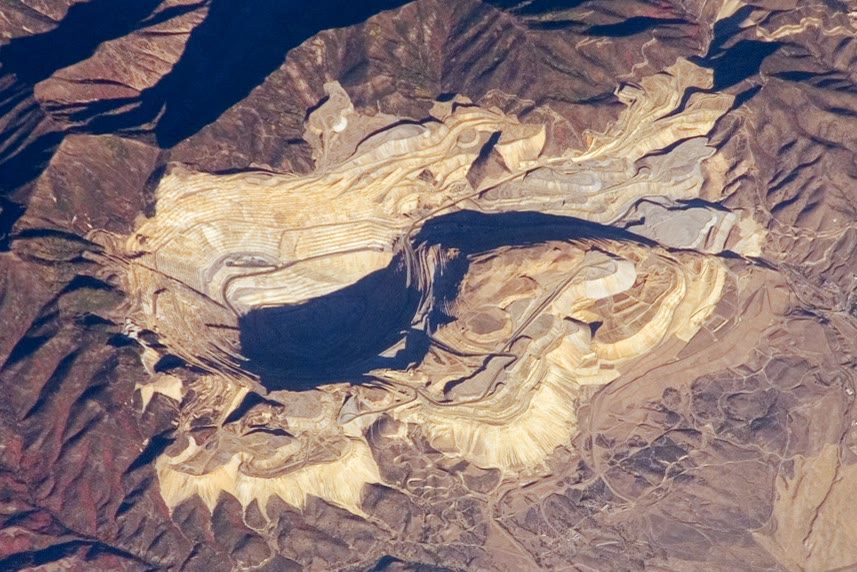
Bingham Canyon, the porphyry deposit shown below, is listed at at copper, of copper. Its factor against the upper crust is 315, and even a perfectly efficient process would have had to drain tonnes of average upper crust, some : a cube on a side. Ore-forming processes are therefore processes that move a lot of matter — magma, water, sediment — through a small volume where the element is trapped.
Definition 29.6 (Ore-deposit types)
An ore-deposit type is a class of deposits that share a geological setting, a host rock, a form, an ore mineralogy and a forming process, so that a description of the class predicts where its members occur. The types fall into four families by process: magmatic (the metal is concentrated by a magma as it crystallises or unmixes), hydrothermal (by a hot aqueous fluid), sedimentary (by the transport and deposition of sediment, or precipitation from water at the surface), and supergene (by weathering of an earlier deposit).
29.2 Magmatic deposits
Chromite in layered intrusions. Chromite, the only commercial source of chromium, gathers in seams of massive chromitite, more than chromite, in the ultramafic lower parts of layered intrusions. The intrusions are 2 to across and up to thick, and the seams range from less than a centimetre to 5–; together they hold most of the world’s chromium reserves, and the Bushveld Complex, met in Chapter 8, is the only one mined for chromite today. Their origin, a cumulate layer forced into the chromite field by the mixing of magmas or a change of pressure or oxidation state, is still debated.
Nickel–copper–PGE sulfides. A mafic or ultramafic magma, produced by large degrees of mantle melting ( to or more, with more than 12 per cent MgO by weight), rises undersaturated in sulfur. If it assimilates sulfur from the crust, or cools far enough, it becomes saturated and an immiscible sulfide liquid separates in droplets. The chalcophile metals pass into these droplets: the ratio of their concentration in the sulfide liquid to that in the silicate liquid, the same kind of partition coefficient as between a mineral and a melt, is to for copper and nickel and to for the platinum-group elements. How much metal a droplet gathers then depends on how much magma it meets.
Proposition 29.7 (R-factor)
Let a unit mass of sulfide liquid separate from, and reach equilibrium with, a mass of silicate magma, the R-factor, in a closed system; let be the concentration of a metal in the magma before the sulfide separated, and its sulfide–silicate partition coefficient. Then the concentration of the metal in the sulfide is
For , ; for , .
Proof. The system of mass held of the metal before separation. After it, the silicate holds and the sulfide , with at equilibrium. Conservation gives , hence (29.2). If , ; if , . ∎
The two limits explain why two kinds of sulfide ore exist. When the sulfide takes almost all the metal of the magma it meets and grows with ; when it is saturated at and more magma adds nothing. Nickel and copper, with of a few hundred, reach their ceiling at of a few hundred to a few thousand, the range of most nickel–copper ores; platinum and palladium, with near , keep gaining up to of to . Ores rich in the platinum-group elements, like the Merensky Reef of the Bushveld and some ores of Noril’sk, therefore record a small mass of sulfide washed by a very large mass of magma (exercises 29.5 and 29.11).
Kimberlites and diamonds. Most diamonds, and almost all mined ones, formed at the base of thick continental lithosphere, in the roots of cratons; kimberlite magmas, coming from depths greater than 120 to and rising at up to , carry them to the surface fast enough to survive. Kimberlites erupt preferentially through thick, old lithosphere, which is where diamond exploration looks.
Pegmatites. Lithium–cesium–tantalum pegmatites are granitic dykes enriched in these rare elements, produced in collisional orogens; they crystallise at about 350 to , remarkably low for a granitic melt, in days to years, and grow enormous crystals — one spodumene crystal was long. Their lithium minerals, spodumene, petalite and lepidolite, supply about a quarter of the world’s lithium.
29.3 Hydrothermal deposits
Definition 29.8 (Hydrothermal fluid and hydrothermal deposit types)
A hydrothermal fluid is a hot aqueous fluid, released by a magma, by metamorphic reactions, or heated sea water, meteoric water or basin brine, that dissolves, transports and deposits elements as it flows through rock. The main hydrothermal ore-deposit types are:
- the porphyry copper deposit: a large, low-grade body of veinlets and disseminated copper sulfides in and around a small porphyry stock, formed by magmatic fluids within a few kilometres of the surface above a subduction zone;
- the epithermal deposit: gold–silver veins and disseminations formed within about of the surface, at about 100 to , in volcanic arcs;
- the volcanogenic massive sulfide deposit (VMS): a lens of massive sulfides formed on or just below the sea floor, at a hydrothermal vent in a submarine volcanic setting;
- the sedimentary exhalative deposit (sedex): laminated zinc–lead sulfides in marine shales of a rift basin, precipitated on or just below the sea floor from basin brines rising along faults;
- the Mississippi Valley-type deposit (MVT): zinc–lead sulfides replacing platform carbonates, epigenetic and unrelated to igneous activity, deposited by basin brines;
- the orogenic gold deposit: gold-bearing quartz veins in metamorphic belts, along major faults, deposited by low-salinity, CO-rich fluids of metamorphic origin.
Transport and deposition. Most metals are carried in hydrothermal fluids as complexes: zinc, lead and copper as chloride complexes, so that salinity controls their solubility, and gold, in reduced fluids, as sulfur complexes such as AuHS(HS). A fluid drops its load when the solubility falls: when it cools; when it boils as its pressure drops, losing HS and CO and changing pH; when it mixes with a fluid of different composition — a brine meeting water rich in HS precipitates sphalerite and galena almost at once; and when it reacts with the wall rock, which changes its pH or oxidation state. Each deposit type is one combination of fluid, pathway and trap.
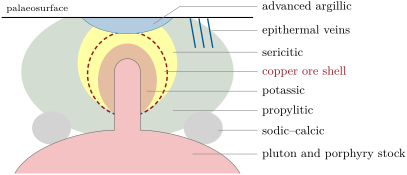
Porphyry copper. Porphyry deposits supply about of the world’s copper and hold about of its resources. They are centred on small cylindrical stocks or swarms of dykes, the tops of larger plutons, emplaced less than 5– deep in arcs above subduction zones, the setting of Chapter 9. A deposit is 0.1 to across, with a similar height; altered rock may extend or more around it. As the magma crystallises, a fluid with 3 to 5 per cent salt by weight separates from it; rising and decompressing, it splits into a brine and a vapour, both carrying metals, and its overpressure fractures the rock. Quartz veins precipitate at about 700 to , and the reaction of the fluid with the rock zones the alteration, as in the section below. Because they form shallow at active margins, where erosion is fast, more than of known porphyry deposits are Cenozoic or Mesozoic.
Epithermal gold. Above some porphyry systems, and in volcanic arcs generally, the same kind of fluids reach the upper of the crust at about 100 to , where they boil and mix with ground water; they deposit gold and silver in quartz veins, with alteration that records near-neutral fluids (adularia, illite) or very acid ones (kaolinite, dickite, pyrophyllite).
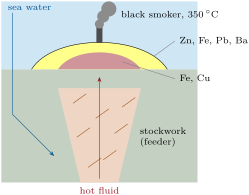
Massive sulfides on the sea floor. Sea water drawn down into the hot crust of a ridge or an arc returns at vents as black smokers at about , first seen on the East Pacific Rise in 1979. Where the vent field lasts, its sulfides build a mound; the ore is more than sulfides, over a stockwork of veins that marks the feeder. The metals are zoned by temperature, iron and copper at the hot base, zinc, iron, lead and barium at the cooler top and margins, as in the mound drawn in the next section. Volcanogenic massive sulfide deposits range from pods of less than a tonne to the of Rio Tinto in Spain, and in age from to deposits forming today.
Basin brines: sedex and MVT. Basin brines of 10 to dissolved salts, heated to 100– by burial, carry zinc and lead as chloride complexes and form the two sediment-hosted types. Sedex deposits form where the brine vents into a restricted, reduced basin along a rift fault and meets hydrogen sulfide, making laminated sulfide muds; they hold more than half of the world’s zinc and lead reserves. MVT deposits form where the brine, driven out of a basin, reaches a carbonate platform at its margin and replaces it at 75 to about ; they hold of the lead and zinc of the sediment-hosted deposits, with about ten times more zinc than lead.
Orogenic gold. In metamorphic belts, devolatilisation reactions release a near-neutral, low-salinity fluid rich in CO; channelled along major faults, it deposits gold-bearing quartz veins at about and 4 to depth. The veins are continuous over great heights: at Kolar, in India.
29.4 Sedimentary and supergene deposits
Definition 29.9 (Placer)
A placer is a sedimentary deposit of dense, durable minerals concentrated by moving water or wind because, for the same size, they settle faster and are entrained less easily than the quartz grains around them.
Minerals denser than about 2.85 are called heavy, against 2.65 for quartz: ilmenite and zircon near 4.7, magnetite 5.2, gold 15 to 19.3. By Stokes’s law a grain’s settling velocity grows with its excess density , eleven times larger for gold than for quartz, so gold of a given size sits with quartz three times as large (exercise 29.3); gold usually stays in river gravels on bedrock, while ilmenite, rutile and zircon reach beaches and dunes. Grades in heavy-mineral sands are the weight per cent of heavy minerals.
Chemical sediments are ores too. The banded iron formations of Chapter 18, precipitated as the oceans’ dissolved iron was oxidised, are a common ore of iron; evaporites supply halite and the potassium salts; laterites, the residue of deep tropical weathering, concentrate aluminium as bauxite. Weathering also upgrades earlier deposits.
Definition 29.10 (Supergene enrichment, gossan)
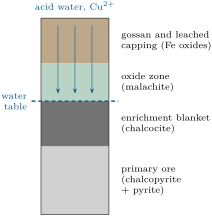
Supergene enrichment is the concentration of a metal by descending ground water: above the water table, oxygenated, acid water dissolves the metal from the sulfides of an orebody, and below it, in reducing conditions, deposits it again, mostly by replacing the primary sulfides. A gossan is the porous, iron-oxide rich rock left at the surface over a weathered sulfide body, its sulfides replaced by goethite, hematite and jarosite.
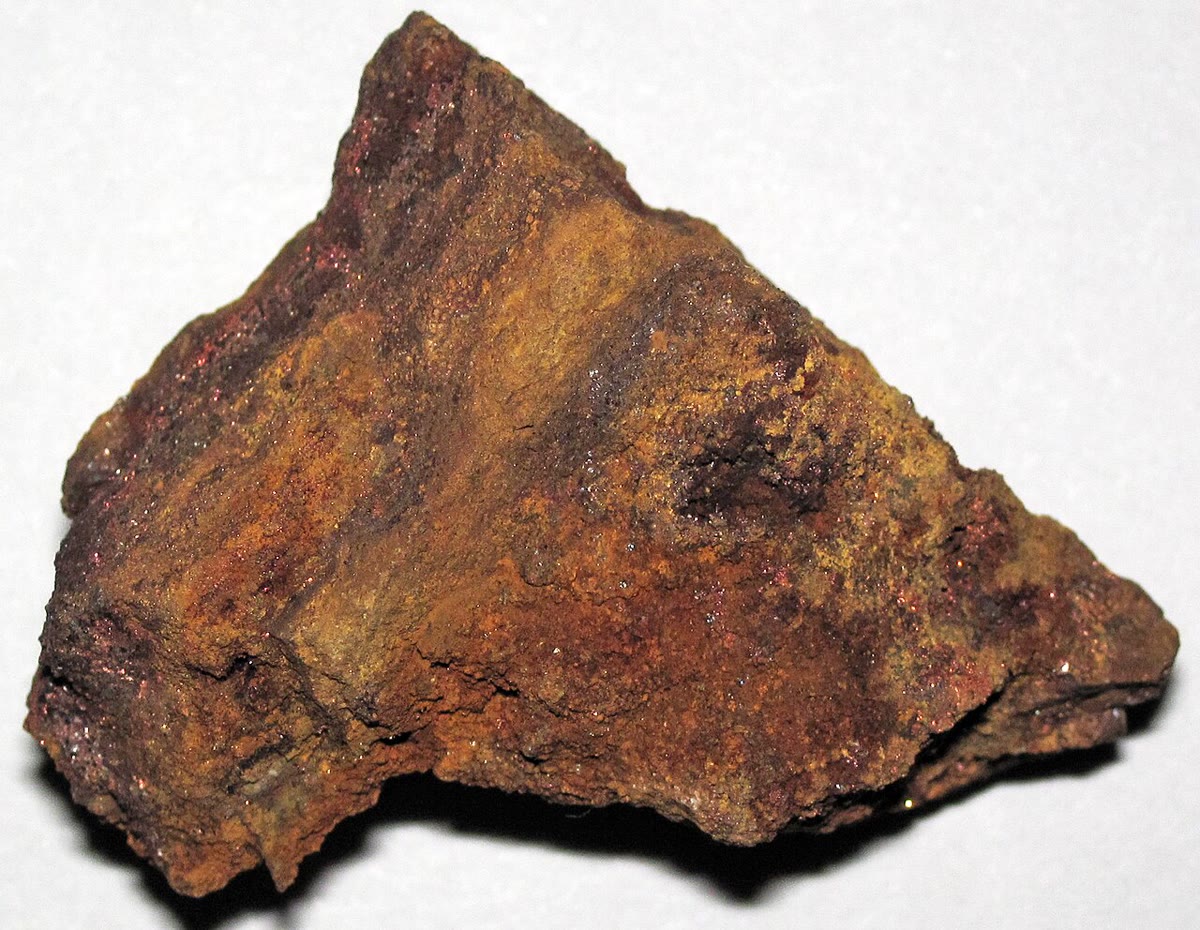
In porphyry deposits, the leached capping above the water table is up to several hundred metres thick; below it, enriched sulfide zones of chalcocite, tens to several hundred metres thick, reach more than at 0.4 to copper, always richer than the primary, hypogene ore beneath. The iron oxides of a gossan and of a leached capping keep the textures of the sulfides they replaced, and guide the search below; gossans and their iron staining revealed many massive sulfide deposits to early miners.
29.5 Grade and tonnage
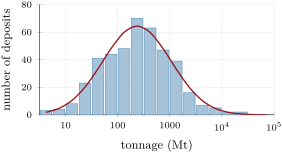
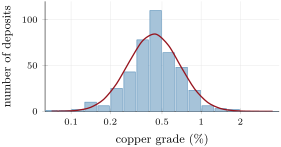
A world compilation lists 422 porphyry copper deposits with their tonnage, at the lowest available cut-off, and their mean copper grade. A tenth of them exceed and a tenth hold less than , with a median of ; the grades run from to between the same deciles, with a median of . Between the deciles the tonnage spreads over a factor of 45, the grade over a factor of 3. On logarithmic axes both histograms are close to normal curves, as the figure below shows: the logarithms of tonnage have a mean of 2.373 and a standard deviation of 0.654, those of grade and 0.199 (logarithms to base 10, tonnage in megatonnes, grade in per cent). The fit is imperfect: the grades are more peaked than a log-normal law, and a few very low-grade deposits make them depart from it in a formal test. And the two are almost independent, with a correlation of 0.1 between their logarithms.
Proposition 29.11 (Product of log-normal variables)
If and are jointly normal, with means and , standard deviations and and correlation , then the contained metal ( in per cent) is log-normal: is normal with
Proof. . A linear combination of jointly normal variables is normal (admitted from the mathematics books); its mean is the sum of the means and its variance , with . ∎
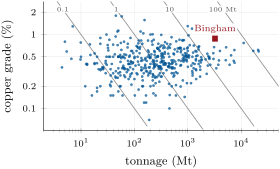
For the porphyry deposits, and : the median deposit holds about of copper, and the contained metal spreads even more widely than the tonnage. A log-normal law with so wide a spread puts most of the metal in a few deposits: the largest tenth hold about of the copper by the law, in the data (exercise 29.12). The figure below plots each deposit by its tonnage and grade, with lines of equal contained copper; Bingham, at , lies between the 10 and lines.
Definition 29.12 (Grade–tonnage curve)
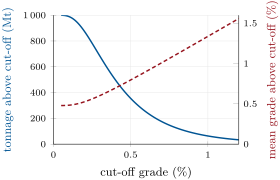
The grade–tonnage curve of a deposit gives, as functions of the cut-off grade , the tonnage of the blocks with a grade above and their mean grade .
Proposition 29.13 (Grade–tonnage curve of a log-normal deposit)
If the grades of the blocks of a deposit of total tonnage are log-normal, normal with mean (the median grade is ) and standard deviation , then, with ,
and the metal above the cut-off is , a fraction of the whole.
Proof. Write , with standard normal. A block is above the cut-off when , which has probability ; hence . The metal above the cut-off per unit of total tonnage is , with the standard normal density. Completing the square, , so the integral is . Dividing by gives the mean grade. ∎
At the whole deposit is kept, at the mean grade , which is above the median. Raising the cut-off removes tonnage faster than metal, because the blocks removed are the poorest: in the illustrative deposit of the figure, raising the cut-off from 0.2 to keeps of the tonnage but of the copper.
29.6 Exploration
Deposits are found by the traces they leave beyond their ore. The alteration halo of a porphyry system is kilometres wide, and where the rock is exposed its minerals can be mapped from aircraft and satellites by their infrared spectra; its metals disperse into the soils, stream sediments, waters and plants around it; and its sulfides and altered rocks change the physical properties that geophysics measures.
Definition 29.14 (Geochemical anomaly)
A geochemical anomaly is a concentration of an element, or of a group of elements, in a sampled medium — rock, soil, stream sediment, water, plants — that departs from its background in the region, the range of concentrations found where no mineralisation is present.
Like grades, concentrations spread over orders of magnitude, so an anomaly is usually judged on logarithms; one simple threshold, used in exercise 29.9, is the mean of the logarithms of the background plus twice their standard deviation. A stream sediment sample mixes the sediment of its whole catchment, so an anomaly fades downstream as clean sediment joins it, and the gradient of the concentrations points up the drainage toward the source. In soils over buried pegmatites, anomalies of lithium, rubidium, cesium, tantalum and tin have been traced above bodies that do not crop out.
Geophysical methods are chosen for the contrast a deposit type offers. Disseminated sulfides make a rock act as a capacitor: the induced polarisation method, which measures this chargeability, was developed for porphyry copper and responds most to the pyrite-rich sericitic zone, the potassic core being poorer in sulfides. Magnetic and gravity surveys map the plutons to which the deposits are related. No method sees ore directly, and every interpretation is non-unique until a drill hole tests it.
Method 29.15 (From assays to a resource estimate)
The data are drill holes on a grid across the deposit, their core logged and assayed in intervals of known length.
- Composite. Average the assays over equal lengths, weighting each assay by its length, so that every composite represents the same volume.
- Model. Divide the deposit into blocks and estimate the grade of each from the nearby composites, weighting them by distance and by the spatial correlation of the grades (the geostatistical method of kriging, admitted).
- Report. Apply a cut-off: tonnage and mean grade of the blocks above it, with the density of the rock, at each confidence level allowed by the drill spacing.
In the field — Logging drill core
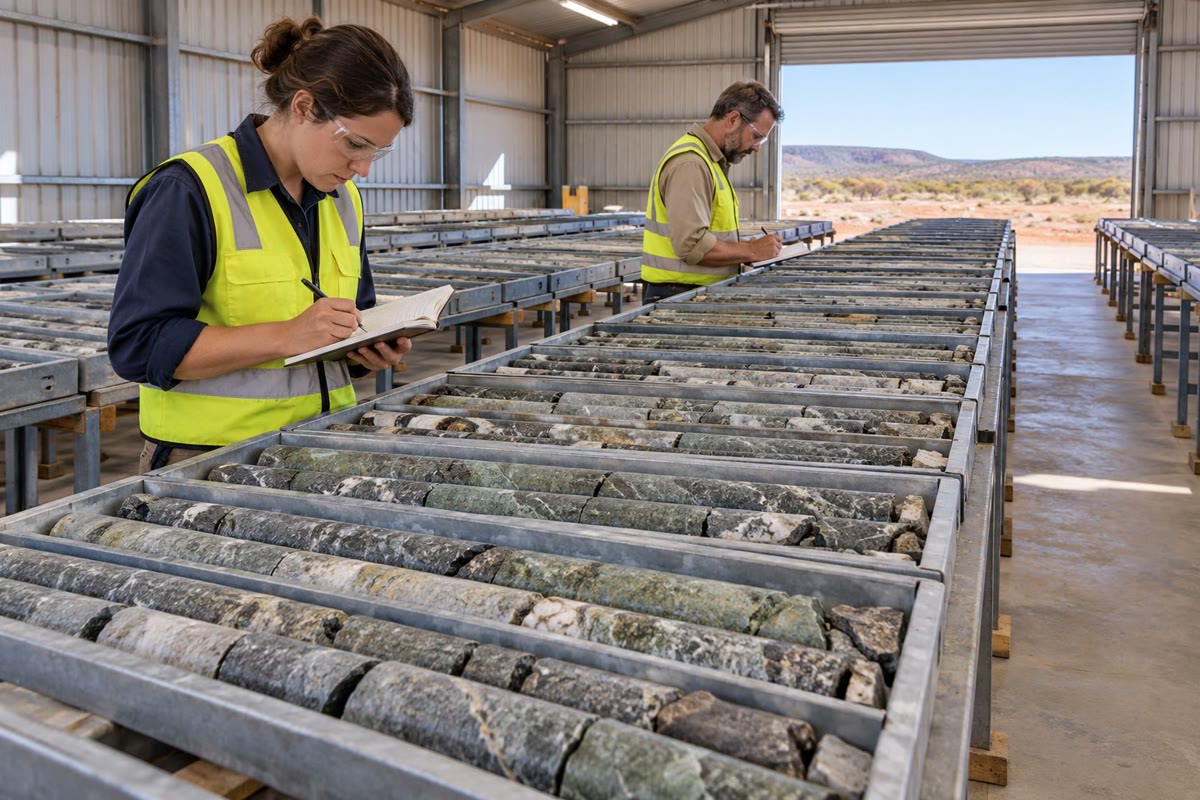
On an exploration project, the core from each drill hole is laid out in metal trays in the order it came out of the ground. Geologists walk the trays, interval by interval, and record what the rock is, how it is altered, which veins cut it and in what proportion, and which sulfides it holds; they mark where the core will be sawn and sampled. The log comes before the assays and is compared with them: an alteration zone or a vein type that carries the metal becomes the thing to follow from hole to hole, and from the log the geologists draw the sections from which the next holes are planned.
Exercises
Data for the exercises, unless stated otherwise: upper continental crust, copper , gold , chromium ; the porphyry copper population of Section 29.5, tonnage (Mt) mean 2.373 and standard deviation 0.654, grade (%) mean and standard deviation 0.199, correlation . Round to three significant figures.
Exercise 29.1 ★
Find the concentration factor against the upper crust of: (a) a copper ore at ; (b) a gold ore at ; (c) a chromitite of chromite, taking chromite as FeCrO (atomic masses Cr 52.00, Fe 55.85, O 16.00).
Solution
Solution of Exercise 29.1.
(a) , and . (b) , and . (c) Chromite holds of chromium by mass; the chromitite, , or , and .
Exercise 29.2 ★
Batu Hijau is reported as at Cu and Au above a cut-off, and as at Cu and Au at the lowest available cut-off. (a) Find the contained copper (Mt) and gold (t) of each estimate. (b) What tonnage and what copper do the extra blocks of the second estimate add, and at what mean grade? (c) Why are both estimates correct?
Solution
Solution of Exercise 29.2.
(a) of copper and g, of gold; and . (b) holding of copper, a mean grade of : the extra blocks lie below the cut-off and just above it. (c) They answer the question at two cut-offs; neither is the size of the deposit without its cut-off.
Exercise 29.3 ★
In Stokes’s law the settling velocity of a grain of diameter is proportional to . Take , quartz 2.65, gold 19.3, zircon 4.7 (in ). (a) How many times faster does a gold grain settle than a quartz grain of the same size? (b) What is the ratio of the diameters of a gold and a quartz grain that settle at the same speed? (c) Which quartz grain settles like a zircon grain of ?
Solution
Solution of Exercise 29.3.
(a) . (b) Equal speeds need , so : a gold grain settles like a quartz grain about three times larger. (c) .
Exercise 29.4 ★
A primary copper ore has a grade of . Weathering leaches all its copper over a thickness of and redeposits it in a blanket thick just below, the density being the same. (a) Find the grade of the blanket. (b) The same if only of the leached copper is redeposited. (c) What leached thickness would give with complete redeposition?
Solution
Solution of Exercise 29.4.
Per unit area and density, the blanket keeps its own copper and receives that of the leached column: . (a) . (b) . (c) . These grades sit in the 0.4– range of enriched porphyry blankets.
Exercise 29.5 ★★
A magma holds of platinum and of nickel; take and . (a) Using (29.2), find the platinum (ppm) and nickel (wt%) contents of the sulfide for , , and . (b) Find their limits for . (c) Explain why a nickel ore says little about , and a platinum ore much.
Solution
Solution of Exercise 29.5.
(a) Platinum, ppb: for , for , for , for . Nickel, ppm: , , , . (b) : of platinum, of nickel. (c) Nickel is within of its ceiling from on, so its content hardly changes over a factor of ten in ; platinum is still nearly doubling there, so its content measures .
Exercise 29.6 ★★
Using (29.3) for the porphyry copper population: (a) find the mean and standard deviation of , and the median contained copper. (b) What fraction of deposits holds more than of copper? How many of 422? (c) Repeat (b) ignoring the correlation.
Solution
Solution of Exercise 29.6.
(a) ; ; median . (b) , : about 33 deposits of 422. (c) , , , about 31: the weak correlation adds a few giants.
Exercise 29.7 ★★
For the illustrative deposit of the figure (, median , ), use (29.4) to find the tonnage, mean grade and contained copper above cut-offs of and . Check one point on the figure.
Solution
Solution of Exercise 29.7.
Mean of all blocks . For : , , : , , . For : , , : at , . On the figure, at a cut-off of the blue curve reads about and the red one about .
Exercise 29.8 ★★
A porphyry deposit holds of copper. Suppose its magmatic fluid carried of copper, half of which was deposited in the ore, and that the magma released of its mass as fluid. (a) Find the mass of fluid and of magma needed. (b) Find the volume of the magma, of density . (c) If the magma held copper, what fraction of it ended in the ore?
Exercise 29.9 ★★
Eight background stream sediments give Cu (ppm) of 1.30, 1.45, 1.38, 1.52, 1.41, 1.35, 1.48 and 1.40. (a) Find the mean and standard deviation (population) of the logarithms, the background median and the threshold mean plus two standard deviations, in ppm. (b) A tributary draining of mineralised ground carries sediment at ; it joins a stream draining at the background median. Assuming each square kilometre yields the same mass of sediment, is the mixed sediment anomalous? (c) Up to what total catchment area does the anomaly stay above the threshold?
Solution
Solution of Exercise 29.9.
(a) Mean of the logarithms 1.411, standard deviation 0.0664; median ; threshold . (b) , above : still anomalous after dilution by nine parts of clean sediment. (c) gives .
Exercise 29.10 ★★★
(a) Prove . (b) Deduce the mean of a log-normal variable, . (c) Show that the fraction of the metal above the cut-off, , always exceeds the fraction of the tonnage, , and interpret.
Solution
Solution of Exercise 29.10.
(a) ; divide by . (b) . (c) increases and , so : the blocks kept are richer than the blocks discarded, so each cut-off keeps a larger share of the metal than of the rock; the difference grows with , the variability of the deposit.
Exercise 29.11 ★★★
(a) From (29.2), find the at which reaches a fraction of its ceiling . (b) Evaluate it for and with (nickel) and (platinum). (c) Compare with the ranges of of nickel–copper ores and of PGE reefs given in the text.
Solution
Solution of Exercise 29.11.
(a) gives , . (b) : , 298 and ; : , and . (c) Nickel reaches of its ceiling inside the range of nickel–copper ores (100 to ), and 90 just above it; platinum needs of to , the range of the PGE reefs.
Exercise 29.12 ★★★
(a) For a log-normal variable with of standard deviation , show that the deposits above the quantile of order hold a fraction of the total metal. (b) Evaluate it for the porphyry population and . (c) The same for ; compare with the four largest deposits, which hold of the copper of the compilation.
Solution
Solution of Exercise 29.12.
(a) With , the deposits above the quantile have ; their metal is , and dividing by the total gives . (b) ; . (c) , against 0.266 for the four largest: the largest deposits are a little larger than the log-normal law expects.
Problem 29.1
Weekend problem — A porphyry prospect
A porphyry prospect (invented) has been drilled. Its discovery hole cut eight intervals, from top to bottom (length in metres, copper grade in per cent): 30 m at 0.12; 40 at 0.35; 50 at 0.62; 60 at 0.48; 40 at 0.27; 30 at 0.81; 50 at 0.41; 30 at 0.18. A geostatistical study of all the holes finds that the block grades are log-normal, with median and for . The mineralised body is close to a vertical cylinder of radius and height , of density . Use the data of the exercises, and round to three significant figures (probabilities to four).
Part I — The discovery hole.
- Find the length of the hole sampled and its length-weighted mean grade.
- Find the arithmetic mean of the eight grades. Why is the weighted mean the right one?
- Which fraction of the length is above , and at what mean grade?
- Find the concentration factor of the weighted mean grade against the upper crust.
- The same for the richest interval.
- Find the mean grade of all the blocks of the deposit. Is the discovery hole representative?
Part II — Tonnage above the cut-off.
- Find the volume and the tonnage of the body; keep .
- For a cut-off of , find and the fraction of the blocks above it.
- Find the tonnage above cut-offs of 0.2, 0.3 and .
- Find the mean grade above the cut-off.
- The same above 0.2 and .
- Raising the cut-off from 0.3 to : by what factors do the tonnage and the mean grade change?
- At which cut-off is half the tonnage kept, and what is its mean grade?
Part III — The prospect among the world’s porphyries.
- Find the copper contained in the whole body, at its mean grade.
- Find the standard score of its tonnage in the world population, and its percentile.
- The same for its mean grade.
- Find the standard deviation of with the correlation, and without it.
- Find the percentile of its contained copper.
- How many of the 422 deposits would be expected to hold more copper?
Part IV — Copper above the cut-off.
- Find the copper contained above the cut-off.
- The same above .
- What fraction of the copper lies above , and what fraction of the tonnage?
- Explain why lowering the cut-off below adds much rock and little copper, using the answers to questions 9 and 20.
- To sum up: how much copper does the prospect contain above the cut-off?
Solution
Solution of Problem 29.1.
1. ; , mean . 2. ; each interval stands for a length of core, hence a volume of rock: a long interval must count more than a short one. 3. , at . 4. . 5. . 6. ; the hole, at , is within of it: representative. 7. ; t, . 8. ; . 9. , 0.4298, ; , 0.6663, 0.3089; , , . 10. ; . 11. ; . 12. Tonnage ; grade . 13. At the median, (): at . 14. . 15. ; : the 86th percentile, a large deposit. 16. ; : an ordinary grade, 52nd percentile. 17. 0.702 with the correlation, 0.684 without. 18. ; ; : the 85th percentile. 19. . 20. . 21. . 22. of the copper, in of the tonnage. 23. From 0.3 to the tonnage grows by () and the copper by (): the added blocks average , the poorest of the deposit. 24. : the prospect contains of copper above the cut-off.