
全部书籍

专业

应用 关于 Coach 登录 开始阅读

书籍暂未推出简体中文版——当前显示英文版。

Earth and Space Sciences · 术语表

什么是 Meridional overturning circulation; thermohaline circulation; deep-water formation?

又称: meridional overturning circulation · thermohaline circulation · deep-water formation

Definition 29.11 University Earth and Space Sciences — Year 1 · 第 29 章 — The Circulation of the Ocean

The meridional overturning circulation (MOC) of an ocean basin is its circulation in the latitude–depth plane, obtained by adding up the northward flow across the whole width of the basin. At a given latitude its strength is the maximum of the overturning streamfunction, the northward transport integrated from the surface down to a given depth, in sverdrups; in the Atlantic it is the AMOC. The older name thermohaline circulation describes the same deep circulation as one driven by differences of temperature and salinity. Deep-water formation is the sinking of surface water, made dense by cooling and by the salt left behind when sea ice forms, to intermediate or abyssal depths.
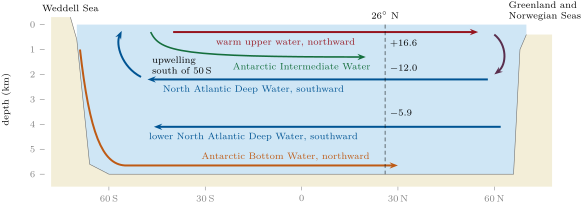
The overturning circulation of the Atlantic in a meridional section (schematic, depth exaggerated). Warm upper water flows north, gives its heat to the atmosphere and sinks in the Greenland and Norwegian Seas; North Atlantic Deep Water returns south at depths of a few kilometres and is brought up south of 50 S by the Ekman divergence under the westerlies. Antarctic Intermediate Water spreads north above it, Antarctic Bottom Water along the bottom, beneath the lower North Atlantic Deep Water. Numbers at 26 N: mean transports in sverdrups measured by the moored array, 2004–2024, northward positive, for the layers 0–800\, m, 1100 to 3000\, m and 3000 to 5000\, m.
The overturning circulation of the Atlantic in a meridional section (schematic, depth exaggerated). Warm upper water flows north, gives its heat to the atmosphere and sinks in the Greenland and Norwegian Seas; North Atlantic Deep Water returns south at depths of a few kilometres and is brought up south of 50∘50{}^{\circ} S by the Ekman divergence under the westerlies. Antarctic Intermediate Water spreads north above it, Antarctic Bottom Water along the bottom, beneath the lower North Atlantic Deep Water. Numbers at 26∘26{}^{\circ} N: mean transports in sverdrups measured by the moored array, 2004–2024, northward positive, for the layers 0–800 m800\,\mathrm{m}, 1100 to 3000 m1100\text{ to }3000\,\mathrm{m} and 3000 to 5000 m3000\text{ to }5000\,\mathrm{m}.
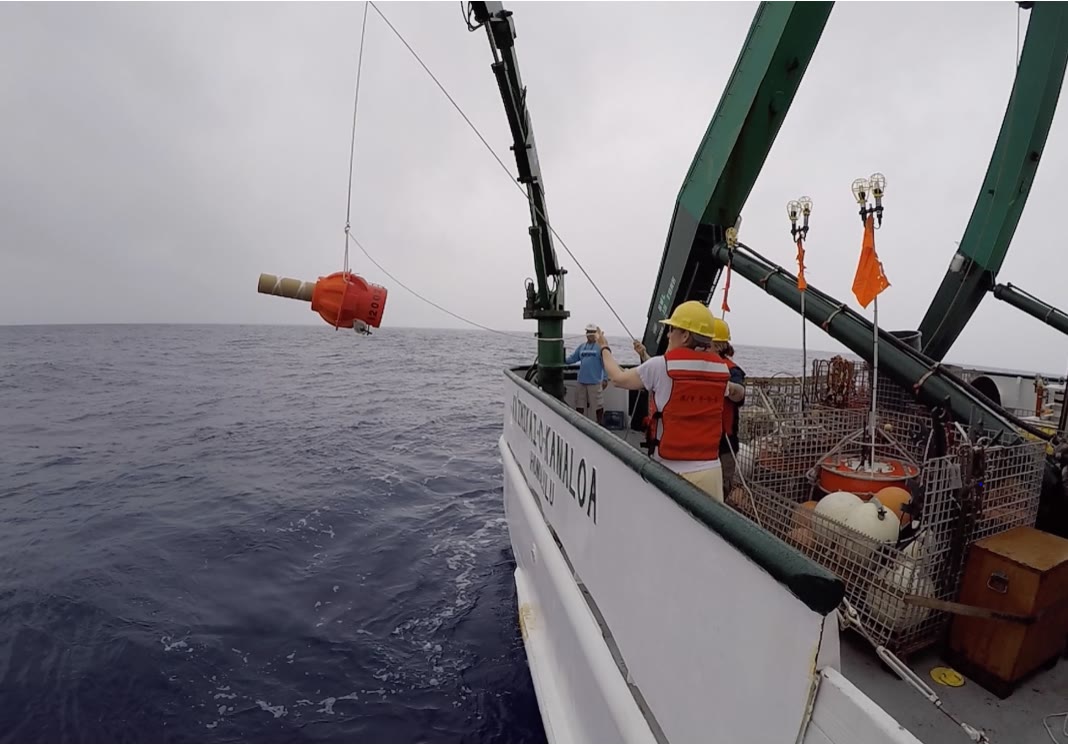
A deep-ocean profiling float (the orange instrument hanging from the crane) being lowered from a research vessel in 2018; once released, it sinks to its working depth and surfaces at regular intervals to send its data. (Unidentified NOAA photographer, public domain, via Wikimedia Commons.)
在原文中阅读 →