
সব বই

পেশাদার

1 Markets I: The Ecosystem and Exchange-Traded Marketsবাজার অনলাইন 2 Markets II: Rates, FX and Creditবাজার অনলাইন 3 Markets III: Commodities, Energy and Cryptoবাজার অনলাইন 4 Quantitative Methodsপদ্ধতি অনলাইন 5 Derivatives and Volatilityডেরিভেটিভস অনলাইন 6 Rates, Credit, XVA and Riskসুদহার, ঋণ ও ঝুঁকি অনলাইন 7 Research Craft: Predictors, Backtests, Measurement, Portfoliosগবেষণা অনলাইন 8 Strategies I: Equities and Futuresকৌশল অনলাইন 9 Strategies II: Volatility, Relative Value, Macro and the Bank Desksকৌশল অনলাইন 10 Microstructure and Executionএক্সিকিউশন অনলাইন 11 Market Making and High-Frequency Tradingমার্কেট মেকিং অনলাইন 12 Machine Learning for Marketsমেশিন লার্নিং অনলাইন 13 Low-Latency Softwareপ্রযুক্তি অনলাইন 14 Networks, Hardware and Trading Infrastructureপ্রযুক্তি অনলাইন 15 Research, Data and Risk Platformsপ্রযুক্তি অনলাইন 16 The Desk and the Firmপ্রতিষ্ঠান অনলাইন 17 The Industry: Firms, Roles and Careersক্যারিয়ার অনলাইন 18 Interviews I: Maths, Probability and Speedক্যারিয়ার অনলাইন 19 Interviews II: Markets, Trading Games and the Final Roundক্যারিয়ার অনলাইন 20 Interviews III: Codeক্যারিয়ার অনলাইন
অ্যাপ পরিচিতি Coach সাইন ইন পড়া শুরু করো

বইগুলো এখনো বাংলা ভাষায় পাওয়া যায় না — ইংরেজি সংস্করণ দেখানো হচ্ছে।

Earth and Space Sciences · পরিভাষা

Tropical cyclone; eye; eyewall কী?

অন্য নাম: tropical cyclone · eye · eyewall

Definition 5.5 High School Earth and Space Sciences · অধ্যায় 5 — Storms and Tropical Cyclones

A tropical cyclone is a storm, hundreds of kilometres across, that forms over a warm tropical sea around a centre of low pressure, with winds spiralling in towards the centre and bands of thunderstorms. When its sustained winds reach 6464 knots, about 119 km/h119\,\mathrm{km}/\mathrm{h}, it is called a hurricane in the Atlantic and the eastern Pacific, a typhoon in the western Pacific, and simply a cyclone in the Indian Ocean and the South Pacific. Its calm, nearly cloudless centre is the eye; the ring of towering thunderstorms around it, where the winds are strongest, is the eyewall.
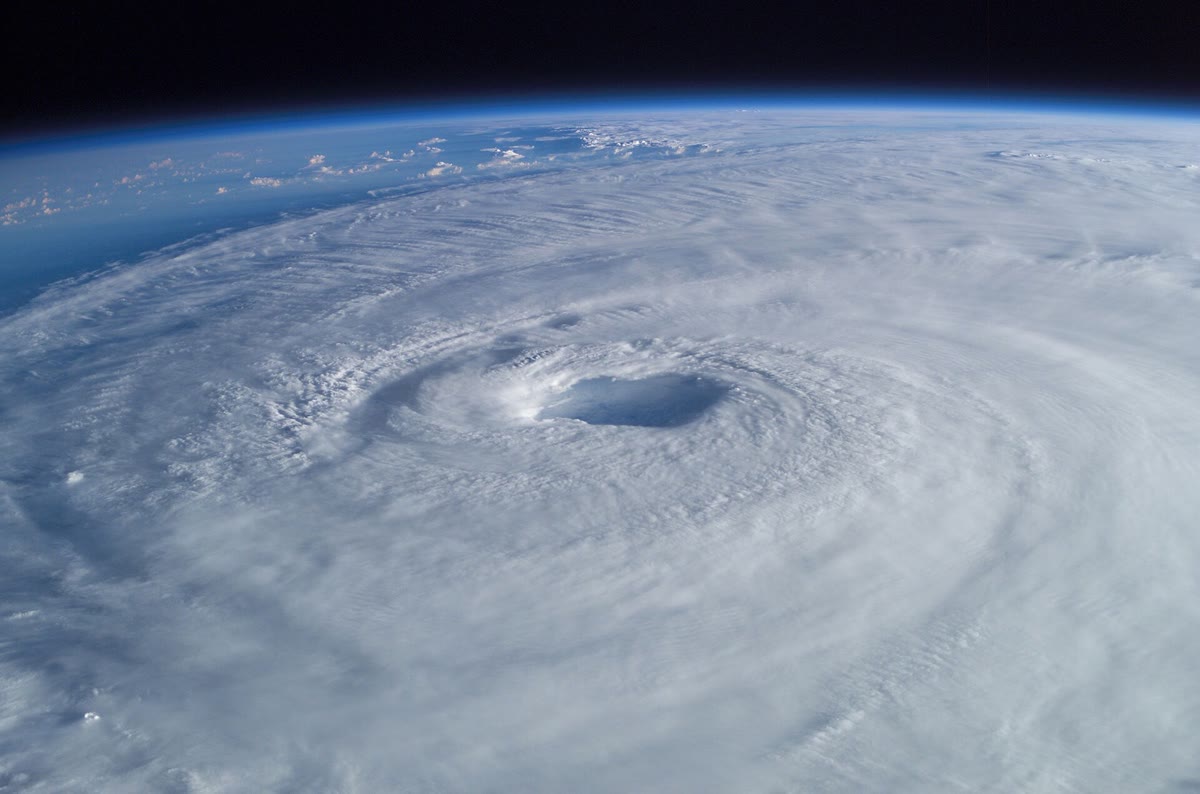
Hurricane Isabel, 15 September 2003, photographed by an astronaut from the International Space Station: the eye, the eyewall and the spiral of cloud around them. Image: Mike Trenchard, Earth Sciences and Image Analysis Laboratory, NASA Johnson Space Center (public domain).
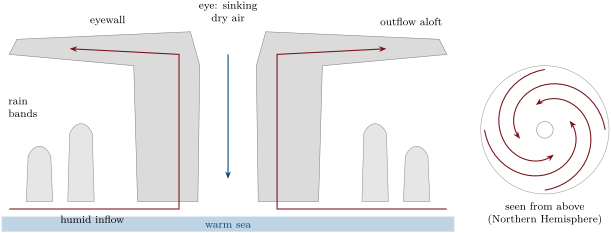
A tropical cyclone in cross-section (schematic, height greatly exaggerated): humid air flows in over the warm sea, rises in the eyewall and the rain bands, and flows out at the top; a little air sinks in the eye. Right: seen from above in the Northern Hemisphere, the inflow turns anticlockwise around the centre.
প্রসঙ্গসহ পড়ো →