
全部书籍

专业

应用 关于 Coach 登录 开始阅读

书籍暂未推出简体中文版——当前显示英文版。

Earth and Space Sciences · 术语表

什么是 Tropical cyclone; eye; eyewall?

又称: tropical cyclone · eye · eyewall

Definition 5.5 High School Earth and Space Sciences · 第 5 章 — Storms and Tropical Cyclones

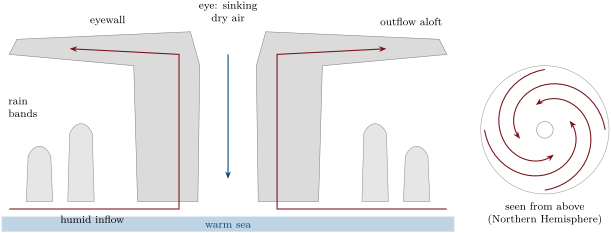
A tropical cyclone is a storm, hundreds of kilometres across, that forms over a warm tropical sea around a centre of low pressure, with winds spiralling in towards the centre and bands of thunderstorms. When its sustained winds reach 6464 knots, about 119 km/h119\,\mathrm{km}/\mathrm{h}, it is called a hurricane in the Atlantic and the eastern Pacific, a typhoon in the western Pacific, and simply a cyclone in the Indian Ocean and the South Pacific. Its calm, nearly cloudless centre is the eye; the ring of towering thunderstorms around it, where the winds are strongest, is the eyewall.
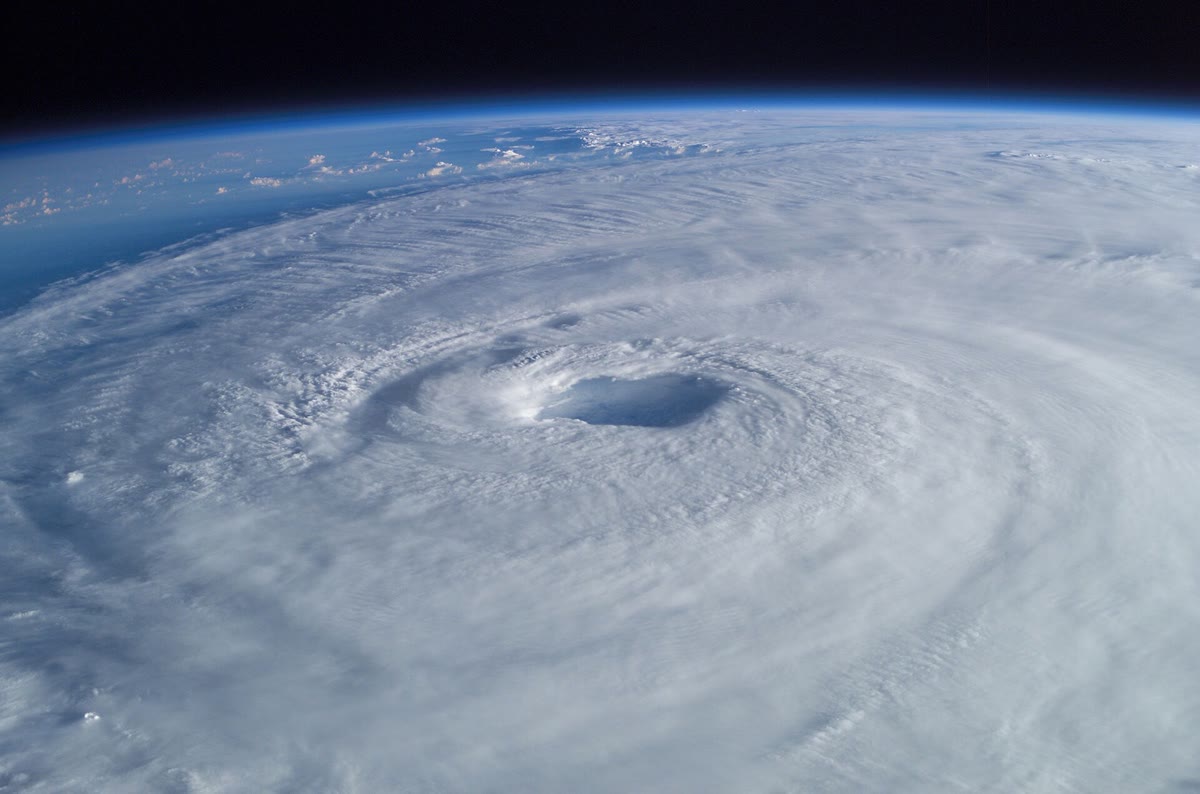
Hurricane Isabel, 15 September 2003, photographed by an astronaut from the International Space Station: the eye, the eyewall and the spiral of cloud around them. Image: Mike Trenchard, Earth Sciences and Image Analysis Laboratory, NASA Johnson Space Center (public domain).
A tropical cyclone in cross-section (schematic, height greatly exaggerated): humid air flows in over the warm sea, rises in the eyewall and the rain bands, and flows out at the top; a little air sinks in the eye. Right: seen from above in the Northern Hemisphere, the inflow turns anticlockwise around the centre.
在原文中阅读 →