全部书籍

专业

应用 关于 Coach 登录 开始阅读

书籍暂未推出简体中文版——当前显示英文版。

Mathematics · 术语表

什么是 Angle?

Definition 40.7 Primary & Middle School Mathematics · 第 40 章 — Lines, Circles and Angles

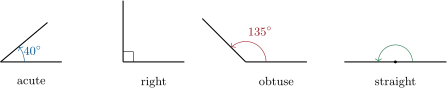
Two rays [AB)[AB) and [AC)[AC) with the same starting point AA form the angle BAC^\widehat{BAC}; the point AA is its vertex (always the middle letter!). Angles are measured in degrees (∘^\circ), from 0∘0^\circ to 360∘360^\circ for a full turn. An angle is:

  • right if it measures 90∘90^\circ;
  • acute if it measures less than 90∘90^\circ;
  • obtuse if it measures between 90∘90^\circ and 180∘180^\circ;
  • straight if it measures 180∘180^\circ (the two rays form a line).
The four families of angles. The right angle (90) is the reference: acute means smaller, obtuse means larger.
The four families of angles. The right angle (90∘90^\circ) is the reference: acute means smaller, obtuse means larger.

示例

Example 40.9

Before measuring, estimate! An angle slightly more open than the corner of a sheet of paper is a little over 90∘90^\circ; half a right angle is 45∘45^\circ; a third of a right angle is 30∘30^\circ. If your protractor says 150∘150^\circ for an angle that looks acute, you read the wrong scale: the correct measure is 180∘−150∘=30∘180^\circ - 150^\circ = 30^\circ.

在原文中阅读 →