 Coach
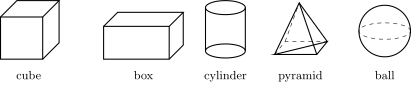
CoachA solid occupies space. Flat sides are faces; faces meet along edges; edges meet at vertices. The family portraits:
- the cube: square faces, edges, vertices;
- the box (rectangular prism): rectangular faces, edges, vertices;
- the cylinder: two disk faces and one rolled face (a can);
- the pyramid: a polygon base and triangles meeting at an apex;
- the ball (sphere): one perfectly round surface, no face, no edge.
Examples
Example 35.2 (Counting on the cube)
Check on a die: faces (the numbers to ), vertices (the corners), edges (run a finger along them: on top, at the bottom, vertical). And — the same curious pattern holds for the box and the pyramid (Example 62.2 returns to it).
Example 35.4 (Reading a net)
On a die, opposite faces add up to . On a net, opposite faces are the ones separated by exactly one square in a row (or around a corner) — not the neighbors! Marking the pairs on the net before folding is a great exercise in seeing space flat.
Example 35.6 (Counting a box layer by layer)
A box cubes long, wide, high: the bottom layer holds cubes, and there are layers:
Counting by layers always works — and it quietly proves the formula of Chapter 43.