Definition 35.5High School Mathematics · Chapter 35 — Continuous Random Variables
For λ>0, X follows the exponential distributionE(λ) if its density on [0,+∞) is
f(t)=λe−λt.
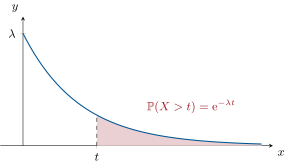
Then P(X≤x)=1−e−λx and P(X>x)=e−λx for x≥0.
The exponential densityλe−λx (here λ=1): the tail area beyond t (red) is e−λt, and memorylessness says every tail looks like the whole distribution rescaled.
 Coach
Log in
Start reading
Coach
Log in
Start reading