 Coach
CoachLet be a group and . The subgroup generated by , written , is the smallest subgroup containing — concretely, all finite products of elements of and their inverses. A group is cyclic when generated by one element: . The order of is (possibly infinite); when finite, it is the least with , and .
Examples
Example 1.15 (Cosets in action: inside )
Take (order ) and . The left cosets are
two classes of three elements partitioning , exactly as the count demands — and visibly the partition into even and odd permutations. Note although : cosets are classes, not labelled by their representatives, and is the only legitimate comparison. This two-class picture is the general one for the signature: and its lone companion coset split in half, which is how the weekend problem counts reachable puzzle positions.
Example 1.16
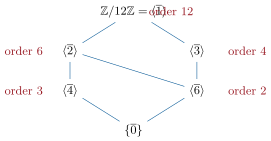
Two immediate dividends. Groups of prime order are cyclic: if is prime and , then divides and is not , so it is : . The subgroup lattice of : by Proposition 1.17 below, there is exactly one subgroup per divisor of — orders , generated respectively by , , , , , . The closing caution: the converse of Lagrange fails in general — has order but no subgroup of order , as we prove in this chapter’s weekend problem (Problem 1.1, question 14). Lagrange restricts the possible orders; it does not promise them.
Example 1.20 (Cycle type as a census)
How many permutations of have the cycle type — one -cycle, one -cycle, one transposition? Choose the supports and the cyclic orders:
list the nine symbols in a row ( ways), bracket the first four, next three, last two into cycles, and divide by the rotations inside each bracket (, and of them) which give the same permutation. (Distinct cycle lengths here, so no further division; equal lengths would also require dividing by the permutations of the equal brackets.) Every such permutation has order and signature (Theorem 1.19 and the signature theorem below). One partition of , one conjugacy class, one census — the combinatorics of is the arithmetic of partitions.