University Mathematics — Year 2 · स्नातक वर्ष 2
1Sets and Structures
This opening chapter sharpens the foundations laid in the Year 1 volume into working tools of the trade: the calculus of sets and quotients, the comparison of infinite sets (countability, Cantor–Bernstein), and the structural theory of groups and rings — Lagrange’s theorem, the symmetric group with its signature, ideals and the Chinese remainder theorem. Everything here is used relentlessly in the rest of the book: the signature builds the determinant (Chapter 2), quotient rings drive arithmetic, and countability underlies both topology and probability.
1.1 Sets, maps, quotients
We use freely the language of sets, maps, and equivalence and order relations set up in the Year 1 volume. Two upgrades deserve a proper statement.
Proposition 1.1 (Images and preimages of families)
Let and let , be families of subsets of , resp. . Then
Proof. Each identity is an unwinding of definitions; for instance for all for all . The image identities and the failure of equality in the intersection case (with the injectivity fix) were proved in the Year 1 volume for two sets; the arguments are identical for families. ∎
Example 1.2 (Where the image inclusion is strict)
Take , , with and . Then
the inclusion of Proposition 1.1 is as strict as can be — the two preimage points of a common value live in different . Injectivity is exactly what forbids this splitting, which is why preimages (which never merge points) satisfy all four identities unconditionally while images lose the one about intersections. Rule of thumb for the whole book: push preimages through set operations freely; handle images with care.
Definition 1.3 (Quotient set)
Let be an equivalence relation on . The quotient set is the set of equivalence classes; the surjection , , is the canonical projection.
Universal property (factorization): if is compatible with (i.e. ), there is exactly one map with .
Proof of the universal property. Uniqueness: the requirement reads
and since is surjective, every element of is some : the values of are all forced. Existence: take the display as the definition of ; it is unambiguous precisely by compatibility — if , then , so and the two candidate values agree — and it factorizes by construction. Note the division of labour: surjectivity of gives uniqueness, compatibility gives existence. ∎
Example 1.4
is the quotient of by congruence modulo ; the well-definedness checks of the Year 1 volume were instances of the universal property. Quotients turn “compatible constructions on representatives” into honest maps — we use this constantly below.
1.2 Countability and cardinality
Definition 1.5 (Equipotence, countability)
Two sets are equipotent when a bijection joins them. A set is countable when it is equipotent to (some authors include finite sets; we say at most countable for “finite or countable”).
Proposition 1.6 (Stability properties)
- Every infinite subset of is countable; a set is at most countable iff it injects into iff it is empty or a surjective image of .
- is countable; a product of two at most countable sets is at most countable.
- An at most countable union of at most countable sets is at most countable.
- and are countable.
Proof. (1) List an infinite by repeated minima: , (nonempty since is infinite); the map is strictly increasing, injective, and surjective onto (every exceeds only finitely many elements of , so it is reached). If injects into via , then is equipotent to : finite or countable. If is surjective, then injects into .
(2) The map is a bijection (every positive integer has a unique odd–even split with odd, by unique factorization). Products: compose injections.
(3) Given sets with surjections (harmless when some is finite: repeat values), the map is a surjection from the countable onto .
(4) : countable union. is a surjective image of (the fraction map), hence at most countable, and infinite. ∎
Example 1.7 (A pairing function, computed)
The bijection of the proof deserves to be seen at work. Its first values:
Row collects the integers for which is exactly divisible by : every natural number appears exactly once. Decoding is as explicit as encoding: for , factor , so . The closing insight: countability proofs are often algorithms in disguise — here, “factor out the twos”.
Example 1.8 (The algebraic numbers are countable)
A complex number is algebraic when it annihilates some nonzero polynomial with rational coefficients. The set of algebraic numbers is countable: polynomials of degree over inject into , a finite product of countable sets (Proposition 1.6 (2)); the union over enumerates the nonzero rational polynomials as ; each has finitely many roots; and
is a countable union of finite sets (Proposition 1.6 (3)), infinite since it contains . Combined with the uncountability of (Theorem 1.9 below), this proves — without exhibiting a single one — that transcendental numbers exist and form an uncountable majority: Cantor’s counting argument of 1874, existence by cardinality alone.
Theorem 1.9 (Cantor; uncountability of )
- For every set , there is no surjection .
- is not countable.
Proof. (1) was proved in the Year 1 volume (the diagonal set ).
(2) Suppose enumerates . Build nested segments with and : split the current segment into three closed thirds; at least one third avoids (a point meets at most two of the three). The nested-segments theorem (adjacent endpoints) provides ; but for some , and : contradiction. ∎
Theorem 1.10 (Cantor–Bernstein)
If injects into and injects into , then and are equipotent.
Proof. Let and be injections. For each point (of or ), trace its ancestor chain of successive preimages, — each step is defined as long as the current point lies in the image of the relevant injection, and is then unique by injectivity. Three mutually exclusive fates: the chain stops at a point of (origin in ), stops at a point of (origin in ), or never stops. This partitions and according to the origin.
Now observe: maps onto — the chain of is the chain of prefixed with one step, so origins match; and every has a chain with at least one step (its origin lies in ), so with . The same argument gives bijections and . Gluing,
is a bijection from onto : it is bijective piecewise, and the three target pieces are disjoint. ∎
Example 1.11
and are equipotent: the identity injects one way, the other; the theorem manufactures the (necessarily discontinuous) bijection. Likewise , (via -type bijections) and (binary expansions, Exercise 1.3) are all equipotent: “the cardinality of the continuum”.
Example 1.12 (The segment and the square)
and are equipotent — dimension is invisible to cardinality. One injection is trivial: . For the other, send to the real whose decimal digits interleave those of and ,
choosing for each coordinate the expansion that does not end in all ’s: with that convention the digits of the image determine those of and , so the map is injective (it need not be surjective — images never have, say, odd-position digits eventually — and that is fine). Cantor–Bernstein (Theorem 1.10) assembles a genuine bijection. Continuity, of course, is hopeless: a continuous bijection between them is impossible — the metric chapters explain why (connectedness distinguishes the line from the plane, Chapter 4).
1.3 Groups
Definition 1.13 (Generated subgroup; order)
Let be a group and . The subgroup generated by , written , is the smallest subgroup containing — concretely, all finite products of elements of and their inverses. A group is cyclic when generated by one element: . The order of is (possibly infinite); when finite, it is the least with , and .
Proof of the order characterization. If some with , let be least with . The elements are pairwise distinct ( with gives , contradicting minimality), and every reduces to one of them by Euclidean division : has exactly elements, and . If no power is trivial, all () are distinct (same division argument) and the order is infinite. ∎
Theorem 1.14 (Lagrange)
Let be a finite group and a subgroup. Then divides . In particular the order of every element divides , and for all .
Proof. The relation is an equivalence (reflexive: ; symmetric: inverses; transitive: products). The class of is the left coset , and is a bijection (inverse ): all classes have elements. Classes partition (the general partition theorem of the Year 1 volume), so . For an element: apply this to ; then . ∎
Example 1.15 (Cosets in action: inside )
Take (order ) and . The left cosets are
two classes of three elements partitioning , exactly as the count demands — and visibly the partition into even and odd permutations. Note although : cosets are classes, not labelled by their representatives, and is the only legitimate comparison. This two-class picture is the general one for the signature: and its lone companion coset split in half, which is how the weekend problem counts reachable puzzle positions.
Example 1.16
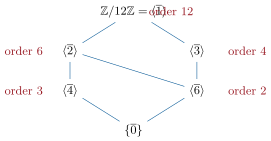
Two immediate dividends. Groups of prime order are cyclic: if is prime and , then divides and is not , so it is : . The subgroup lattice of : by Proposition 1.17 below, there is exactly one subgroup per divisor of — orders , generated respectively by , , , , , . The closing caution: the converse of Lagrange fails in general — has order but no subgroup of order , as we prove in this chapter’s weekend problem (Problem 1.1, question 14). Lagrange restricts the possible orders; it does not promise them.
Proposition 1.17 (Cyclic groups)
Proof. (1) The map from onto is compatible with congruence mod (, by the order characterization); the universal property (Definition 1.3) yields a well-defined bijective morphism from .
(2) Let be nontrivial and least with . Euclidean division shows (for : forces , so ), and (divide by : ). Then ; taking realizes each divisor . Uniqueness: any subgroup of order is, by the above, of the form with — so is forced and the subgroup is determined.
(3) We claim . Write . For any , the order characterization of Definition 1.13 gives the chain of equivalences
the last step by Gauss’s lemma, since and are coprime. The least such is : , which equals iff . There are such classes modulo . ∎
1.4 The symmetric group
Definition 1.18
is the group of permutations of (order ). A cycle maps and fixes everything else; is its length, a -cycle is a transposition. Two cycles are disjoint when their supports (non-fixed points) are.
Theorem 1.19 (Cycle decomposition)
Every permutation is a product of pairwise disjoint cycles, uniquely up to the order of the factors. Disjoint cycles commute, and is the lcm of the lengths.
Proof. Consider the “orbit” relation on the support of : iff for some — an equivalence relation. Each class (finite, so the iterates cycle back — the first repetition must return to by injectivity) carries the cycle , and is the product of these cycles: on each orbit, only the corresponding cycle acts. Uniqueness: any disjoint-cycle factorization reproduces exactly the orbits (the cycle through must be ). Disjoint cycles commute since they move disjoint points; the order statement follows because iff each cycle’s -th power is (disjointness), iff each length divides . ∎
Example 1.20 (Cycle type as a census)
How many permutations of have the cycle type — one -cycle, one -cycle, one transposition? Choose the supports and the cyclic orders:
list the nine symbols in a row ( ways), bracket the first four, next three, last two into cycles, and divide by the rotations inside each bracket (, and of them) which give the same permutation. (Distinct cycle lengths here, so no further division; equal lengths would also require dividing by the permutations of the equal brackets.) Every such permutation has order and signature (Theorem 1.19 and the signature theorem below). One partition of , one conjugacy class, one census — the combinatorics of is the arithmetic of partitions.
Theorem 1.21 (Signature)
There is exactly one group morphism (for ) taking the value on transpositions: the signature. Moreover where is the number of inversions (pairs with ), a -cycle has signature , and the alternating group has order .
Proof. Existence. For set
The factors’ absolute values multiply to (the unordered pairs run over all pairs), so . Morphism: for ,
the middle product being after reindexing by the pairs (each unordered pair appears once, and numerator and denominator flip sign together). A transposition with has an odd number of inversions; counted exactly: the inverted pairs , , with are
that is of them, odd. (Alternatively: check directly, with one inversion, and conjugate — conjugates have equal signature since is a morphism to an abelian group.) Hence .
Uniqueness. Transpositions generate (any cycle , and Theorem 1.19 finishes); a morphism to is determined by its values on generators.
Consequences. The cycle identity above writes a -cycle as transpositions: signature . : the morphism is surjective (transpositions exist for ), and the two “cosets” and are equipotent and partition (Lagrange’s argument): . ∎
Example 1.22
: order , signature . The signature is the fastest parity check on shuffles — and the engine of the determinant in Chapter 2.
Example 1.23 (Three roads to one sign)
Let send to . Via cycles: and , so and . Via inversions: in the value list the out-of-order pairs are , , , , , , : seven of them, and . Via transpositions: , three factors, . Three computations, one parity: the uniqueness in Theorem 1.21 guarantees that no bookkeeping scheme can ever make them disagree — which is exactly what makes usable as an invariant (see the weekend problem).
Remark 1.24 (Where the signature goes from here)
The signature is the seed of three later harvests: it builds the determinant and its product rule in Chapter 2; it powers parity invariants for combinatorial puzzles (this chapter’s weekend problem solves the fifteen puzzle with it); and the alternating groups it defines become central in the Year 3 volume, where their simplicity for explains why degree- equations have no solution in radicals.
1.5 Rings, ideals, quotients
Definition 1.25 (Ideal)
Let be a commutative ring. An ideal is an additive subgroup such that for all , . Kernels of ring morphisms are ideals; iff iff contains a unit. The ideal generated by is (a principal ideal).
Theorem 1.26 (Ideals of and of )
Every ideal of is for a unique ; every ideal of ( a field) is for a unique monic (or zero) . Consequently gcd’s exist in both rings with Bézout relations: , and likewise for polynomials.
Proof. For this was the subgroup theorem of the Year 1 volume (an ideal is in particular a subgroup, and is an ideal). For : let be an ideal and nonzero of minimal degree, normalized monic. For , Euclidean division gives with : minimality forces , so . Uniqueness: two monic generators divide each other. The Bézout statements are the equality of the ideal (resp. its polynomial analogue) with the principal ideal of the gcd — the very definition of gcd used in Year 1, now recognized as a statement about ideals. ∎
Example 1.27 (A polynomial gcd, two ways)
Compute in . By Euclid:
so the gcd is , and back-substitution gives the Bézout relation
By ideals: the ideal is principal (Theorem 1.26); it contains (the display) and is contained in (both generators vanish at , hence are multiples of ): the monic generator is . The closing insight: the ideal viewpoint identifies the gcd without dividing — common roots locate the ideal, and Euclid merely certifies it.
Definition 1.28 (Quotient ring , revisited)
For an ideal of , the relation is an equivalence compatible with and ; the quotient set inherits a ring structure — the quotient ring — making a morphism with kernel . For , this is the of the Year 1 volume, now with its universal property: any morphism killing factors through .
Theorem 1.29 (Chinese remainder theorem, ring form)
If , the map
is a ring isomorphism. Consequently for coprime , and
Proof. The map is a well-defined ring morphism (compatibilities are immediate). Injectivity: mod and mod with forces (Gauss). Surjectivity: both sides have elements, so injectivity suffices (finite equal cardinalities) — or explicitly: from a Bézout relation , the class of
maps to , since makes , and symmetrically mod — the recipe used numerically in Example 1.30. Units correspond to pairs of units (a product ring’s units are the pairs of units), so . For a prime power, (the non-units mod are the multiples of ); multiplicativity assembles the product formula. ∎
Example 1.30 (Inverting the Chinese isomorphism)
Take , . The inverse of the isomorphism is made explicit by the two idempotents: seek , and , . From : , so ; from : , , so . Then the class of modulo is the unique solution of , : for , one gets — exactly the intermediate value found by substitution in Exercise 1.8. The closing insight: and satisfy , , , modulo ; they are the images of and , and every Chinese decomposition is at bottom a decomposition of into orthogonal idempotents.
Theorem 1.31 (Euler; Fermat revisited)
The units of form a group of order ; hence for :
and Fermat’s little theorem is the case prime, now one line from Lagrange.
Proof. The invertible classes are exactly those of integers coprime to (Year 1 volume): of them, forming a group under multiplication. Lagrange (Theorem 1.14): every element to the power of the group order is the identity. ∎
Example 1.32 (A unit group without a generator)
The group has elements. Is it cyclic? Compute orders using the Chinese isomorphism (a unit mod is a pair of units): the factors have orders and , so every element’s order divides — no element generates. Concretely:
orders and never . Contrast with Exercise 1.10: is cyclic for prime, because there the unit group sits inside a field. Euler’s theorem still applies with exponent , but the true universal exponent here is — Euler is an upper bound, not always the sharp one.
Definition 1.33 (Algebra)
A -algebra is a -vector space with a ring structure whose multiplication is -bilinear. Examples: , , , function spaces , as an -algebra. Morphisms of algebras are linear ring morphisms; the evaluation from to (or ) is the central example, driving Chapter 3.
Example 1.34 (An evaluation morphism and its kernel)
Take and the evaluation , . Since ,
(only the constant and linear terms of survive). Hence : a principal ideal, exactly as Theorem 1.26 predicts, generated by the monic of least degree in the kernel — the minimal polynomial of , star of Chapter 3. The image is the two-dimensional commutative algebra : evaluation morphisms shrink the infinite-dimensional onto small, computable algebras.
Remark 1.35 (Perspectives: three melodies to listen for)
Three structural ideas from this chapter recur throughout the volume, each time in heavier orchestration. Factorization through a quotient (Definition 1.3): it builds here, defines maps on solution sets of linear systems in Chapter 2, and silently underlies every “well defined on classes” argument. Invariants: the signature is a morphism to that no legal move can dodge — the same logic gives the determinant’s product rule (Chapter 2), the trace’s similarity invariance, and the conserved quantities of Chapter 16. Counting against a structure: Lagrange counts through cosets, dimension counts through bases (Chapter 2), multiplicity counts through polynomial degrees (Chapter 3); whenever a bound looks miraculous, some partition or grading is doing the counting.
Remark 1.36 (Common pitfalls)
Four classics. (i) A map on a quotient must be checked well defined: “ (formula on )” is legitimate only if the formula is constant on classes — the compatibility of Definition 1.3, not a formality. (ii) is false in general, even for commuting elements ( and ); Exercise 1.4 gives the correct coprime-and-commuting statement, and disjoint cycles the correct permutation version. (iii) Countability survives countable unions and finite products, but not countable products: is uncountable (Exercise 1.3) although each factor has two elements. (iv) Cantor–Bernstein needs only injections both ways, but the bijection it builds is usually discontinuous and non-explicit — do not expect a formula (Example 1.11).
Remark 1.37 (Where this chapter is used)
Almost everywhere. The signature builds determinants (Chapter 2); the evaluation morphism and the principal ideals of produce minimal polynomials and the kernel decompositions of Chapter 3; countability is the stage on which Chapter 21 performs (probability on countable spaces) and the reason topology keeps producing countable dense sets (Chapter 4). The quotient construction is redeployed in the Year 3 volume to build fields and, from them, Galois theory: the universal property proved here is used there word for word.
1.6 Exercises
Exercise 1.1 ★
Which of the following sets are countable? The set of finite subsets of ; the set of all subsets of ; ; the set of polynomials with rational coefficients; the set of sequences of ’s and ’s that are eventually zero.
Solution
Solution of Exercise 1.1.
Finite subsets of : countable — the set of subsets of is finite, and the finite subsets form the countable union over of these (Proposition 1.6 (3)); infinite since it contains all singletons.
All subsets of : not countable, by Cantor’s theorem (Theorem 1.9 (1) with ).
: not countable — otherwise would be a union of two countable sets, contradicting Theorem 1.9 (2).
Polynomials over : countable — the polynomials of degree inject into (finite products of countable sets), and take the union over .
Eventually-zero binary sequences: countable — they biject with finite subsets of (the support).
Exercise 1.2 ★
In , let and . Compute and in disjoint-cycle form, the orders and signatures of all four permutations, and .
Solution
Solution of Exercise 1.2.
Compute element by element, applying the right factor first. sends , , , , , , :
a -cycle. Likewise sends , , , , , , :
also a -cycle (as expected: and are conjugate, hence share their cycle type).
Orders and signatures: has cycle type : order , signature ; is a -cycle: order , signature ; both products are -cycles: order , signature .
: , so (square the -cycle; the transposition squares away).
Exercise 1.3 ★
Construct explicit injections showing that , and the set of binary sequences are pairwise equipotent (binary expansions both ways; Cantor–Bernstein absorbs the double-representation nuisance).
Solution
Solution of Exercise 1.3.
: a sequence maps to its support — a bijection (indicator functions), no theorem needed.
: the base- map is injective (two distinct sequences differ first at rank ; the tails cannot compensate a gap of , since ).
: binary expansion, choosing (say) the expansion not ending in all ’s: injective.
By Cantor–Bernstein (Theorem 1.10) applied to the last two injections, and are equipotent, hence all three sets are.
Exercise 1.4 ★
Let be a group and commuting elements of finite coprime orders and . Prove that . Show by an example in that commutation is essential.
Solution
Solution of Exercise 1.4.
Let and . First (commutation allows splitting the power), so . Conversely gives ; this element lies in , a subgroup whose order divides both and (Lagrange in each cyclic group), hence is trivial: , so and , and by coprimality . Hence .
In : take (order ) and (order ), coprime orders, which do not commute: has order — indeed has no element of order . Commutation is essential.
Exercise 1.5 ★★
Let be a finite group of even order. Prove that contains an element of order . (Pair each element with its inverse; count the self-paired ones.)
Solution
Solution of Exercise 1.5.
Pair every with . The pairs with have two elements and partition their union; the remaining elements are exactly those with , i.e. . Since is even and the two-element pairs cover an even number of elements, the set has even cardinality; it contains , so it contains at least one other element — an element of order .
Exercise 1.6 ★★
Prove that () is generated by the -cycles. (A product of two transpositions is a -cycle or a product of two -cycles.)
Solution
Solution of Exercise 1.6.
Every element of is a product of an even number of transpositions (Theorem 1.21: decompose into transpositions; the count is even since the signature is ). It suffices to write each product of two transpositions with -cycles:
(check by evaluation), and . So the -cycles generate .
Exercise 1.7 ★★
Determine all group morphisms: from to ; from to (count them: ); from to .
Solution
Solution of Exercise 1.7.
: only the zero morphism. For any and every , is divisible by in ; the only integer divisible by every is , so for all .
: a morphism is determined by , which must satisfy , i.e. is a multiple of ; there are such classes, and each choice does define a morphism (factor through by the universal property).
: only the trivial one. If , then for every , is an -th power in . But a rational cannot be an -th power for all : some prime appears in with a nonzero exponent , and for (exponents of -th powers are multiples of , by unique factorization). Hence .
Exercise 1.8 ★★
Using the Chinese remainder theorem, compute , find all with , and , and compute the last two digits of (Euler mod ; beware: work mod and mod ).
Solution
Solution of Exercise 1.8.
: .
System: moduli pairwise coprime, total . From and : with , i.e. , : . Then : , , : .
Last two digits of : mod , . Mod : and , so . Solve , : gives : . The last two digits are .
Exercise 1.9 ★★★
Prove that a finite integral domain is a field. Deduce that is a field iff is prime (again).
Solution
Solution of Exercise 1.9.
Let be a finite integral domain and , . The map is injective (, no zero divisors); an injective map of a finite set to itself is surjective (Year 1 volume, the pigeonhole equivalence). So for some : every nonzero element is invertible, is a field.
: if is prime it is an integral domain ( or , Euclid’s lemma), finite, hence a field; if is composite, exhibits zero divisors.
Exercise 1.10 ★★★
(A classic) Let be a field and a finite subgroup of . Prove that is cyclic. Hint: let be the maximal order among elements of ; show every element’s order divides (using Exercise 1.4 on suitable coprime parts), so all of satisfies ; count roots of . In particular is cyclic.
Solution
Solution of Exercise 1.10.
Let , attained at .
Claim: every has order dividing . Suppose some has order with : then some prime power divides but not . Write with and . The element has order ; the element has order ; these orders are coprime and the two elements commute ( is abelian), so by Exercise 1.4 their product has order : contradicting maximality.
So all satisfy : the polynomial has at least roots in the field , whence (a nonzero polynomial of degree has at most roots, Year 1 volume). But by Lagrange. Hence and , of cardinality , is all of : cyclic.
Exercise 1.11 ★★★
Prove that the group is not cyclic, and worse: it is not even finitely generated. Prove on the other hand that every finitely generated subgroup of is cyclic.
Solution
Solution of Exercise 1.11.
Not cyclic: the subgroup consists of the integer multiples of , all of which have denominator dividing (in lowest terms); it therefore misses . No single generator can reach the unbounded denominators of .
Not finitely generated: the subgroup generated by consists of rationals whose denominators divide (integer combinations have denominator dividing ): it misses .
Finitely generated subgroups are cyclic: with as above, the subgroup is contained in . The map is an isomorphism from onto carrying to a subgroup of , which is for some (Year 1 volume): so is cyclic, generated by .
Exercise 1.12 ★★
(Dedekind’s criterion) Prove that every infinite set contains a countable subset, and deduce that a set is infinite if and only if it is equipotent to a proper subset of itself. (For the direct implication, shift a countable subset by one step; for the converse, recall the pigeonhole principle.)
Solution
Solution of Exercise 1.12.
A countable subset. Let be infinite. Construct inductively: is nonempty, pick ; if are chosen, is nonempty ( is not finite), pick there. The are pairwise distinct by construction, so is a countable subset of .
Infinite equipotent to a proper subset. Define by and for . It is injective (the two pieces are injective with disjoint images) and surjective onto : every is hit, every is hit. So is equipotent to the proper subset .
Converse. If is finite and is a bijection onto with , then is an injection of into itself that is not surjective, contradicting the pigeonhole principle (Year 1 volume: an injective self-map of a finite set is bijective). So a set equipotent to a proper subset is infinite.
1.7 Problem: The Fifteen Puzzle
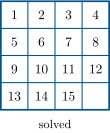
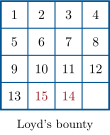
The fifteen puzzle is a tray holding fifteen sliding tiles numbered to and one empty cell; a move slides one of the tiles adjacent to the empty cell into it. In the 1890s Sam Loyd popularized the puzzle by offering $1000 to anyone who could exchange the tiles and and return every other tile to its place. Nobody ever collected, and this weekend problem proves both halves of the reason: the signature of Theorem 1.21 forbids Loyd’s exchange, and — the harder, constructive half — everything the signature allows is genuinely solvable. The full statement is the Johnson–Story theorem (1879).
Problem 1.1
Weekend problem — the Johnson–Story solvability theorem
Number the cells to in reading order (left to right, top to bottom), so that cell sits in row and column with . Cell (bottom right) is the home of the empty cell; we treat the empty cell as a sixteenth tile, written and identified with the number . A configuration is a bijection , cell content; the solved configuration is . Throughout, is the signature of Theorem 1.21 and two cells are adjacent when they share an edge of the tray.
Part I — Configurations, moves, signatures.
- Justify that the configurations are exactly the elements of , so there are of them, and that the number of legal moves from a given configuration is , or , according to whether the empty cell lies in a corner, on an edge, or in the interior.
- Let be a configuration, the cell of the blank, and a cell adjacent to . Show that sliding the tile of into produces the configuration with , and deduce that every move flips the signature: .
- Checkerboard the tray: for the cell in row , column . Show that every move flips , and deduce that a sequence of moves returning the blank to its starting cell has even length.
Show that
is invariant under every legal move, and compute .
Part II — Loyd’s bounty: the invariant at work.
- Loyd’s configuration agrees with the solved one except that cells and hold tiles and . Compute and conclude that no sequence of moves links to the solved configuration: Loyd’s $1000 was never in danger.
- Show that exactly half of all configurations satisfy : . (For a fixed blank cell, pair configurations by composing with one fixed transposition of two other cells.)
- Show that every move is undone by a legal move, that “ is reachable from by legal moves” is an equivalence relation, and that the class of the solved configuration satisfies . Conclude that there are at least two classes.
- Suppose the blank is home: . Show that where is the restriction of to the cells , and that any configuration can be carried by legal moves to one with the blank home. Conclude: to prove it suffices to realize every even permutation of the fifteen non-home cells by a sequence of moves starting and ending with the blank home.
Part III — Blank tours and the program group. A program is a finite sequence of legal moves, started from a configuration with the blank home, whose final configuration again has the blank home. Its effect is the permutation of the cells defined by: the content of cell ends in cell .
- Show that a program run from ends at ; that running two programs in succession composes their effects; and that the set of all effects is a subgroup of (permutations of the cells ) contained in the alternating group .
- (The elementary tour) From the blank at home, slide the blank around the bottom-right block: cells . Show the effect is the -cycle , and that the reverse tour gives . Both lie in .
(The grand tour) Verify that
is a closed walk through all sixteen cells (adjacent steps only), and that its effect is the -cycle
Writing , , , …, for its cycle order, check that the reverse elementary tour of question 10 is exactly .
Prove the conjugation formula in any : for a permutation and a -cycle,
and note that , being a group, is closed under conjugation by its own elements.
Deduce that contains all fifteen consecutive -cycles of the grand tour:
Part IV — Generating the alternating group.
- (Lemma A) Let and be -cycles whose supports share exactly two points, say supports and . Show that, after replacing or by its inverse if necessary (which changes nothing to the generated subgroup), the product is a double transposition; show that contains no subgroup of order (a subgroup of index contains every square; count the -cycles among squares); and conclude that is the whole alternating group of the four letters .
- (Lemma B) Let be a set of letters, , and let be a subgroup of some containing every even permutation of and one -cycle with . Show that for all distinct there is an even permutation of with , , and deduce .
- Deduce that the group of Lemma B contains every even permutation of (use Exercise 1.6: the -cycles generate). Then, chaining Lemmas A and B along the consecutive -cycles of question 13, prove that .
- Conclude that : every even rearrangement of the fifteen tiles is achievable by a program, and has elements.
- (The Johnson–Story theorem, 1879) Assemble questions 6, 7, 8 and 17: the configurations reachable from the solved one are exactly the configurations with ; and reachability has exactly two classes, the class of the solved configuration and the class of Loyd’s . (For the second point, relabel the tiles and : show maps move sequences to move sequences and exchanges with .)
Part V — Criteria, variants, and the view from above.
- (The practical criterion) Read the fifteen tiles in reading order of their cells, skipping the blank, and let be the number of inversions of this list; let be the row of the blank counted from the bottom. Show that , so that is solvable if and only if is odd.
- (Group actions) An action of a group on a set is a map , , with and ; the orbit of is , and the action is free when forces . Show that defines a free action of on the set of blank-home configurations, that its orbits are exactly the classes of mutual reachability by programs, and recover from the orbit count that these configurations split into exactly classes.
- (The obstruction) Show that the board admits no closed walk visiting every cell exactly once: the grand-tour strategy of Part III fails for the eight puzzle. (Checkerboard the nine cells.)
- (The repair) On the board with cells to in reading order and home : compute the effects of the perimeter tour (a -cycle fixing the center ) and of the corner tour (a -cycle through the center). Conjugating the latter by the powers of and chaining Lemmas A and B, prove that the eight puzzle’s program group is all of , hence that exactly of the configurations are solvable.
- (A poor board) Now let the board be a single cycle of cells carrying tiles. Show that the cyclic order of the tiles is invariant, that each reachability class has exactly configurations (the classes are the orbits of a cyclic group of order ), and that there are classes — for far more than : on a thin board the parity invariant captures almost nothing, and geometry rules.
- Two verdicts by the criterion of question 19: the fully reversed tray (tiles in cells to , blank home) and the tray with the blank in cell followed by the tiles in cells to . Which one is solvable?
- (Synthesis) The proof has two independent pillars: an invariant (, built from the signature morphism) showing at most half the configurations are reachable, and an explicit generation theorem () showing at least half are. In one sentence each, say where the following entered: the morphism property of ; Lagrange’s theorem; the generation of by -cycles; conjugation. State the meta-principle in one line.
Solution
Solution of Problem 1.1.
1. A configuration assigns to each of the cells one of the contents (tiles – or the blank ), each exactly once: precisely a bijection , an element of ; there are of them. A legal move slides one tile adjacent to the blank, so the number of moves is the number of neighbours of the blank’s cell: for the four corner cells, for the eight edge cells, for the four interior cells.
2. After the slide, cell holds the former content of and cell holds the blank; all other cells are untouched: , , elsewhere. That is exactly . Since is a morphism and : .
3. Adjacent cells differ by one step in exactly one of the two coordinates, so changes parity: takes opposite values on adjacent cells. A move transfers the blank from to the adjacent , flipping . Along a closed walk of the blank, is flipped once per move and returns to its initial value: the number of moves is even.
4. By questions 2 and 3, one move flips both factors of ; their product is unchanged. For the solved configuration: and the blank is at cell , row , column : , so .
5. is the transposition of cells: ; its blank is home, : . Since is preserved by every move, no sequence of moves joins and . The prize was structurally safe.
6. Fix a cell and two other cells distinct from , and set . On the set of configurations with blank at , the map is an involution (it preserves since fixes ) and flips , hence flips : it pairs the configurations with bijectively with those with . So each of the blank positions contributes configurations with , and
7. The move sliding the tile of into is undone by sliding that same tile (now in ) back into : composing with twice is the identity. Hence: reflexivity (empty sequence), symmetry (reverse the sequence, undoing each move), transitivity (concatenate): an equivalence relation. Every has by question 4, so ; and gives a second class.
8. If , then permutes the cells ; call this restriction. Appending a fixed point changes neither the cycle type nor the signature (decompose into transpositions; the same product works in ), so , and gives . Any configuration can be carried to a blank-home one: the grid is connected, so walk the blank along a path of adjacent cells to cell (each step is a legal move). Now suppose every even is realized by a program. Given with : walk the blank home to reach (equivalent to ), with , i.e. its restriction is even; the program realizing carries to (see question 9). By transitivity , whence and equality.
9. Single move: the content of ends in and the blank in : the effect is , and indeed . Induction: if a sequence has effect and carries to , following it with a move of effect yields , and contents move by (first , then ). So effects compose, and a program run from ends at . Subgroup: the empty program has effect ; concatenation gives products; reversing a program (question 7) gives inverses. A program’s effect fixes cell (blank starts and ends home), so . Evenness: a program of moves has even (question 3), and forces : .
10. Track the four slides from the blank at : move sends the content of to ; move sends the content of to ; move sends the content of to ; move sends the content parked in (originally in ) to . Net: , , , blank home: the effect is . The reverse tour undoes it: effect . Both are effects of programs, hence in .
11. Adjacency of consecutive cells: within each listed pair the cells differ by in the same row (, , ; , , ; , ; , ) or by within a column (, , ; ; ; ): a closed walk through all cells, of length . Effect: as in question 10, writing the visited cells : the content of moves to for , and the content of , parked in after the first move, is carried to by the last move. So the effect maps , and , , , , , , , , , , , , , : exactly the -cycle . Its cycle order starts , , , and maps — which is precisely , the reverse elementary tour.
12. Let and . If : ; likewise and . If , then is fixed by , so is fixed. Hence . And for , by the subgroup axioms.
13. (question 11) and (questions 10–11). Since (indices mod ), question 12 gives
14. Up to inverting, assume and (a -cycle on is or its inverse; likewise on ; replacing a generator by its inverse leaves unchanged). Then, applying first,
a double transposition. The subgroup consists of even permutations of the four letters, so and ; it contains an element of order and one of order , so (Lagrange, Theorem 1.14, applied to the two cyclic subgroups). If had a subgroup of order , it would have index , and then for every : for this is clear; for the only cosets are and , so the coset is or , and would force . So every square lies in . But every -cycle is a square, , and contains eight -cycles: , contradiction. Hence : .
15. Extend , to a bijection of (send the remaining letters bijectively anywhere onto the complement of ). If is odd, pick two distinct letters (possible: ) and replace by , which is even and still maps , . Extend by the identity off : an even permutation (it is an even permutation of ). Then question 12:
using .
16. Every -cycle of lies in : those supported in are even permutations of ; one with support is or , both delivered by question 15. By Exercise 1.6, the -cycles of the -element set generate its alternating group, so contains every even permutation of . Chaining: let . Lemma A applied to and (supports share ) gives all even permutations of . If contains all even permutations of (), then has and new letter : Lemma B and the first part give all even permutations of . Induction up to : (even permutations of all fifteen cells), and since each is even: .
17. Questions 13 and 16: ; question 9: . So , of order : every even rearrangement of the fifteen tiles is the effect of a program.
18. Question 8 reduced to realizing every even by a program: done by question 17. With question 6, . Two classes: let act on contents: . A legal move from is a legal move from (the blank cell is unchanged: , and the moved cell is the same), and : maps move sequences to move sequences, bijectively (it is an involution). It flips : , same blank cell. Hence maps the class of bijectively onto the class of , which is therefore all of : exactly two classes. This is the Johnson–Story theorem.
19. Index the cells in reading order and let be the blank’s cell. Count the inversions of (pairs of cells with ): pairs of two tile cells contribute ; pairs involving the blank: cells after the blank all hold tiles , each inverted ( pairs), cells before it are never inverted. So . Since ,
using . By question 18, is solvable iff iff is odd. Check: solved, , : odd, solvable; Loyd, , : even, unsolvable.
20. Action: and ; and is again a blank-home configuration ( fixes cell ). Free: gives (compose with ). Orbits = program classes: question 9 says the configurations reachable from by programs are exactly the , : the orbit . Count: freeness makes injective, so every orbit has elements; the blank-home configurations therefore split into orbits — the blank-home shadow of the two Johnson–Story classes.
21. The grid is bipartite for the checkerboard colouring: every step of a walk changes colour, so every closed walk has even length. A closed walk visiting each of the cells exactly once would have length , odd: impossible. The grand-tour construction of Part III is therefore unavailable on the eight puzzle.
22. Perimeter tour (all steps adjacent; length , even): by the bookkeeping of question 11 with , the effect is
a -cycle fixing the center (content of moves to , of to , of to , of to , of to , of to , and of to ). Corner tour : effect (content of moves to , of to , of — parked at — to ). Set : . Conjugation (question 12):
since fixes . The supports of and share exactly : Lemma A gives all even permutations of . Then adjoins by Lemma B (its letters lie in the current set, ), and adjoin in turn: all even permutations of the eight non-home cells lie in the program group, which also consists of even permutations (the argument of question 9 is board-independent). So , and the reasoning of questions 6, 8, 18 — also board-independent — shows the reachable configurations are exactly those with : half of , i.e. .
23. Label the cells around the cycle. A move swaps the blank with one of its two neighbours. Read the tiles in cyclic order starting just after the blank: a word listing the tiles. Moving the blank one step forward replaces by , where is the blank cell and cyclically rotates the word by one; the backward move is the inverse. The cyclic order of the tiles (the word up to rotation) is thus invariant. The reachable class of is the orbit of the map , an element of order in the product of the two cyclic groups (translations of and rotations of the word positions), the lcm being because : each class has exactly configurations, all with the same necklace. Classes: . For , : the parity invariant (two classes at best) is blind to almost all of the obstruction; the wealth of the board — where parity is the only obstruction — is a genuinely geometric fact, not a formal one.
24. Both trays have the tiles in fully reversed order, so in both cases (every pair of tiles is inverted). Blank home: , even: unsolvable. Blank in cell : the blank is in the top row, , odd: solvable. Two trays that differ only by where the hole sits fall on opposite sides of the wall.
25. Morphism property: it converts “one move = one transposition” into “one move = one sign flip” (questions 2, 4), making computable move by move. Lagrange: it forced in Lemma A and sized the cosets in the order- exclusion (question 14). Generation by -cycles: it converted “ contains enough -cycles” into “ contains all of ” (question 16). Conjugation: it manufactured the fifteen consecutive -cycles from a single tour transported by the grand tour (questions 12–13), and the -cycles in Lemma B. Meta-principle: an invariant proves impossibility, an explicit construction proves possibility, and a problem is fully solved exactly when the two bounds meet — here, at one half.