Mathematics · Glossary

What is Intersection, union, complement?

Also known as: complement · incompatible

Definition 9.5 High School Mathematics · Chapter 9 — Probability and Sampling

Let AA and BB be events.

  • ABA \cap B (“AA and BB”) occurs when both occur;
  • ABA \cup B (“AA or BB”) occurs when at least one occurs;
  • the complement Aˉ\bar A (“not AA”) occurs exactly when AA does not;
  • AA and BB are incompatible when they cannot occur together: AB=A \cap B = \varnothing.
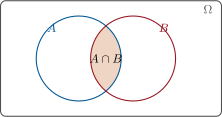
Two overlapping events: in (A) + (B), the shaded intersection A ∩ B is counted twice, which explains the subtraction in the addition rule.
Two overlapping events: in P(A)+P(B)\P(A) + \P(B), the shaded intersection ABA \cap B is counted twice, which explains the subtraction in the addition rule.

Examples

Example 9.7

Draw one card from a standard 5252-card deck. Let AA: “the card is a heart” (1313 cards) and BB: “the card is a king” (44 cards). Then ABA \cap B is “the king of hearts” (11 card), and

P(AB)=1352+452152=1652=413.\P(A \cup B) = \frac{13}{52} + \frac{4}{52} - \frac{1}{52} = \frac{16}{52} = \frac{4}{13}.

The complement rule is often the fastest route: the probability that the card is not a heart is 11352=341 - \frac{13}{52} = \frac34.

Example 9.9

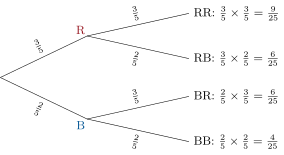
An urn contains 33 red balls and 22 blue balls. Draw one ball, put it back, draw again. Each draw gives red (R) with probability 35\frac35 and blue (B) with probability 25\frac25.

The tree of two draws with replacement. The four path probabilities sum to 1.
The tree of two draws with replacement. The four path probabilities sum to 11.

The probability of getting two balls of the same color is P(RR)+P(BB)=925+425=1325\P(\text{RR}) + \P(\text{BB}) = \frac{9}{25} + \frac{4}{25} = \frac{13}{25}; the probability of at least one blue is 1P(RR)=1925=16251 - \P(\text{RR}) = 1 - \frac{9}{25} = \frac{16}{25} (complement rule).

Read in context →