Definition 9.2High School Mathematics · Chapter 9 — Probability and Sampling
Assigning to each outcome ωi a number pi≥0, with p1+⋯+pn=1, defines a probability: the probability P(A) of an eventA is the sum of the pi of the outcomes in A. In particular P(Ω)=1 and the impossible event∅ has probability 0.
Examples
Example 9.4
Roll a fair die: Ω={1,2,3,4,5,6}, each outcome having probability61. The eventA: “the result is even” is A={2,4,6}, so P(A)=63=21. The eventB: “the result is at least 5” is B={5,6}, so P(B)=62=31.
Example 9.7
Draw one card from a standard 52-card deck. Let A: “the card is a heart” (13 cards) and B: “the card is a king” (4 cards). Then A∩B is “the king of hearts” (1 card), and
P(A∪B)=5213+524−521=5216=134.
The complement rule is often the fastest route: the probability that the card is not a heart is 1−5213=43.
Example 9.9
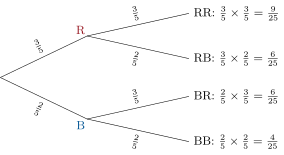
An urn contains 3 red balls and 2 blue balls. Draw one ball, put it back, draw again. Each draw gives red (R) with probability53 and blue (B) with probability52.
The tree of two draws with replacement. The four path probabilities sum to 1.
The probability of getting two balls of the same color is P(RR)+P(BB)=259+254=2513; the probability of at least one blue is 1−P(RR)=1−259=2516 (complement rule).
 Coach
Coach