
Mathematics · Glossary

What is Linear function?

Also known as: proportionality

Definition 67.1 Primary & Middle School Mathematics · Chapter 67 — Linear and Affine Functions

A linear function multiplies every number by a fixed number aa:

f(x)=ax.f(x) = a x .

The number aa is the coefficient of ff. Two quantities are proportional exactly when one is a linear function of the other.
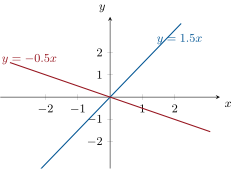
Two linear functions: both graphs pass through the origin; the coefficient a is the height reached at x = 1.
Two linear functions: both graphs pass through the origin; the coefficient aa is the height reached at x=1x = 1.

Examples

Example 67.2

If apples cost 33 per kilogram, the price of xx kilograms is f(x)=3xf(x) = 3x: buying twice as much costs twice as much, and the price of 2.52.5 kg is f(2.5)=7.5f(2.5) = 7.5.

Conversely, if a linear function satisfies f(4)=10f(4) = 10, then a=104=2.5a = \frac{10}{4} = 2.5 and f(x)=2.5xf(x) = 2.5x: one value determines a linear function completely.

Read in context →