Mathematics · Glossary

What is lp?

Definition 8.3 University Mathematics — Year 3 · Chapter 8 — Banach Spaces and the Fundamental Theorems

The classical sequence spaces (over KK, indexed by N\N):

p={x=(xn):xp=(nxnp)1/p<}(1p<),\ell^p = \Bigl\{x = (x_n) : \norm x_p = \Bigl(\sum_n \abs{x_n}^p\Bigr)^{1/p} < \infty\Bigr\}\quad (1 \leq p < \infty),
={x:x=supxn<},\ell^\infty = \{x : \norm x_\infty = \sup\abs{x_n} < \infty\},

and c0={x:xn0}c_0 = \{x : x_n \to 0\} with \norm\cdot_\infty. That p\norm\cdot_p is a norm follows from the Minkowski inequality, proved in the discrete case exactly as in Chapter 12 (or by summing the finite-dimensional inequality of Year 2). All are Banach spaces, and c0c_0 is a closed subspace of \ell^\infty (Exercise 8.3).

Unit balls of the p-norms in the plane, nested as p grows from 1 (diamond) through 2 (disc) and 4 (superellipse) to ∈fty (square). Convexity of every ball is the Minkowski inequality; the corners at p = 1 and p = ∈fty are where strict convexity, uniqueness of best approximations, and the equality cases of  all degenerate at once.
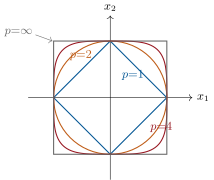
Unit balls of the pp-norms in the plane, nested as pp grows from 11 (diamond) through 22 (disc) and 44 (superellipse) to \infty (square). Convexity of every ball is the Minkowski inequality; the corners at p=1p = 1 and p=p = \infty are where strict convexity, uniqueness of best approximations, and the equality cases of Exercise 12.12 all degenerate at once.
Read in context →