University Mathematics — Year 3 · Bachelor Year 3
8Banach Spaces and the Fundamental Theorems
Functional analysis studies infinite-dimensional normed spaces through the operators and functionals living on them. Its founding discovery is that completeness, via Baire’s theorem, forces strong uniformity: pointwise bounded families of operators are norm-bounded (Banach–Steinhaus), continuous bijections have continuous inverses (open mapping), and graphs detect continuity (closed graph). The other pillar, Hahn–Banach, needs no completeness at all — only Zorn’s lemma — and guarantees that dual spaces are rich enough to see every vector. This chapter proves all four theorems and tests them on the classical sequence spaces , on concrete dual computations, and on a genuinely surprising application: there exist continuous -periodic functions whose Fourier series diverges at a point — resolving in the negative a question Year 2 left open.
Throughout, are normed spaces over or ; Banach space means complete normed space.
8.1 Bounded operators; sequence spaces
Definition 8.1
denotes the space of bounded (= continuous, Year 2) linear maps with the operator norm ; it is submultiplicative: . The dual is .
Proposition 8.2
If is a Banach space, so is ; in particular is always a Banach space.
Proof. Let be Cauchy for . For each , : is Cauchy in , convergent; call the limit . is linear (limits of linear identities); passing to the limit in () gives : in operator norm, and . ∎
Definition 8.3
The classical sequence spaces (over , indexed by ):
and with . That is a norm follows from the Minkowski inequality, proved in the discrete case exactly as in Chapter 12 (or by summing the finite-dimensional inequality of Year 2). All are Banach spaces, and is a closed subspace of (Exercise 8.3).
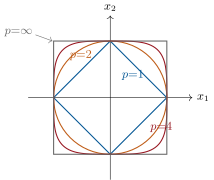
Proposition 8.4 (Neumann series)
Let be Banach and with . Then is invertible in , with (convergent in operator norm). Consequently the set of invertible operators is open, and inversion is continuous on it.
Proof. The series converges absolutely (, geometric) in the Banach (Proposition 8.2; Exercise 7.1(b)). Telescoping, , and similarly on the other side. For openness: if is invertible and , then with : invertible. Continuity of inversion: the series expression gives locally. ∎
Example 8.5 (A Volterra equation, solved by Neumann)
On , consider the integral equation
Here , so for the Neumann series applies directly: . Computing, , so
as differentiation confirms. Better: (the iterated kernel shrinks factorially), so converges for every — the operator is invertible for all , even though eventually: what matters is the spectral decay of the powers, not the first norm. Volterra operators have this factorial decay built in (Exercise 7.4(a) exploited exactly this), which is why initial value problems never suffer the resonance phenomena of boundary value problems (Chapter 15).
8.2 Hahn–Banach
Theorem 8.6 (Hahn–Banach, analytic form)
Let be a real vector space, sublinear ( and for ), a subspace and linear with on . Then extends to a linear with on .
Proof. One-step extension. Let ; we extend to by choosing correctly: we need, for all , ,
which after dividing by (sublinearity) reduce to
Such exists iff every left member is every right member: indeed , i.e. .
Zorn. Order the extensions of dominated by (pairs: subspace, functional) by extension; a chain has the union as upper bound; a maximal element must be defined on all of , else the one-step extension contradicts maximality. ∎
Corollary 8.7
Let be a normed space ( or ).
- Every ( a subspace) extends to with .
- For every there is with and . In particular separates the points of , and .
- For a closed subspace and , there is vanishing on with and .
Proof. (1) Real case: apply Theorem 8.6 with (sublinear); the extension satisfies , so , and is restriction. Complex case: let , a real functional with ; note (check on real and imaginary parts: ). Extend real-linearly with the same bound, and set : -linear (direct check on multiplication by ), extends ; norm: for given write , then .
(2) On define : norm on ; extend by (1). The duality formula: is clear, by this .
(3) On define ; then for , : on the subspace; extend by (1). ∎
Remark 8.8
By (2), the canonical map , , is an isometry (Exercise 8.10): every normed space sits inside its bidual. Spaces with surjective are called reflexive; the weekend problem shows () is reflexive while is not.
8.3 The Baire trilogy
Theorem 8.9 (Banach–Steinhaus, uniform boundedness)
Let be a Banach space, normed, and a family with for every . Then .
Proof. The sets are closed (intersections of preimages of closed balls) and cover . Baire (Theorem 7.6) gives and a ball . For : , so for every . ∎
Corollary 8.10
If is Banach and converge pointwise ( for each ), then , , and .
Proof. Convergent sequences are bounded: pointwise boundedness; Banach–Steinhaus bounds the norms by some ; then ( is linear as a pointwise limit), and the sharper bound by passing to in . ∎
Theorem 8.11 (Divergent Fourier series)
There exist continuous -periodic functions whose Fourier series diverges at : . Indeed such form a dense subset of .
Proof. Work in , a Banach space, with the functionals (Dirichlet kernel, Year 2). Each is continuous with
( is clear; : take continuous, , approximating — the sign has finitely many jumps; smoothing each jump on an interval of length changes the integral by .) The Lebesgue constants tend to infinity:
(using on , then substituting ). Cutting into arches:
If every continuous had , Banach–Steinhaus would force : contradiction. So some — in fact a nonmeagre, dense set of (the complement of , a countable union of closed sets which, having no interior by the above applied in any ball, is meagre) — has . ∎
Theorem 8.12 (Open mapping)
Let be Banach spaces and surjective. Then is open: for some . Consequently a bijective bounded operator between Banach spaces has a bounded inverse.
Proof. Write . Surjectivity gives ; Baire (Theorem 7.6) gives interior to : some . Re-center at : for , both and are limits of images , with , so with : , i.e. .
Removing the closure (here completeness of enters): let . Pick with ( scaled by ); inductively with . The series converges absolutely in the Banach , to (norm ), and by continuity: . Openness of on arbitrary opens follows by translation and scaling; for the corollary, openness of means is continuous. ∎
Corollary 8.13 (Equivalent norms)
If a vector space is complete for two comparable norms (), the norms are equivalent.
Proof. The identity is bounded and bijective between Banach spaces: its inverse is bounded. ∎
Theorem 8.14 (Closed graph)
Let be Banach and linear. If the graph is closed in (i.e. and imply ), then is bounded.
Proof. with is Banach; , a closed subspace, is Banach. The projection is bounded and bijective, so its inverse is bounded (Theorem 8.12): . ∎
Method 8.15
When to reach for which theorem. Hahn–Banach: to produce a functional with prescribed behavior (norming a vector, vanishing on a subspace, extending from a subspace) — no completeness needed. Banach–Steinhaus: to convert pointwise information into uniform bounds — typically to show a limit operation is continuous, or (contrapositive) to prove divergence for some element, as for Fourier series. Open mapping / closed graph: to get continuity for free from algebraic bijectivity or from a closure property of the graph — typical use: comparing two complete norms, or proving automatic continuity. All three Baire theorems require completeness of the source; counterexamples otherwise (Exercise 8.7).
8.4 Dual spaces, concretely
Theorem 8.16
Isometrically: and , via the pairing .
Proof. We prove ; the second identification is Exercise 8.5. To associate (): absolutely convergent, with , so . Conversely let ; set ( the unit sequences). For any , test (norm ; in the complex case use unimodular factors ): . So with . Finally : both agree on the , hence on finite sequences, dense in (truncation: precisely because ); continuous functionals agreeing on a dense set are equal. The correspondence is linear, bijective, and isometric ( from the two inequalities). ∎
8.5 Exercises
Exercise 8.1 ★
Compute the operator norms: (a) the shifts and on ; (b) the multiplication operator on , for ; (c) the functional on — show and that the norm is not attained.
Solution
Solution of Exercise 8.1.
(a) : is an isometry, . For the backward shift: , with equality for : .
(b) ; testing gives for every : .
(c) : . For let be on , on , affine between: and : . Not attained: with forces and , i.e. (continuity, ) on and on : contradiction at .
Exercise 8.2 ★
Let be Banach, invertible, and with . Show that is invertible and estimate . Application: if a linear system is solvable with invertible, a sufficiently small perturbation of keeps it uniquely solvable, with a quantitative bound on the change of solution.
Solution
Solution of Exercise 8.2.
Write with : by Proposition 8.4, is invertible with , whence
For the linear system: and differ by at most that bound times — small perturbations of an invertible system remain uniquely solvable, with Lipschitz dependence of the solution on the operator.
Exercise 8.3 ★★
(a) Prove that , and are Banach spaces, and that is the closure in of the space of finite sequences. (b) Show with for , and that the inclusion is strict.
Solution
Solution of Exercise 8.3.
(a) : let be Cauchy. Each coordinate is Cauchy (): let . Given , for : for every ; let , then : , and . : Cauchy for is uniformly Cauchy: converges uniformly to a bounded sequence. is closed in : if uniformly with , then gives : ; a closed subspace of a Banach space is Banach. Finite sequences: their closure contains every (truncations converge: ) and is contained in the closed .
(b) By homogeneity assume : then for all , so and ; for , directly. Strictness: with lies in (Riemann series).
Exercise 8.4 ★★
Let be a closed subspace and . Using Corollary 8.7, prove the duality formula
(note: a maximum). Deduce that : closed subspaces are exactly the intersections of kernels of functionals.
Solution
Solution of Exercise 8.4.
() If and : for every , ; take the infimum. (, attained) Corollary 8.7(3) produces with , , : the supremum is a maximum. Consequence: trivially, and a point is excluded from the intersection by the functional above (, being closed).
Exercise 8.5 ★★
Prove isometrically, following the scheme of Theorem 8.16 (finite sequences are dense in ). Where does the argument break for ?
Solution
Solution of Exercise 8.5.
For : , so ; testing on : : equality. Conversely, given , set : , so ; and agree on finite sequences, which are dense in (): . The map is linear, isometric, onto. For the same start produces a sequence , but finite sequences are not dense in (the constant sequence is at distance from all of them), so is not determined by the — and indeed (Problem 8.1).
Exercise 8.6 ★★
Let be normed with Banach, and bilinear, continuous in each variable separately. Show that is (jointly) continuous: . (Apply Banach–Steinhaus to the family .)
Solution
Solution of Exercise 8.6.
For each fixed , is continuous linear: . So the family (each member continuous, by continuity in ) is pointwise bounded on the Banach space : Banach–Steinhaus (Theorem 8.9) yields with for all ; homogeneity in finishes: .
Exercise 8.7 ★★
(a) On , compare and : the identity is bounded and bijective but its inverse is unbounded. Which hypothesis of Corollary 8.13 fails? (b) Exhibit a discontinuous linear map from a dense subspace of to (e.g. on finite sequences), and explain why this does not contradict the closed graph theorem.
Solution
Solution of Exercise 8.7.
(a) : the identity is bounded, and bijective. Its inverse is unbounded: has but . No contradiction with Corollary 8.13: is not complete (Exercise 7.1); the corollary requires completeness on both sides.
(b) On the space of finite sequences (dense in ), is linear and unbounded ( with ). The closed graph theorem does not apply: is not complete — and has no continuous extension to , illustrating that density without uniform continuity is powerless (Theorem 7.2).
Exercise 8.8 ★★★
(Hellinger–Toeplitz) Let be linear (everywhere defined) and symmetric: for all , where . Show that is bounded. (Closed graph: if and , test against arbitrary .) Moral: unbounded symmetric operators — the Hamiltonians of quantum mechanics — can never be defined on the whole space.
Solution
Solution of Exercise 8.8.
We verify the closed-graph hypothesis. Let and in . For every :
using continuity of the inner product in each slot (Cauchy–Schwarz) and symmetry twice. So is orthogonal to every , in particular to itself: . The graph is closed and is Banach: is bounded (Theorem 8.14). Hence a symmetric operator defined on all of is automatically bounded; genuinely unbounded symmetric operators (position, momentum, Hamiltonians) must live on proper dense subspaces.
Exercise 8.9 ★★★
(Polya’s theorem on quadrature) For each , let be a quadrature rule on (, ). Show that for every continuous if and only if: (i) for every polynomial , and (ii) . (Compute ; use Banach–Steinhaus and Weierstrass.) Check that rules with positive weights exact on constants satisfy (ii) automatically.
Solution
Solution of Exercise 8.9.
First, : is the triangle inequality; by testing a piecewise linear with and (interpolate linearly between the finitely many nodes; where nodes coincide the signs agree).
() Pointwise convergence at every implies (i), and pointwise boundedness, so Banach–Steinhaus (Theorem 8.9) on the Banach gives (ii).
() Let . Given and , choose a polynomial with (Corollary 7.16); then
Positive weights, exactness on constants: for rules exact on constants — (ii) holds with constant .
Exercise 8.10 ★★
Show that , , is a linear isometry (use Corollary 8.7(2)), and that it is surjective when . Show also that if is separable then so is . (Pick nearly norming a dense sequence of and show their closed span is , via Corollary 8.7(3).)
Solution
Solution of Exercise 8.10.
Linearity of is formal; by Corollary 8.7(2). If : (a basis gives coordinate functionals), so , and the injective (isometric) is onto. Separability: let be dense in and choose with . Let ; if , take , , vanishing on (Corollary 8.7(3)); choose :
so : contradiction. Hence , and rational (or ) combinations of the form a countable dense set.
Exercise 8.11 ★★
(Quotient spaces) Let be a Banach space and a closed subspace. On define
(a) Show this is a well-defined norm on (where does closedness of enter?), and that the projection has and maps the open unit ball onto the open unit ball. (b) Show that is complete. (Use the series criterion of Exercise 7.1(b): given classes with , lift each to with and sum in .) (c) Compute: for (convergent sequences) and , show isometrically via .
Solution
Solution of Exercise 8.11.
(a) Well defined: depends only on (translating by does not change the distance). Homogeneity and triangle inequality pass from through the infimum. Separation needs closedness: means , i.e. , i.e. . : . Open ball onto open ball: if , some representative has ; conversely by the norm inequality — so is open, the model case of the open mapping theorem.
(b) Let and lift with : then , so converges in the Banach (Exercise 7.1(b)), and continuity of gives : every absolutely convergent series of converges, which is equivalent to completeness (same exercise).
(c) The map is linear , vanishes exactly on , so it induces a linear bijection . Isometry: — : subtract from the sequence , leaving of norm ; : for , .
Exercise 8.12 ★★
(Bounded projections and complemented subspaces) Let be a Banach space and linear with (an algebraic projection), , . (a) Suppose is bounded. Show that and are closed and with the decomposition . (b) Conversely, suppose with both closed, and let be the projection onto along . Show that is bounded. (Closed graph: if and , then , , and uniqueness of the decomposition identifies .) (c) Deduce the equivalence: a subspace admits a bounded projection iff it is closed and has a closed algebraic complement — and note (without proof) that closed subspaces without this property exist ( inside is the classical example): Hilbert spaces, where always works (Chapter 13), are the exception, not the rule.
Solution
Solution of Exercise 8.12.
(a) is closed (preimage of under a continuous map); (indeed iff , using ), closed likewise. Every splits as with , , and (): .
(b) The graph argument: let and . Then ( closed, ) and ( closed). So with , ; by uniqueness of the decomposition, . The graph of is closed, is Banach: is bounded (Theorem 8.14).
(c) (a) and (b) together are the equivalence. In a Hilbert space every closed has the closed complement (Chapter 13): every closed subspace is complemented. In general Banach spaces this fails — has no closed complement in (Phillips’ theorem, beyond our tools) — so bounded projections are a privilege, and the closed graph theorem is exactly the bookkeeping that converts geometric splittings into bounded operators.
8.6 Problem: the duality of the spaces
Problem 8.1
Weekend problem — , reflexivity, and the strangeness of
Fix and let be the conjugate exponent, . The pairing throughout is .
Part I — Hölder and Minkowski for sequences.
- (Young’s inequality) For show , using concavity of or by studying .
- (Hölder) Deduce: for , ; identify the equality case.
- (Minkowski) Deduce the triangle inequality for . (Write and apply Hölder to each term.)
- Prove that is complete and that the finite sequences are dense in it.
Part II — The duality .
- For , show that defines with , and, testing on (suitably truncated and normalized), that .
- Conversely, given , set ; show with (test on truncations as in question 5 and let the truncation length grow), and conclude : the map is an isometric isomorphism .
- Deduce that is reflexive for : composing the two dualities, every element of comes from ; verify carefully that the composite is the canonical .
Part III — and are different animals.
- Show that () and are separable, but is not. (The uncountably many indicator sequences of subsets of are pairwise at distance .)
- Deduce from Exercise 8.10 that but : is not reflexive. (If were , it would be separable, forcing separable.)
- (A Banach limit, explicitly) On , let . Show that is sublinear, and that on the subspace of convergent sequences, satisfies . Extend by Hahn–Banach to and show: is positive (), shift-invariant (), extends the limit, and satisfies .
- Show that such a , viewed in , is not of the form for any ; conclude again . (Evaluate on the unit sequences , then on the constant sequence .)
- Evaluate on , and show that no shift-invariant multiplicative extension of the limit can exist (consider and where is the shift).
Part IV — Epilogue: why reflexivity matters.
- Using Corollary 8.10 and question 6, show that every bounded sequence of () has a subsequence that converges weakly: converges for every . (Diagonal extraction on the countably many coordinates; identify the weak limit in using uniform boundedness of norms and Hölder.) Show by example ( in , against well-chosen elements of ) that this fails in : weak compactness is a privilege of reflexive spaces.
Part V — The weak topology at work, and Schur’s surprise. Write in a normed space (weak convergence) when for every .
- Complete the census: show isometrically, by the scheme of questions 5–6 (what replaces the test sequences?). Assemble the chain of successive duals and mark where reflexivity fails.
- Show that every weakly convergent sequence of a Banach space is bounded: view the through the canonical embedding as functionals on and apply Banach–Steinhaus (Theorem 8.9) — on which Banach space, and why is completeness available there?
- Show that in , : iff and for every coordinate (one direction uses Banach–Steinhaus through the canonical embedding; for the other, approximate by finite sequences). Deduce in while : weak limits can lose mass.
- Show that the norm is weakly lower semicontinuous: implies (pick a norming functional for , Corollary 8.7).
- (Radon–Riesz in ) Show that in , weak convergence together with convergence of norms implies norm convergence (expand ). Give a counterexample to the same statement without the norm hypothesis.
(Schur, step 1) Let in and suppose, for contradiction, along a subsequence. Show first that for each (which functionals?), then construct recursively indices and integers such that the mass of concentrates on the block :
- (Schur, step 2) Define by for . Show and derive a contradiction with . Conclude Schur’s theorem: in , weakly convergent sequences converge in norm.
- Deduce that has no weakly convergent subsequence in (its only candidate limit is , coordinatewise — then apply Schur), recovering question 13’s failure of weak compactness; and resolve the apparent paradox: in weak and norm convergence of sequences coincide, yet the weak and norm topologies differ and bounded sets still fail to be weakly sequentially compact — no contradiction, only the failure of reflexivity.
- (Synthesis table) For , tabulate: the dual; separability; reflexivity; whether bounded sequences admit weakly convergent subsequences; and one signature property of each space, justified in one line from this problem.
Part VI — Complements: nearest points, averaged convergence, the value of a Banach limit.
- (Nearest points: a dividend of reflexivity) Let be a closed subspace of () and . Show that is attained: extract from a minimizing sequence a weakly convergent subsequence (question 13), keep the weak limit inside by building, via Hahn–Banach, a functional vanishing on but not at a point outside it, and conclude with question 17. Then show the privilege is not universal: in , for , prove is not attained on the unit ball, establish the distance formula , and deduce that no has a nearest point in the closed hyperplane .
(Banach–Saks in ) Let in with . Construct a subsequence with for all , and deduce
after extraction, the Cesàro means converge in norm. Check on , whose means have norm : weak convergence, useless for the sequence itself (question 16), becomes norm convergence for averages.
- (The value of a Banach limit) Let be any Banach limit (question 10) and . Show and ; deduce that all Banach limits agree on periodic sequences, with value the mean over a period — on , consistent with question 12’s . Then show agreement fails in general: for the block sequence equal to on for even and elsewhere, show that the Cesàro means oscillate between and , and build two Banach limits with (extend from with the extreme admissible values : check that is dominated by the sublinear of question 10).
Solution
Solution of Problem 8.1.
1. For : by concavity of , ; exponentiate. (If the inequality is trivial.) Equality iff .
2. We may assume (homogeneity; zero cases trivial). Then
Equality requires for all (Young’s equality case) and alignment of the phases of .
3. ; summing and applying Hölder ( against , noting ):
if (else trivial), divide by and use . (Finiteness of first: .)
4. Completeness: as for (Exercise 8.3), coordinatewise limits plus the uniform tail bound , letting then tend to infinity. Density of finite sequences: .
5. Hölder gives : . Testing: let for , beyond (with the unimodular phase, so that ). Then and (as ), so
6. Set . With the same test vectors, , whence for every : , . The functionals and agree on the dense finite sequences (question 4): . With question 5, is an isometric isomorphism .
7. Let . Composing with the isometry of question 6, defines an element of , which (question 6 with swapped) is for a unique : for every , . On the other hand : the same value. Since every element of is some , : is onto — is reflexive.
8. Finite sequences with rational (real and imaginary) entries are countable and dense in () and in . In : the family is uncountable with for ; the balls are pairwise disjoint, and a dense set must meet each: no countable dense set exists.
9. If were reflexive, then would be separable (isometric image of the separable ); by Exercise 8.10, the separability of the dual would force separable — contradicting question 8. So is not reflexive (and is strictly larger than , as question 11 makes concrete).
10. Homogeneity of is clear; subadditivity: averages are linear, and . On : the Cesàro means of a convergent sequence converge to its limit, so there; in particular on . Hahn–Banach (Theorem 8.6) extends to with globally. Positivity: for , . Shift-invariance: the averages of telescope to , so and . Bounds: (averages lag behind sups), and applying this to gives the lower bound.
11. , so for all . If with , then for all : ; but . So : , again.
12. For : , so : . If were a shift-invariant multiplicative extension of the limit: gives , so ; but gives : contradiction. Averaging and multiplication cannot coexist.
13. Let . Coordinates are bounded by : a diagonal extraction gives a subsequence (still written ) with for every . Then : for all . Weak convergence: for and arbitrary,
where the first term tends to as (finitely many coordinates) and the second is small for large (Hölder on the tail): for every — weak convergence, since every functional is a (question 6). In this fails: consider , bounded. Any subsequence converges coordinatewise to , so its only weak limit candidate is ; but testing against defined by (and elsewhere), diverges. No weakly convergent subsequence: weak sequential compactness of balls characterizes the reflexive world.
14. For , is defined on with , and testing on gives : . Conversely, for put ; the same tests give , so , and on the dense finite sequences, hence everywhere. The chain of duals: , (Exercise 8.10), (questions 9–11): reflexivity fails at the very first step — — and never recovers.
15. is a family of bounded functionals on the Banach space (duals are complete, Proposition 8.2); for each , the sequence converges, hence is bounded. Banach–Steinhaus on gives , and is isometric (Remark 8.8): .
16. () Boundedness is question 15; coordinates are the functionals . () Let , , ; choose with . Then
and the finite sum tends to : for every . (That with follows from Fatou-style finite-section bounds: .) For in : bounded, coordinatewise , so , yet : the unit of mass escapes to infinite index, invisible to every fixed functional.
17. Take with and (Corollary 8.7). Then . (With : , and the inequality can be strict.)
18. In , (real case: ). Weak convergence applied to the functional gives , and the norms converge by hypothesis: the right side tends to . Counterexample without norm convergence: , .
19. Coordinate convergence: apply the functionals (). Construction: having chosen , pick so large that (finitely many coordinates, each ), then so large that the tail satisfies (convergence of the series defining ). The block then carries all but of the mass of .
20. With as defined ( everywhere):
the middle inequality because the mass off the block is at most (question 19). But and force : contradiction. Hence weakly null sequences of are norm-null, and by translation weakly convergent ones converge in norm: Schur’s theorem.
21. A weakly convergent subsequence of would have limit (coordinates), hence by Schur — but the norms are . So no weakly convergent subsequence exists, as found by hand in question 13. No paradox: Schur says sequences cannot distinguish the weak from the norm topology in (the topologies themselves do differ — weak neighborhoods are never norm-bounded), and weak sequential compactness of the unit ball is a different, stronger property, equivalent to reflexivity (Eberlein–Šmulian, beyond our tools; the failure, at least, we have proved).
22. The census.
| sep. | refl. | weak seq. cpt. balls | ||
|---|---|---|---|---|
| yes | no | no () | ||
| yes | no | no (, q. 21) | ||
| yes | yes | yes (q. 13) | ||
| no | no | no |
Signatures: — its bidual is : the first non-reflexive step (question 14); — Schur’s property (question 20); — reflexivity and weak compactness (questions 7, 13); — non-separability and Banach limits: functionals no sequence can represent (questions 8, 10–11). One family of spaces, four different worlds.
23. Let with . Then : bounded, so by question 13 a subsequence . If , then ( closed); on the linear form satisfies (because ), and Hahn–Banach extends it to with , ; but then : contradiction. So , and gives, by question 17,
the distance is attained at . In : for every (a nonzero null sequence cannot satisfy for all ), while the truncated ones give : so , never attained. Distance formula: for , , so ; conversely, for in the unit ball with , the vector lies in with : equality. If some attained it, would satisfy , so would attain its norm at : impossible. A closed hyperplane of with no nearest points anywhere — reflexivity was not decorative.
24. Set . Given , each map tends to (), so there is beyond the previous index with for ; call the choice . Then
and dividing by : . (For a weak limit , apply this to .) On the orthonormal no extraction is even needed: . Averages convert weak convergence into norm convergence: the Banach–Saks property of .
25. , so linearity and shift-invariance give . For any bounded and , pick with for ; positivity applied to and give , and symmetrically : hence for every . If is -periodic, is the constant sequence equal to the period mean : for every Banach limit — on , on as in question 12. For the block sequence: at with even the last block is all ones, so the Cesàro mean is ; at with odd all the ones sit in , so the mean is . Hence and . On define . Domination by : for , sublinearity gives , i.e. (note for : Cesàro means of a convergent sequence converge to its limit); for , gives ; for there is equality. So on , and Hahn–Banach extends it to on , which is a Banach limit exactly as in question 10 (domination by yields positivity, shift-invariance, and the value on ), with . The same computation with (using for the case ) yields a Banach limit with . Two Banach limits, one sequence, two values: outside the periodic (and, more generally, almost convergent) world, a Banach limit is a genuine choice.