
Mathematics · Glossary

What is polar curve?

Definition 24.6 University Mathematics — Year 1 · Chapter 24 — Plane Curves

A polar curve is given by r=r(θ)r = r(\theta): the point of parameter θ\theta is

M(θ)=r(θ)u(θ),u(θ)=(cosθ,sinθ).M(\theta) = r(\theta)\,\vec u(\theta), \qquad \vec u(\theta) = (\cos\theta, \sin\theta).

With v(θ)=(sinθ,cosθ)=u(θ)\vec v(\theta) = (-\sin\theta, \cos\theta) = \vec u\,'(\theta), the velocity is

M(θ)=r(θ)u(θ)+r(θ)v(θ).M'(\theta) = r'(\theta)\, \vec u(\theta) + r(\theta)\, \vec v(\theta) .

Consequences: where r0r \neq 0, the point is regular, and the tangent makes with the ray the angle VV given by tanV=rr\tan V = \frac{r}{r'} (angle between MM' and u\vec u); where r(θ0)=0r(\theta_0) = 0, the curve passes through the origin with tangent the ray θ=θ0\theta = \theta_0 (direction u(θ0)\vec u(\theta_0), read off M(θ0)=r(θ0)u(θ0)M'(\theta_0) = r'(\theta_0)\vec u(\theta_0), or from the limit chord: the chord from OO to M(θ)M(\theta) is carried by u(θ)\vec u(\theta) itself, which tends to u(θ0)\vec u(\theta_0) — so the rule holds even when r(θ0)=0r'(\theta_0) = 0 and the point is singular, which is why polar cusps at the origin, like the cardioid’s, get their tangent for free).
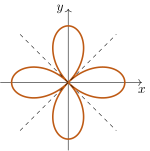
The four-petaled rose r = 2 (). The petals along the y-axis are traced with r < 0 (the point plots on the ray opposite to ); the dashed diagonals = ± π4 are the tangents at the origin, where r vanishes.
The four-petaled rose r=cos2θr = \cos 2\theta (Exercise 24.4). The petals along the yy-axis are traced with r<0r < 0 (the point plots on the ray opposite to θ\theta); the dashed diagonals θ=±π4\theta = \pm\frac\pi4 are the tangents at the origin, where rr vanishes.
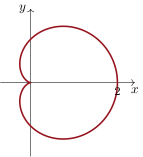
The cardioid r = 1 +. Polar curves are read by sweeping the angle: the radius swells and shrinks as  turns.
The cardioid r=1+cosθr = 1 + \cos\theta. Polar curves are read by sweeping the angle: the radius swells and shrinks as θ\theta turns.

Examples

Example 24.7 (The cardioid)

r(θ)=1+cosθr(\theta) = 1 + \cos\theta. Symmetry: r(θ)=r(θ)r(-\theta) = r(\theta): reflection in the xx-axis; study θ[0,π]\theta \in \intcc{0}{\pi}. rr decreases from 22 to 00; at θ=π\theta = \pi, r=0r = 0: the curve reaches the origin tangentially to the ray θ=π\theta = \pi (the xx-axis), forming a cusp there — the heart’s point. Tangent at θ=0\theta = 0: r=0r' = 0, so tanV=\tan V = \infty: perpendicular to the axis.

The angle VV deserves one more reading. At θ=π2\theta = \frac\pi2: r=1r = 1 and r=1r' = -1, so tanV=rr=1\tan V = \frac{r}{r'} = -1: the tangent makes three-quarters of a right angle with the outgoing ray — the curve is already bending back toward its cusp. The formula tanV=r/r\tan V = r/r' delivers tangent directions along the whole curve with no computation of M(θ)M'(\theta) whatsoever: it is the polar analogue of reading a slope.

Example 24.8 (Polar to cartesian: a hidden circle)

What is the polar curve r=2cosθr = 2\cos\theta? Multiply by rr: r2=2rcosθr^2 = 2r\cos\theta, i.e. x2+y2=2xx^2 + y^2 = 2x, i.e.

(x1)2+y2=1:(x - 1)^2 + y^2 = 1 :

the circle of center (1,0)(1, 0) and radius 11, passing through the origin. Bookkeeping matters: as θ\theta runs over (π2,π2]\intoc{-\frac\pi2}{\frac\pi2} the whole circle is swept exactly once (rr vanishes at both ends), and at θ=±π2\theta = \pm\frac\pi2 the rule “tangent at the origin along the ray θ=θ0\theta = \theta_0” gives a vertical tangent there — matching the geometry, since the vertical axis is indeed tangent to this circle at OO. For θ\theta beyond that range, r<0r < 0 retraces the same circle: a reminder that a polar curve is a parametrized object, allowed to pass over itself.

Read in context →