Mathematics · Glossary

What is Probability?

Definition 71.5 Primary & Middle School Mathematics · Chapter 71 — Statistics and Probability

A random experiment has several possible outcomes; an event is a set of outcomes. Each outcome gets a probability: a number between 00 and 11, with all the probabilities of the outcomes summing to 11; the probability P(A)\P(A) of an event AA is the sum of the probabilities of its outcomes. When all nn outcomes are equally likely,

P(A)=number of favorable outcomesn.\P(A) = \frac{\text{number of favorable outcomes}}{n}.

Examples

Example 71.6

A wheel is split into 88 equal sectors: 33 red, 33 blue, 22 green. Each sector has probability 18\frac18, so

P(red)=38,P(green)=28=14,P(not green)=114=34.\P(\text{red}) = \frac38, \qquad \P(\text{green}) = \frac28 = \frac14, \qquad \P(\text{not green}) = 1 - \frac14 = \frac34 .

Example 71.9

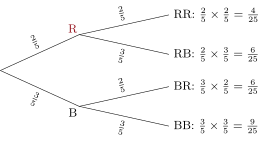
A bag holds 22 red and 33 black tokens. Draw one token, note its color, put it back, draw again. Each draw gives red with probability 25\frac25, black with probability 35\frac35.

The tree of the two draws with replacement: multiply along the branches, and check that the four paths sum to 1.
The tree of the two draws with replacement: multiply along the branches, and check that the four paths sum to 11.

Probability of two tokens of the same color: 425+925=1325\frac{4}{25} + \frac{9}{25} = \frac{13}{25}. Probability of at least one red: 1P(BB)=1925=16251 - \P(\text{BB}) = 1 - \frac{9}{25} = \frac{16}{25}.

Read in context →