Mathematics · Glossary

What is projection?

Also known as: symmetry

Definition 20.14 University Mathematics — Year 1 · Chapter 20 — Linear Maps

Let E=FGE = F \oplus G. The projection onto FF along GG maps x=f+gx = f + g (unique decomposition) to p(x)=fp(x) = f; the associated symmetry is s(x)=fgs(x) = f - g. Both are linear, and s=2pids = 2p - \mathrm{id}.

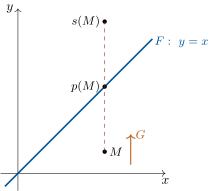
The projection onto F = Vect(1,1) along G = Vect(0,1) and its symmetry, on the point M = (2,\ 0.5): sliding vertically, M hits F at p(M) = (2,2) and lands at s(M) = 2p(M) - M = (2,\ 3.5), as far above F (measured along G) as M was below.
The projection onto F=Vect(1,1)F = \operatorname{Vect}(1,1) along G=Vect(0,1)G = \operatorname{Vect}(0,1) and its symmetry, on the point M=(2, 0.5)M = (2,\ 0.5): sliding vertically, MM hits FF at p(M)=(2,2)p(M) = (2,2) and lands at s(M)=2p(M)M=(2, 3.5)s(M) = 2p(M) - M = (2,\ 3.5), as far above FF (measured along GG) as MM was below.

Examples

Example 20.16 (A projection and its symmetry, explicitly)

In R2\R^2, project onto F=Vect(1,1)F = \operatorname{Vect}(1,1) along G=Vect(0,1)G = \operatorname{Vect}(0,1). Decompose (x,y)=a(1,1)+b(0,1)(x, y) = a(1,1) + b(0,1): the first coordinate gives a=xa = x, the second b=yxb = y - x. Hence

p(x,y)=(x,x),s(x,y)=2p(x,y)(x,y)=(x, 2xy).p(x, y) = (x, x), \qquad s(x, y) = 2p(x,y) - (x,y) = (x,\ 2x - y).

Check the algebra: p(p(x,y))=p(x,x)=(x,x)p(p(x,y)) = p(x,x) = (x,x), and s(s(x,y))=s(x,2xy)=(x,2x(2xy))=(x,y)s(s(x,y)) = s(x, 2x - y) = (x, 2x - (2x - y)) = (x, y). Geometrically, ss is the “oblique reflection” across the line y=xy = x in the vertical direction: it fixes FF pointwise and reverses GG. Had we projected onto the same FF along G=Vect(1,1)G' = \operatorname{Vect}(1,-1) instead, the formula would change to p(x,y)=(x+y2,x+y2)p'(x,y) = \bigl(\frac{x+y}2, \frac{x+y}2\bigr): a projection is determined by its image and its kernel, never by the image alone.

Read in context →