Mathematics · Glossary

What is radius of curvature?

Also known as: center of curvature · osculating circle

Definition 18.14 University Mathematics — Year 2 · Chapter 18 — Curves

When κ(s)0\kappa(s) \neq 0, the radius of curvature is R(s)=1/κ(s)R(s) = 1/\abs{\kappa(s)} and the center of curvature is γ~(s)+1κ(s)N(s)\tilde\gamma(s) + \frac{1}{\kappa(s)} N(s); the circle with that center and radius R(s)R(s) is the osculating circle, the best circular approximation of the curve at γ~(s)\tilde\gamma(s).

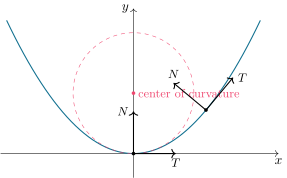
The parabola y = x2/2, its moving Frenet frame (T, N), and the osculating circle at the vertex (radius 1, since (0) = 1). The frame turns as the point moves; curvature is the rate of that turning per unit of arc length.
Figure 18.1. The parabola y=x2/2y = x^2/2, its moving Frenet frame (T,N)(T, N), and the osculating circle at the vertex (radius 11, since κ(0)=1\kappa(0) = 1). The frame turns as the point moves; curvature is the rate of that turning per unit of arc length.

Examples

Example 18.15 (The osculating circle of the exponential)

For y=exy = \eu^x at the point (0,1)(0, 1): f(0)=f(0)=1f'(0) = f''(0) = 1, so by the graph formula below,

κ(0)=1(1+1)3/2=122,R=22.\kappa(0) = \frac{1}{(1 + 1)^{3/2}} = \frac1{2\sqrt2}, \qquad R = 2\sqrt2 .

The unit tangent is T=(1,1)2T = \frac{(1, 1)}{\sqrt2}, the direct normal N=(1,1)2N = \frac{(-1, 1)}{\sqrt2}, and the center of curvature is

(0,1)+22(1,1)2=(2, 3):(0, 1) + 2\sqrt2\cdot\frac{(-1, 1)}{\sqrt2} = (-2,\ 3) :

the osculating circle has equation (x+2)2+(y3)2=8(x + 2)^2 + (y - 3)^2 = 8. As a check of the “best circular approximation” claim: solving the circle’s equation for yy near (0,1)(0,1) and expanding gives y=1+x+x22+O(x3)y = 1 + x + \frac{x^2}2 + O(x^3) — exactly the second-order Taylor expansion of ex\eu^x. The osculating circle matches value, slope and second derivative; an ordinary tangent circle would match only the first two.

Example 18.16 (The evolute of a circle is its center)

For the circle of radius RR traversed counterclockwise, κ=1/R\kappa = 1/R and NN points toward the center, so the center of curvature γ~+1κN\tilde\gamma + \frac1\kappa N is the center of the circle, for every ss: the osculating circle of a circle is the circle itself, and the locus of centers of curvature collapses to a point. This degenerate case calibrates Exercise 18.6: there the evolute’s velocity is κκ2N-\frac{\kappa'}{\kappa^2}N, which vanishes identically precisely when κ\kappa is constant.

Example 18.18 (Circle, line, parabola)

A line has κ=0\kappa = 0 (and conversely: T=0T' = 0 means TT constant, so γ~(s)=γ~(0)+sT\tilde\gamma(s) = \tilde\gamma(0) + sT, a line). The circle of radius RR traversed counterclockwise has κ=1/R\kappa = 1/R: with γ(t)=(Rcost,Rsint)\gamma(t) = (R\cos t, R\sin t), the formula gives κ=R2/R3\kappa = R^2/R^3. For the parabola y=x2/2y = x^2/2: κ(x)=1/(1+x2)3/2\kappa(x) = 1/(1 + x^2)^{3/2}, maximal at the vertex — the parabola is most sharply bent where it turns around.

Read in context →