Mathematics · Glossary

What is Scale?

Definition 49.7 Primary & Middle School Mathematics · Chapter 49 — Proportionality

On a map or model at scale 1n\frac{1}{n} (written 1:n1 : n), the distances on the map are proportional to the real distances, with coefficient 1n\frac1n:

map distance=1n×real distance,\text{map distance} = \frac{1}{n} \times \text{real distance},

both measured in the same unit.

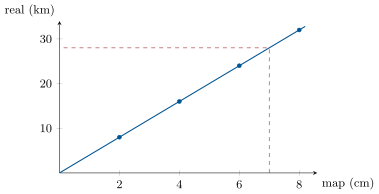
A scale is a proportionality: map distances against real distances line up on a straight line through the origin (here 1 cm  4 km; the dashes read 7 cm  28 km).
A scale is a proportionality: map distances against real distances line up on a straight line through the origin (here 11 cm \leftrightarrow 44 km; the dashes read 77 cm \leftrightarrow 2828 km).

Examples

Example 49.8

On a 1:500001 : 50\,000 map, two towns are 77 cm apart. Real distance:

7×50000=350000 cm=3500 m=3.5 km.7 \times 50\,000 = 350\,000 \text{ cm} = 3\,500 \text{ m} = 3.5 \text{ km}.

Conversely, a 1212 km hiking trail measures on the map 1212 km =1200000= 1\,200\,000 cm, so 1200000÷50000=241\,200\,000 \div 50\,000 = 24 cm.

Read in context →