Primary & Middle School Mathematics · Grades 1–9
49Proportionality
Grade 6 met proportional tables (Chapter 44); this chapter turns proportionality into a fully-fledged tool: the cross rule for finding a fourth value, percentages, and scales of maps and models. Speed, the most famous proportionality of all, is studied in Chapter 61.
49.1 Recognizing and completing tables
Definition 49.1 (Proportionality table)
A table of two rows is a proportionality table when the numbers of the second row are those of the first multiplied by one fixed number, the coefficient. Equivalently: all column quotients are equal.
Example 49.2
| top | |||
|---|---|---|---|
| bottom |
Quotients: , , : proportional, coefficient .
Theorem 49.3 (Cross rule)
In a proportionality table with columns and , the cross products are equal:
Consequently the fourth value can be computed from the three others: .
Proof. Let be the coefficient: and . Then
both cross products equal . Dividing by gives the formula for . ∎
Example 49.4 (Fourth proportional)
If identical books weigh kg, how much do such books weigh? Table and cross rule:
| books | ||
|---|---|---|
| kg |
Check by the unit: one book weighs kg, twelve weigh kg.
49.2 Percentages
Method 49.5 (Applying and finding percentages)
- Apply : multiply by ( of is );
- find the percentage that a part represents: compute and rewrite over ( out of : );
- always ask: a percentage of what? The reference whole matters.
Example 49.6
In a school, of the students are girls. Percentage:
The other way: how many are the boys? . Check: .
49.3 Scales
Definition 49.7 (Scale)
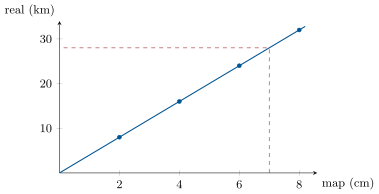
On a map or model at scale (written ), the distances on the map are proportional to the real distances, with coefficient :
both measured in the same unit.
Example 49.8
On a map, two towns are cm apart. Real distance:
Conversely, a km hiking trail measures on the map km cm, so cm.
Remark 49.9
Graphs are the quickest test of proportionality (Chapter 44): points on a straight line through the origin mean proportional quantities; a line missing the origin (like a taxi fare with a fixed charge) means not proportional, even though it is a straight line. Affine functions, in Chapter 67, will make this precise.
49.4 Exercises
Exercise 49.1 ★
Which tables are proportionality tables? Give the coefficient when it exists.
Solution
Solution of Exercise 49.1.
First table: quotients , , : proportional, coefficient .
Second table: and , but : not proportional.
Exercise 49.2 ★
Complete using the cross rule, writing the computation: kg of potatoes cost euros; how much do kg cost?
Solution
Solution of Exercise 49.2.
With the cross rule: , so euros.
Exercise 49.3 ★
A printer prints pages in minutes. At the same rate, how many pages in minutes? How long for pages?
Solution
Solution of Exercise 49.3.
Rate: pages per minute. In minutes: pages. For pages: minutes.
Exercise 49.4 ★
Compute: of ; of ; such that of is .
Solution
Solution of Exercise 49.4.
of : . of : . of is : , so .
Exercise 49.5 ★
Out of shots, a basketball player scored . What is her success percentage? (Rewrite the fraction over .)
Solution
Solution of Exercise 49.5.
.
Exercise 49.6 ★
On a map, a path measures cm. What is its real length in km? A lake is km long: how long is it on the map?
Solution
Solution of Exercise 49.6.
Path: cm km. Lake: km cm on the ground, so cm on the map.
Exercise 49.7 ★
A model car is built at scale . The real car is m long. How long is the model, in cm?
Solution
Solution of Exercise 49.7.
m cm, and cm.
Exercise 49.8 ★★
A recipe uses g of chocolate for servings. Aline has g of chocolate. For how many servings is that enough (whole number of servings)?
Solution
Solution of Exercise 49.8.
Chocolate per serving: g. With g: servings exactly.
Exercise 49.9 ★★
The price of a jacket drops from to euros.
- What is the discount in euros? In percent of the original price?
- Later the price goes back up from to euros. Explain why this rise is not — compute the correct percentage of increase.
Solution
Solution of Exercise 49.9.
1. Discount: euros, i.e. of the original price.
2. The rise of euros is now compared with the new reference : . A percentage always refers to a whole; the whole changed, so the percentage does too.
Exercise 49.10 ★★
Two rows of a table are proportional:
Find the coefficient, then and .
Solution
Solution of Exercise 49.10.
Coefficient from the complete column: . Then and .
Exercise 49.11 ★★★
A photocopier reduces documents to of their size. A segment of cm is copied, then the copy is copied again with the same setting.
- How long is the segment after one copy? After two?
- Why is the answer after two copies not of the original? What single percentage corresponds to two copies?
Solution
Solution of Exercise 49.11.
1. After one copy: cm. After two: cm.
2. The second reduction applies to the already-reduced copy, not to the original: the factors multiply, , so two copies reduce to of the original — not .
49.5 Problem: Measuring the Earth with a stick
Problem 49.1
Weekend problem — shadows are a proportionality, and how Eratosthenes computed the circumference of the Earth in 240 BC
Twenty-two centuries ago, with no telescope, no satellite and no calculator, the librarian of Alexandria measured the Earth — using a stick, a well, a camel caravan and this chapter’s mathematics. This problem retraces his steps: first the proportionality of shadows, then the famous computation itself, and finally what his answer looks like at human scale.
Part I — The shadow of a stick. The sun is so far away that its rays reach us parallel to one another. At a given moment, all vertical objects and their shadows are therefore proportional.
- At noon, a vertical stick of m casts a shadow of m, and a tree’s shadow measures m. How tall is the tree (Theorem 49.3)?
- At the same moment, a tower casts a m shadow: how tall is the tower? And how long is the shadow of a child m tall?
- Explain in one sentence why all these computations are valid only at the same moment of the day.
- Legend says Thales measured the Great Pyramid by waiting for the moment when his own shadow was exactly as long as he was tall. What is the proportionality coefficient at that moment, and how tall is the pyramid if the tip of its shadow lies m from the point of the ground directly below its apex?
- Summarize Part I: at one given moment, which quantity is the same for the stick, the tree, the tower and the pyramid (Definition 49.1)?
Part II — Eratosthenes’ computation. Eratosthenes knew two facts. In the town of Syene, at noon on the summer solstice, the sun stood exactly overhead: sunlight reached the bottom of the deepest wells, and vertical sticks cast no shadow. In Alexandria, km due north, at the same moment, a vertical stick did cast a shadow, and the sun’s rays made an angle of with the vertical.
- Explain why these two observations together prove that the ground of Syene and the ground of Alexandria are not parallel — that is, the Earth’s surface is curved. (What would parallel rays do to two sticks on a flat Earth?)
- On a drawing of the round Earth with parallel sun rays, the in Alexandria reappears at the center of the Earth, as the angle between the directions of the two cities. Make the drawing and convince yourself (the clean justification uses the equal-angle pairs of Chapter 51).
- What fraction of a full turn is ?
- The arc from Syene to Alexandria ( km) corresponds to ; the whole circumference corresponds to . Set up the proportionality and compute the circumference of the Earth.
- Deduce the diameter of the Earth, using (Proposition 43.3) and rounding to the nearest hundred kilometers. (The modern value is km — how close was a man with a stick in 240 BC?)
Part III — The Earth at human scale.
- A globe is built at scale . Using the circumference found in question 9, show that the globe’s circumference is exactly m. What is its diameter, to the nearest centimeter?
- Mont Blanc rises about km. Convert km to centimeters, divide by , and express the mountain’s height on the globe in millimeters. What does the answer say about how “bumpy” the Earth really is?
- A walker covers km per day. At that pace, how many days for Eratosthenes’ full circumference — and roughly how many years is that?
- The breathable atmosphere is concentrated in roughly the first km above the ground. What percentage of the Earth’s radius (about km) is that (Method 49.5)? Round to the nearest tenth of a percent.
- Historians estimate that Eratosthenes’ announced value, converted to modern units, may have been about km. Taking km as the true value, compute his percentage of error. Conclude in one sentence about sticks, wells and proportionality.
Solution
Solution of Problem 49.1.
1. Heights and shadows are proportional, so by the cross rule (Theorem 49.3), with the stick’s column and the tree’s : , hence m.
2. Tower: m. Child’s shadow: m (shadow height the moment’s coefficient ).
3. As the sun moves across the sky, the coefficient linking heights to shadows changes; only measurements taken at the same moment share the same coefficient.
4. At that moment the coefficient is : every height equals its shadow. The pyramid’s apex is therefore m high — the height of the Great Pyramid (its shadow’s tip, measured from the point below the apex, is all one needs).
5. The column quotient — the proportionality coefficient of the moment — is common to every vertical object: that is exactly what makes the table of heights and shadows a proportionality table (Definition 49.1).
6. Sun rays arrive parallel. On a flat Earth, two parallel rays would strike two vertical sticks at the same angle: both would cast proportional shadows — either both no shadow, or both a shadow. One stick with no shadow (Syene) and one with a shadow (Alexandria), at the same instant, is impossible on a flat Earth: the two verticals must point in different directions — the surface curves.
7. On the drawing, the Syene vertical points straight at the sun; the Alexandria vertical is tilted by the angle between the two city directions, seen from the center. Since the rays are parallel, that tilt is exactly the measured between ray and stick in Alexandria.
8. : one fiftieth of a full turn.
9. Arc lengths are proportional to angles: if — one fiftieth of the turn — corresponds to km, the full turn corresponds to
10. Diameter km — against the modern km: correct to well within one percent, with a stick.
11. km cm, and cm m of circumference. Diameter: cm — a handsome desk globe.
12. km cm, and cm mm. The highest mountain of the Alps is a tenth of a millimeter on a meter-round globe: a speck of dust. At this scale the Earth is smoother than most polished balls.
13. days, and : nearly three years of walking.
14. , that is about (more precisely ): the atmosphere is a whisper-thin skin on the planet.
15. Error: km, and . One sentence: with a stick, a well, a measured road and one proportionality, Eratosthenes measured a planet to within a few percent — mathematics travels far on very little.