
Mathematics · Glossary

What is Sign table?

Definition 2.15 High School Mathematics · Chapter 2 — Algebra: Equations and Inequalities

A sign table records, on one row per factor, the sign (++ or -) of each factor of an expression as xx runs over R\R, with a 00 at each value where the factor vanishes; a final row gives the sign of the product, using the rule of signs column by column.
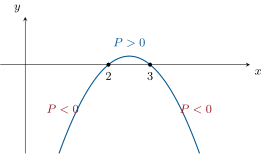
The graph of P(x) = (x-2)(3-x) confirms the sign table: positive between the roots 2 and 3, negative outside.
The graph of P(x)=(x2)(3x)P(x) = (x-2)(3-x) confirms the sign table: positive between the roots 22 and 33, negative outside.

Examples

Example 2.16

Sign of P(x)=(x2)(3x)P(x) = (x - 2)(3 - x). The factor x2x - 2 vanishes at 22 and is positive after; the factor 3x3 - x vanishes at 33 and is positive before:

xx-\infty 2233 ++\infty
x2x - 2-00++++
3x3 - x++++00-
P(x)P(x)-00++00-

So P(x)>0P(x) > 0 exactly on (2,3)\intoo{2}{3}, and P(x)0P(x) \leq 0 on (,2][3,+)\intoc{-\infty}{2} \cup \intco{3}{+\infty}.

Example 2.18

Solve x+1x30\dfrac{x + 1}{x - 3} \leq 0. The numerator vanishes at 1-1, the denominator at 33 (forbidden value). The quotient is negative when the two have opposite signs, which happens for xx between 1-1 and 33. Including the bound where the numerator vanishes but excluding the forbidden value: the solution set is [1,3)\intco{-1}{3}.

Read in context →