Algebra is the art of computing with letters. This chapter reviews and sharpens the two basic moves — expanding and factoring — and uses them to solve equations and inequalities systematically, with the sign table as the central tool.
2.1 Expanding and factoring
Definition 2.1(Expanding, factoring)
Expanding an expression means transforming products into sums; factoring means the reverse, transforming a sum into a product. The basic rule is distributivity:
Common factor: spot a factor present in every term and pull it out, e.g. 6x2+4x=2x(3x+2). The common factor can be a whole bracket: (x+1)(2x−3)+(x+1)(x+7)=(x+1)(3x+4).
Remarkable identity: recognize a2−b2, or a2±2ab+b2, e.g. 9x2−16=(3x)2−42=(3x+4)(3x−4).
Combine both, and check the result by expanding it back.
Example 2.6
Factor E=(2x+1)2−(x−3)2. This is a difference of two squares a2−b2 with a=2x+1 and b=x−3:
Mind the second bracket: subtracting x−3 means subtracting xand adding 3.
2.2 Equations
Definition 2.7(Equation, solution)
An equation is an equality containing an unknown number x; a solution is a value of x that makes the equality true. Solving the equation means finding all its solutions.
Two equations are equivalent when they have exactly the same solutions. Adding the same number to both sides, or multiplying both sides by the same nonzero number, produces an equivalent equation.
Example 2.8(First-degree equation)
Solve 5x−7=2x+8, one move at a time:
5x−75x−2x3xx=2x+8=8+7=15=5(add 7−2x to both sides)(divide both sides by 3).
The unique solution is 5. Check: 5×5−7=18 and 2×5+8=18.
Theorem 2.9(Zero-product rule)
A product of real numbers is zero if and only if at least one of its factors is zero:
A×B=0⟺A=0 or B=0.
Proof. If A=0 or B=0, the product is clearly 0. Conversely, suppose AB=0 and A=0. Dividing both sides by A gives B=0. ∎
Method 2.10(Solving by factoring)
To solve an equation whose right-hand side is 0 and whose left-hand side can be factored:
bring everything to the left so the equation reads E=0;
factor E into a product of first-degree factors;
apply the zero-product rule and solve each small equation;
collect all the solutions found.
Example 2.11
Solve (x−2)(3x+6)=0: either x−2=0, giving x=2, or 3x+6=0, giving x=−2. Solutions: −2 and 2.
Solve x2=9x. Do not divide by x (it could be zero!); bring everything to one side and factor:
x2−9x=0⟺x(x−9)=0⟺x=0 or x=9.
Example 2.12(Quotient equation)
Solve x+2x−1=0. A quotient is zero exactly when its numerator is zero and its denominator is not. Here x−1=0 gives x=1, and 1+2=3=0: the only solution is 1. The value x=−2 is forbidden (division by zero) and must always be excluded first.
2.3 Inequalities and sign tables
Proposition 2.13(Rules for inequalities)
Let a≤b.
For any c: a+c≤b+c (adding preserves the order).
If c>0: ac≤bc (multiplying by a positive number preserves the order).
If c<0: ac≥bc (multiplying by a negative number reverses the order).
Proof. 1. (b+c)−(a+c)=b−a≥0. 2. bc−ac=(b−a)c is the product of two nonnegative numbers, so bc≥ac. 3. Now (b−a)c≤0 as the product of a nonnegative and a negative number, so bc≤ac. ∎
Example 2.14
Solve −2x+3>9:
−2x+3−2xx>9>6<−3(subtract 3)(divide by −2<0: reverse the inequality).
The solution set is (−∞,−3).
Definition 2.15(Sign table)
A sign table records, on one row per factor, the sign (+ or −) of each factor of an expression as x runs over R, with a 0 at each value where the factor vanishes; a final row gives the sign of the product, using the rule of signs column by column.
Example 2.16
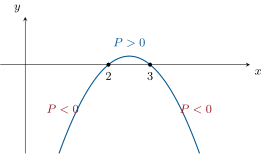
Sign of P(x)=(x−2)(3−x). The factor x−2 vanishes at 2 and is positive after; the factor 3−x vanishes at 3 and is positive before:
x
−∞
2
3
+∞
x−2
−
0
+
+
3−x
+
+
0
−
P(x)
−
0
+
0
−
So P(x)>0 exactly on (2,3), and P(x)≤0 on (−∞,2]∪[3,+∞).
The graph of P(x)=(x−2)(3−x) confirms the sign table: positive between the roots 2 and 3, negative outside.
Method 2.17(Solving an inequality with a sign table)
To solve an inequality like E(x)≥0 or E(x)<0:
bring everything to the left-hand side, so the right-hand side is 0 (never multiply both sides by an expression whose sign is unknown);
factor the left-hand side, or put it over a common denominator if it is a quotient;
build the sign table with one row per factor (for a quotient, mark forbidden values with a double bar in the last row);
read off the intervals where the requested sign holds, checking whether each bound is included.
Example 2.18
Solve x−3x+1≤0. The numerator vanishes at −1, the denominator at 3 (forbidden value). The quotient is negative when the two have opposite signs, which happens for x between −1 and 3. Including the bound where the numerator vanishes but excluding the forbidden value: the solution set is [−1,3).
2.4 Exercises
Exercise 2.1★
Expand and simplify:
3(2x−5)−2(x−7),(x+4)(2x−1),(3x−2)2,(5−x)(5+x).
Solution
Solution of Exercise 2.1.
3(2x−5)−2(x−7)=6x−15−2x+14=4x−1.
(x+4)(2x−1)=2x2−x+8x−4=2x2+7x−4.
(3x−2)2=9x2−12x+4.
(5−x)(5+x)=25−x2.
Exercise 2.2★
Factor:
x2−49,x2+10x+25,7x2−14x,16x2−8x+1.
Solution
Solution of Exercise 2.2.
x2−49=(x+7)(x−7) (difference of squares).
x2+10x+25=(x+5)2.
7x2−14x=7x(x−2) (common factor).
16x2−8x+1=(4x−1)2.
Exercise 2.3★
Solve:
4x+9=x−3,32x−1=5,2(x−3)=2x+1.
(One of them has no solution — explain why.)
Solution
Solution of Exercise 2.3.
4x+9=x−3: 3x=−12, so x=−4.
32x−1=5: 2x−1=15, so x=8.
2(x−3)=2x+1 expands to 2x−6=2x+1, i.e. −6=1: false for every x. No solution — the two sides define parallel lines that never meet.
Exercise 2.4★
Solve using the zero-product rule:
(x+5)(2x−8)=0,x2−16=0,x2+6x+9=0.
Solution
Solution of Exercise 2.4.
(x+5)(2x−8)=0: x=−5 or x=4.
x2−16=(x−4)(x+4)=0: x=4 or x=−4.
x2+6x+9=(x+3)2=0: the single solution x=−3.
Exercise 2.5★
Solve the inequalities and write the solution sets as intervals:
3x−5≤7,−4x+1>9,2(x−1)≥5x+4.
Solution
Solution of Exercise 2.5.
3x−5≤7: 3x≤12, so x≤4: solution set (−∞,4].
−4x+1>9: −4x>8, dividing by −4 reverses the inequality: x<−2: solution set (−∞,−2).
2(x−1)≥5x+4: 2x−2≥5x+4, so −3x≥6, so x≤−2: solution set (−∞,−2].
Exercise 2.6★★
Factor E=(x−1)(x+3)−(x−1)(2x−5), then solve E=0.
Solution
Solution of Exercise 2.6.
The common factor is (x−1):
E=(x−1)[(x+3)−(2x−5)]=(x−1)(x+3−2x+5)=(x−1)(8−x).
Then E=0 when x=1 or x=8 (zero-product rule).
Exercise 2.7★★
Solve x2=5x, then (2x+1)2=(x−4)2. (For the second one, bring everything to the left and factor the difference of squares.)
Solution
Solution of Exercise 2.7.
x2=5x: x2−5x=x(x−5)=0, so x=0 or x=5 (never divide by x: the solution 0 would be lost).
(2x+1)2=(x−4)2: bring to the left and factor the difference of squares:
(x+2)(4−x)>0: the factor x+2 vanishes at −2 (positive after), 4−x vanishes at 4 (positive before). The product is positive exactly when both factors are positive, i.e. on (−2,4).
x+12x−6≥0: numerator zero at 3, denominator zero at −1 (forbidden). Sign table: the quotient is positive when both parts have the same sign, i.e. for x<−1 or x>3; it vanishes at x=3. Solution set: (−∞,−1)∪[3,+∞).
Exercise 2.9★★
A streaming service costs 9 per month, plus a one-time signup fee of 15; a rival costs 12 per month with no fee. After how many months does the first service become the cheaper choice overall? Set up and solve an inequality.
Solution
Solution of Exercise 2.9.
After x months the first service costs 9x+15 and the second 12x. The first is cheaper when
9x+15<12x⟺15<3x⟺x>5.
From the 6th month on, the first service is the cheaper choice overall.
Exercise 2.10★★
Solve x−1x+3=2. (Multiply both sides by x−1 after excluding the forbidden value, or bring everything to the left over a common denominator.)
Solution
Solution of Exercise 2.10.
Forbidden value: x=1. For x=1, multiply both sides by x−1:
x+3=2(x−1)=2x−2⟺x=5.
Since 5=1, the solution is x=5. Check: 5−15+3=48=2.
Exercise 2.11★★★
Let n be an integer. Show that (n+1)2−n2 is always odd, and that the difference between the squares of two consecutive odd numbers is always a multiple of 8.
Solution
Solution of Exercise 2.11.
(n+1)2−n2=n2+2n+1−n2=2n+1, which is odd for every integern.
Two consecutive odd numbers can be written 2n−1 and 2n+1. Then
Weekend problem — sum-and-product problems, completing the square the way al-Khwarizmi drew it, and the equation x2=x+1
Four thousand years ago, Babylonian scribes solved this on clay: find two numbers knowing their sum and their product. Their trick — look for the numbers symmetrically around the half-sum — still cracks every quadratic equation today, under its modern name, completing the square. This problem learns the trick, watches al-Khwarizmi literally complete a square, and puts the method to work on the most celebrated proportion of them all.
Part I — The Babylonian problem.
Warm-up (Theorem 2.3): factor x2−10x+25, then 9x2−49, then — combining an identity with a difference of squares — x2+6x+9−4.
Solve (x+1)(x+5)=0 and (3x−7)(3x+7)=0 (Theorem 2.9).
The scribe’s problem: two numbers have sum 10 and product 21. Following Babylon, write them as 5−t and 5+t (symmetric around the half-sum) and find t, then the two numbers.
Same method: sum 14, product 33.
The general recipe: for sum s and product p, show that the two numbers are
2s−tand2s+t,wheret2=(2s)2−p,
and state the condition on s and p for the problem to have a solution.
Part II — Completing the square.
Expand (x−a)(x−b) and conclude: the solutions of x2−sx+p=0 are exactly the pairs of numbers with sum s and product p. (The scribes were solving quadratic equations without knowing it.)
Verify that x2−10x+21=(x−5)2−4, and solve x2−10x+21=0 by factoring the right side as a difference of squares. Compare with question 3.
Solve x2+6x−7=0 by completing the square.
Complete the square in x2+4x+5, and explain why the equationx2+4x+5=0 has no real solution. State the general criterion: once written as (x+h)2+k, when does a quadratic expression vanish?
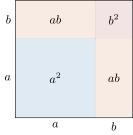
The name is literal. In ninth-century Baghdad, al-Khwarizmi drew x2+6x=7 as a square of side x with two 3×x rectangles glued to two of its sides, and completed the square with the missing 3×3 corner. Draw the figure and explain how it turns the equation into (x+3)2=16 — then solve.
Solve x2≤10x−21 (bring everything to one side and reuse question 7).
Solve x+2x−1≥0 with a sign table, minding the forbidden value.
An old promise kept: for the farmer of queen Dido’s fence problem, in the Middle School volume, with 20 m of fence, the area of an x×(10−x) pen satisfies
A(x)=x(10−x)=25−(x−5)2.
Verify the identity, and read off it a proof of what grade 6 could only conjecture: the maximum area, and the unique x achieving it.
Another: prove that x+x1≥2 for every x>0, with equality only at x=1. (Multiply by x, gather, recognize a square — the arithmetic–geometric inequality of the Euclid’s-relations weekend problem of the Middle School volume in a new costume.)
Part IV — The golden section. Cut a segment of length 1 into a large part x and a small part 1−x so that whole is to large as large is to small: x1=1−xx.
Show that the condition reads x2+x−1=0.
Solve by completing the square, and keep the root that is a length: x=25−1≈0.618.
The golden ratio is φ=x1=5−12. Rationalize the denominator (multiply top and bottom by 5+1, an identity at work) and show φ=25+1≈1.618.
Verify exactly the two magic identities of φ:
φ2=φ+1,φ1=φ−1.
Finale: explain why φ is irrational (the irrationality weekend problem of the Middle School volume supplies the key fact about 5), then compute the ratios 35, 58, 813, 1321 of consecutive Hemachandra–Fibonacci numbers (the rhythm-counting weekend problem of the Middle School volume) to three decimals. What do they seem to chase? (The proof that they catch it belongs to the chapters on sequences.)
3.(5−t)(5+t)=25−t2=21 gives t2=4, t=2: the numbers are 3 and 7 (sum 10, product 21: check).
4.(7−t)(7+t)=49−t2=33: t=4, numbers 3 and 11.
5.(2s−t)(2s+t)=(2s)2−t2=p forces t2=(2s)2−p. A solution exists exactly when this is ≥0, i.e. when p≤(2s)2 — the product of two numbers of given sum can never beat the square of the half-sum (queen Dido’s fence problem, in the Middle School volume knew).
6.(x−a)(x−b)=x2−(a+b)x+ab: the equationx2−sx+p=0 says precisely “x is one of two numbers with sum s and product p”.
7.(x−5)2−4=x2−10x+25−4=x2−10x+21. Difference of squares: (x−5−2)(x−5+2)=(x−7)(x−3)=0: solutions 3 and 7 — the scribe’s numbers of question 3.
8.x2+6x−7=(x+3)2−16=0 gives (x+3)2=16, x+3=±4: x=1 or x=−7.
9.x2+4x+5=(x+2)2+1≥1>0 for every x: no real solution. In the form (x+h)2+k: solutions exist exactly when k≤0 (then (x+h)2=−k has the two roots −h±−k); when k>0 the expression stays positive.
10. The square of side x (area x2) with two 3×x rectangles (6x in all) forms an L of area x2+6x=7; the missing 3×3 corner (area 9) completes a big square of side x+3. Adding 9 to both sides: (x+3)2=16, so x+3=4 (lengths are positive) and x=1. The algebra and the picture are the same act.
11.(x−3)(x+2): negative between the roots. Solution of <0: x∈(−2,3).
12.x2−10x+21≤0, i.e. (x−3)(x−7)≤0: between the roots, ends included: x∈[3,7].
13. Zero at x=1, forbidden at x=−2; the quotient is positive outside the roots: x∈(−∞,−2)∪[1,+∞).
14.25−(x−5)2=25−x2+10x−25=x(10−x): identity verified. Since (x−5)2≥0 always, A(x)≤25, with equality exactly when x=5: the 5×5 square pen, maximum 25 m2 — the grade-6 table, now a two-line proof.
15. For x>0, multiply the claim by x: x2+1≥2x, i.e. x2−2x+1=(x−1)2≥0 — true, with equality only at x=1. Dividing back by x>0 preserves everything (Proposition 2.13).
16. Cross-multiplying x1=1−xx (all lengths positive): x2=1−x, i.e. x2+x−1=0.
17.x2+x−1=(x+21)2−45=0 gives x+21=±25. The positive root: x=25−1≈0.618.
19.φ2=4(5+1)2=46+25=23+5, and φ+1=25+3: equal. And φ−1=25−1=x=φ1 (that is how φ was defined). The golden ratio is the number whose square adds one and whose reciprocal subtracts one.
20.5 is irrational (the irrationality weekend problem of the Middle School volume: 5 is no perfect square), and adding 1 then halving preserves irrationality (rational operations, Problem 1.1). Ratios: 35≈1.667, 58=1.600, 813=1.625, 1321≈1.615: alternately above and below, closing in on φ=1.618… — the rhythm-counting numbers of the rhythm-counting weekend problem of the Middle School volume secretly chase the golden section; the chapters on sequences will catch them in the act.