Mathematics · Glossary

What is Square root?

Definition 65.1 Primary & Middle School Mathematics · Chapter 65 — Square Roots

Let a0a \geq 0. The square root of aa, written a\sqrt a, is the unique nonnegative number whose square is aa:

a0and(a)2=a.\sqrt a \geq 0 \qquad\text{and}\qquad \left(\sqrt a\right)^2 = a .

Negative numbers have no square root, since every square is nonnegative.

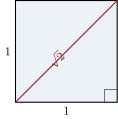
The diagonal of a unit square has length √12 + 12 = √2 1.414, by the Pythagorean theorem ( recalls it). This number is irrational: its decimals never repeat.
The diagonal of a unit square has length 12+12=21.414\sqrt{1^2 + 1^2} = \sqrt2 \approx 1.414, by the Pythagorean theorem (Chapter 69 recalls it). This number is irrational: its decimals never repeat.

Examples

Example 65.9 (Adding square roots)

Sums of square roots simplify only when the roots are alike. Compute 12+2748\sqrt{12} + \sqrt{27} - \sqrt{48}, simplifying each term first:

12=4×3=23,27=9×3=33,48=16×3=43,\begin{align*} \sqrt{12} &= \sqrt{4 \times 3} = 2\sqrt3, \\ \sqrt{27} &= \sqrt{9 \times 3} = 3\sqrt3, \\ \sqrt{48} &= \sqrt{16 \times 3} = 4\sqrt3, \end{align*}

so the sum is 23+3343=(2+34)3=32\sqrt3 + 3\sqrt3 - 4\sqrt3 = (2 + 3 - 4)\sqrt3 = \sqrt3.

Example 65.10 (Expanding with square roots)

The identities of algebra apply to square roots. Expand (5+2)2\left(\sqrt5 + 2\right)^2 with (a+b)2=a2+2ab+b2(a+b)^2 = a^2 + 2ab + b^2:

(5+2)2=5+2×25+4=9+45.\left(\sqrt5 + 2\right)^2 = 5 + 2 \times 2\sqrt5 + 4 = 9 + 4\sqrt5 .

And with the third identity, (a+b)(ab)=a2b2(a+b)(a-b) = a^2 - b^2:

(7+3)(73)=73=4:\left(\sqrt7 + \sqrt3\right)\left(\sqrt7 - \sqrt3\right) = 7 - 3 = 4 :

the product of two irrational numbers can be an integer.

Read in context →