Primary & Middle School Mathematics · Grades 1–9
65Square Roots
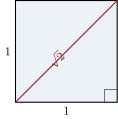
How long is the diagonal of a square of side ? The Pythagorean theorem answers , a number whose square is — and which turns out not to be a fraction. This chapter defines square roots, establishes the rules for computing with them, and teaches how to simplify expressions like .
65.1 Definition and first properties
Definition 65.1 (Square root)
Let . The square root of , written , is the unique nonnegative number whose square is :
Negative numbers have no square root, since every square is nonnegative.
Example 65.2
, , , . The first square roots to know by heart are those of the perfect squares: .
Proposition 65.3 (Square root of a square)
For every real number (positive or not):
Proof. The number is nonnegative and its square is (a number and its opposite have the same square). Being the unique nonnegative number of square , it is . ∎
Example 65.4
: the square root “forgets” the sign, it does not restore it. In particular is wrong for negative .
65.2 Products and quotients of square roots
Theorem 65.5 (Multiplication and division rules)
For all and :
Proof. The number is nonnegative (product of nonnegative numbers), and its square is
By uniqueness of the nonnegative number whose square is , it equals . The quotient rule is proved the same way. ∎
Remark 65.6 (No such rule for sums!)
is not in general:
Method 65.7 (Simplifying )
To simplify the square root of an integer:
Example 65.8
Simplify : since ,
Simplify : since , . And a quotient: .
Example 65.9 (Adding square roots)
Sums of square roots simplify only when the roots are alike. Compute , simplifying each term first:
so the sum is .
Example 65.10 (Expanding with square roots)
The identities of algebra apply to square roots. Expand with :
And with the third identity, :
the product of two irrational numbers can be an integer.
65.3 The equation
Theorem 65.11 (Solving )
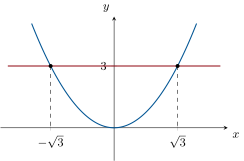
- If , the equation has exactly two solutions: and ;
- if , the only solution is ;
- if , there is no solution.
Proof. Rewrite as when , and factor as a difference of squares:
so or (these coincide when ). When there is no solution, since for every . ∎
Example 65.12
: solutions and . : solutions and (exact values; ). : no solution. : divide by 3 first, , solutions .
65.4 Exercises
Exercise 65.1 ★
Compute without a calculator:
Solution
Solution of Exercise 65.1.
; ; (since ); ; ; .
Exercise 65.2 ★
Simplify:
Solution
Solution of Exercise 65.2.
; ; ; .
Exercise 65.3 ★
Compute and simplify:
Solution
Solution of Exercise 65.3.
.
.
.
.
Exercise 65.4 ★
Solve: ; ; ; .
Solution
Solution of Exercise 65.4.
: or .
: or .
means : no solution.
: , so or .
Exercise 65.5 ★
Reduce to a single term: , then .
Solution
Solution of Exercise 65.5.
.
.
Exercise 65.6 ★★
Expand and simplify:
Solution
Solution of Exercise 65.6.
.
.
.
Exercise 65.7 ★★
A square field has area m. What is the length of its side? Of its diagonal (exact value, then rounded to the nearest meter)?
Solution
Solution of Exercise 65.7.
Side: m. Diagonal (Pythagoras): m.
Exercise 65.8 ★★
Show that (multiply numerator and denominator by ). Use the same trick to write and without a square root in the denominator.
Solution
Solution of Exercise 65.8.
.
. .
Exercise 65.9 ★★
True or false? Justify with a proof or a counterexample.
- For all : .
- For all : .
- For all : .
- .
Solution
Solution of Exercise 65.9.
1. True: this is the product rule (Theorem 65.5).
2. False: but .
3. False for negative : . The correct statement is .
4. True: .
Exercise 65.10 ★★★
Let . Compute , and deduce a simpler expression of . Same question for (aim for a square of the form , and mind the sign).
Solution
Solution of Exercise 65.10.
. So (a nonnegative number, so the root just removes the square).
Similarly , and , so (not , which is negative!).
65.5 Problem: The number that is not a fraction
Problem 65.1
Weekend problem — the legendary proof that is irrational, its many cousins, and Heron’s uncannily good recipe for approximating it
The diagonal of a unit square is a perfectly real length — you drew it in Example 58.9 — and yet, as the Pythagoreans discovered to their horror some twenty-five centuries ago, no fraction whatsoever measures it. Legend claims the discovery was punished by drowning. This problem walks you through the immortal proof (four questions and it is yours for life), multiplies the victims, and ends with the recipe engineers used for two thousand years to tame the untameable number.
Part I — The proof.
- First hunt it down: check that , then that , by squaring the bounds. One more digit: between which three-decimal numbers does lie?
- Now suppose — for the sake of contradiction — that for some fraction in lowest terms (Method 64.16). Square both sides and show that . What is the parity of ?
- The parity facts of Problem 58.1 say: odd numbers have odd squares. Deduce that is even, write , substitute — and show that must be even too.
- Where is the contradiction? Conclude, and state the theorem in full: is irrational — it is no quotient of whole numbers.
- The proof leaned once, discreetly, on the words “in lowest terms”. Point to the exact step that would collapse without them, and explain why assuming lowest terms was legitimate in the first place.
Part II — The victims multiply.
- A second proof style, via prime factorizations (Theorem 64.6): in , compare the parity of the exponent of on each side (Problem 64.1: squares carry even exponents). Conclude that is irrational.
- Run the same exponent argument on for a general whole number : for which does it produce a contradiction, and for which does it fail? State the complete result: is irrational exactly when …
- Prove the shield lemma: a nonzero rational times an irrational is irrational. (Suppose with rational, , and solve for .) Deduce that and are irrational.
- Prove that is irrational. Then the pretty one: supposing were rational, compute , isolate , and find the contradiction.
- Temper the enthusiasm: give two irrational numbers whose sum is rational, and two whose product is rational. (Irrationality is not preserved by arithmetic — each case needs its own proof.)
Part III — Heron’s recipe. Two thousand years before calculators, Heron of Alexandria approximated like this: guess ; replace the guess by the average of and ; repeat.
- Start from the guess and compute the next two guesses as exact fractions.
- Compute the third guess, again as an exact fraction, and its decimal value. Compare with question 1: how many decimals of are already correct?
- The idea behind the recipe: a rectangle of area with one side has the other side . Show that always lies between and (consider the two cases and ), so averaging the two sides squeezes the rectangle towards the square.
- The guesses , , hide a gem: compute , then , then . Part I proved impossible — how close do Heron’s fractions come to the impossible?
- Finale, in two sentences: the diagonal of the unit square exists on paper, no fraction measures it, and its decimal writing can never repeat (Problem 63.1). What kind of “new numbers” must the number line therefore contain — and where in this series is their full story told?
Solution
Solution of Problem 65.1.
1. ; . Three decimals: , so .
2. Squaring gives , hence : the number is twice a whole number — even.
3. If were odd, would be odd (Problem 58.1); since is even, is even: . Substituting: , so is even, and by the same parity fact is even.
4. Both and even means both divisible by — but was in lowest terms, sharing no common divisor. Contradiction: the assumed fraction cannot exist. Theorem: is irrational.
5. The contradiction lives entirely in “lowest terms”: without it, “ and both even” contradicts nothing. Assuming lowest terms is legitimate because every fraction has a lowest-terms form (Method 64.16: divide out the GCD) — if were any fraction at all, it would be a lowest-terms one, and that one is impossible.
6. In prime factorizations, squares carry even exponents (Problem 64.1). In , the exponent of is even on the left, but odd on the right (even from , plus one). No number has two factorizations (Theorem 64.6): contradiction, and is irrational.
7. In , the argument finds a prime with contradictory exponent parity exactly when some prime appears in with an odd exponent. If every exponent of is even, is a perfect square (, and is whole). Complete result: is irrational for every whole that is not a perfect square —
8. From with : , a quotient of rationals, hence rational. So if is irrational, cannot be rational: and are irrational (multipliers and ).
9. If were rational, then would be rational: contradiction. If were rational, then would be too, giving rational — but is irrational (question 7). So is irrational.
10. Sums: and (or and ) are each irrational, with rational sums and . Products: . Irrationality can evaporate in arithmetic — hence the case-by-case proofs.
11. From : average of and : . Then average of and : .
12. Against : five decimals correct after three steps — the recipe roughly doubles the correct decimals each round.
13. If (guess too big), then , and : the companion side is too small. If , the inequalities reverse. Either way sits between and , so their average — the next guess — is closer than the worse of the two sides: the rectangle of area gets squarer at every step.
14. ; ; . Every Heron guess satisfies : Part I proved that hitting is impossible, and these fractions miss the impossible by exactly one unit — the closest whole numbers can ever come.
15. The number line must contain numbers beyond the fractions — lengths like , whose decimal writings run forever without repeating: the real numbers. Their honest construction is a story for the High School volume and, in full rigor, the university ones.