Primary & Middle School Mathematics · Grades 1–9
69Trigonometry in the Right Triangle
In a right triangle, once you know one acute angle, the shape of the triangle is fixed — only its size can vary. The ratios of its sides therefore depend only on the angle: these ratios are the cosine, sine and tangent. Together with the Pythagorean theorem, they let you compute every side and every angle of a right triangle from very little information.
69.1 The Pythagorean theorem, again
Theorem 69.1 (Pythagoras)
In a triangle right-angled at , the square of the hypotenuse is the sum of the squares of the two legs:
Conversely, if in a triangle, then the triangle is right-angled at .
Proof. Admitted at this level. ∎
Example 69.2
A right triangle has legs and . Then
To find a leg: if and , then , so .
69.2 Cosine, sine, tangent
In a right triangle, relative to an acute angle , the three sides have names: the hypotenuse (opposite the right angle, the longest side), the side opposite to , and the side adjacent to (the leg touching ).
Definition 69.3 (Trigonometric ratios)
For an acute angle of a right triangle:
These ratios depend only on , not on the size of the triangle (all right triangles with the same acute angle are scalings of one another, by Thales).
![The three sides seen from the angle = B: the hypotenuse [BC], the adjacent side [BA], the opposite side [AC].](/images/onecourse/chapters/math-1/g9-trig/fig-b3579ad88883.svg)
Proposition 69.4 (First properties)
For every acute angle :
- and (a leg is shorter than the hypotenuse);
- ;
- .
Proof. Write for the adjacent side, for the opposite side, for the hypotenuse of a right triangle with angle .
1. and , so the two ratios are strictly between and .
2. By Pythagoras, . Divide everything by :
3. . ∎
Method 69.5 (Finding a side)
To compute an unknown side when one side and one acute angle are known:
- mark the known angle and label the three sides (hypotenuse, opposite, adjacent) from that angle;
- choose the ratio (cos, sin or tan) that involves the known side and the wanted side;
- write the equation and solve it;
- sanity-check: the hypotenuse must come out longest.
Example 69.6
In a right triangle, the hypotenuse measures and one angle is ; compute the side opposite to it. The ratio involving the opposite side and the hypotenuse is the sine:
For the adjacent side, use the cosine: . Check with Pythagoras: .
Method 69.7 (Finding an angle)
When two sides are known, compute the ratio they form, identify it as a cosine, sine or tangent of the unknown angle, and apply the calculator’s inverse function (, or ) to the ratio.
Example 69.8
A ladder m long leans against a wall, its foot m from the wall. The angle between the ladder and the ground satisfies
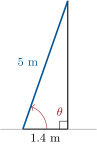
Example 69.9 (Special angles)
Two triangles give exact values. Half a square of side 1 (a right isosceles triangle) has hypotenuse and angles of :
Half an equilateral triangle of side 1 gives the angles and :
69.3 Exercises
Exercise 69.1 ★
A right triangle has legs and . Compute its hypotenuse. Another has hypotenuse and one leg : compute the other leg.
Solution
Solution of Exercise 69.1.
Hypotenuse: .
Other leg: .
Exercise 69.2 ★
A triangle has sides , and . Is it right-angled? Same question for sides , and .
Solution
Solution of Exercise 69.2.
: yes, right-angled (converse of Pythagoras), with the right angle opposite the side .
: not right-angled.
Exercise 69.3 ★
In a triangle right-angled at , with the angle at noted : which side is the hypotenuse? Which side is opposite to ? Write , and as ratios of the sides , , .
Solution
Solution of Exercise 69.3.
The hypotenuse is (opposite the right angle at ). The side opposite to is ; the adjacent side is . Hence
Exercise 69.4 ★
In a right triangle, the hypotenuse measures and one acute angle is . Compute the two legs (round to the tenth; , ).
Solution
Solution of Exercise 69.4.
Opposite leg: . Adjacent leg: . (Check: .)
Exercise 69.5 ★
In a right triangle, the leg adjacent to the angle measures and the opposite leg measures . Compute , then (round to the degree; ).
Solution
Solution of Exercise 69.5.
, so .
Exercise 69.6 ★★
A drone flies at an altitude of m. From an observer on the ground, it is seen at an angle of elevation of . At what horizontal distance from the observer is the drone ()?
Solution
Solution of Exercise 69.6.
In the right triangle formed by the observer, the point on the ground below the drone, and the drone: the altitude m is the side opposite the elevation angle, the horizontal distance is adjacent. So
Exercise 69.7 ★★
An access ramp must rise m with an angle of at most to the horizontal. What minimum length along the slope must the ramp have ()? Round up to the nearest tenth of a meter.
Solution
Solution of Exercise 69.7.
The rise ( m) is opposite the angle; the ramp length is the hypotenuse:
The ramp must be at least m long.
Exercise 69.8 ★★
Using Proposition 69.4: an acute angle satisfies . Compute without finding , then .
Solution
Solution of Exercise 69.8.
From : , and for an acute angle, so . Then .
Exercise 69.9 ★★★
Justify the exact values of Example 69.9: in the right isosceles triangle with legs , compute the hypotenuse; in the equilateral triangle of side , compute the height, and deduce the cosine and sine of and .
Solution
Solution of Exercise 69.9.
Right isosceles triangle with legs : hypotenuse ; each acute angle is , and
Equilateral triangle of side : its height splits it into two right triangles with hypotenuse , base , and height (Pythagoras). The angles are (at the base) and (at the top). Reading the ratios:
69.4 Problem: Measuring what you cannot reach
Problem 69.1
Weekend problem — the surveyor’s two-station method for inaccessible heights, road grades, the distance to the horizon, and the tangent’s race to infinity
No tape measure reaches the top of a mountain, the summit of a tower across a river, or the horizon at sea — but an angle gauge and this chapter’s three ratios do. The centerpiece of this problem is the surveyors’ classic two-station method, which computes a height without ever approaching its base; around it: road signs, ladders, stairs, the curvature of the Earth, and a first glimpse of a function exploding to infinity.
Part I — One station. (Values: , , , .)
- From a point m from the foot of a lighthouse, the top is seen at an elevation of (measured from the horizontal, at eye level). How high is the top above eye level?
- A road sign announces a grade: the road rises m per m of horizontal run. What angle does the road make with the horizontal? And what grade percentage would a road have?
The two acute angles of a right triangle are complementary, and each one’s opposite side is the other’s adjacent side. Deduce the “co” identities:
- An m ladder leans at to the ground. Using the exact values of Example 69.9, give the height reached and the distance of the foot from the wall — exactly, then to the centimeter.
- Verify numerically for and exactly for . Why is this identity (Proposition 69.4) a good habit for checking calculator work?
Part II — Two stations. A mountain’s summit is visible, its base unreachable. From a point , the summit’s elevation is ; walking m straight toward the mountain, to , the elevation becomes . Write for the summit’s height above eye level and for the horizontal distance from to the vertical of the summit. (, .)
- Express and using , and : two equations for two unknowns.
From each equation express the horizontal distance in terms of , subtract, and derive the two-station formula:
Compute to the nearest ten meters.
- Compute as well, and sanity-check your two answers against the sighting from .
- In one sentence: why is the two-station method indispensable — what single measurement, impossible here, would the one-station method of question 1 have required?
- A tower is sighted at , and at after walking m toward it. Using and , compute the height exactly — the answer is a multiple of — then to the meter.
Part III — To the horizon and up the wall.
- How far is the horizon? Standing with eyes meters above a spherical Earth of radius , your line of sight grazes the sphere: the sight line, the radius to the grazing point and the radius to your feet form a right triangle. Show with Pythagoras (Theorem 69.1) that the distance to the horizon satisfies , and compute for eyes at m ( m).
- Same question from the top of a m tower. (Sailors’ rule of thumb: the horizon in kilometers is about with in meters — check your two answers against it.)
- Your thumb, about cm wide, held at arm’s length, about cm from your eye: what angle does it cover? The full Moon covers about : how much of your thumb hides the whole Moon?
- Comfortable stairs have risers of cm and treads of cm. What angle do they climb? Compare with the of Example 69.9, and with a steep attic ladder at : what riser would it need on a cm tread?
- The tangent’s race: compute (calculator) , , , . What happens as the angle approaches , and why (think adjacent side)? The wall is vertical, the ratio has no value, and the graph shoots to infinity — your first asymptote, a creature studied closely in the High School volume.
Solution
Solution of Problem 69.1.
1. The height above eye level is the side opposite , with adjacent side m: m.
2. gives — steep for a road, yet a modest angle. A road has : a grade. (“One hundred percent” is far from vertical — a favorite ski-lift misunderstanding.)
3. In a right triangle with acute angles and , the side opposite one is adjacent to the other and the hypotenuse is shared. So , and symmetrically : the cosine is the sine of the complement.
4. Height: m. Foot: m exactly.
5. (to rounding); and . Any pair of values failing the identity betrays a wrong reading or a calculator in the wrong mode — a free error detector.
6. and .
7. and ; subtracting, , whence the formula. Numbers: , , difference : m.
8. m. Check from : : consistent.
9. The one-station method needs the horizontal distance to the point directly below the summit — unmeasurable across a gorge or inside a mountain. The two-station method replaces it by a distance you can pace out yourself: the m between your own two viewpoints.
10. m — the Eiffel Tower’s second floor, measured with two sightings and a stroll.
11. Sight line , radii (to the grazing point, perpendicular to the sight line) and (to the eye): Pythagoras gives , so ( is minuscule against ). Eyes at m: m — the sea horizon is barely five kilometers away.
12. km. Sailors’ rule: km and km — both match.
13. gives . The Moon’s is about a quarter of a thumb: the Moon looks enormous and is hidden by a fingernail — the eye is a poor protractor.
14. Stairs: — comfortable stairs climb at almost exactly the of the special values. At on a cm tread, the riser would be cm: a ladder, not a staircase.
15. ; ; ; . As the adjacent side shrinks to nothing while the opposite side holds: the quotient grows beyond every bound. At exactly there is no triangle and no value — the graph of the tangent climbs a vertical asymptote, first of many in the High School volume.