
Mathematics · Glossary

What is submanifold with boundary?

Definition 21.21 University Mathematics — Year 3 · Chapter 21 — Differential Forms and Stokes’ Theorem

A kk-submanifold with boundary MRnM \subseteq \R^n is a set covered by regular parametrizations of two kinds: interior charts γ ⁣:VMW\gamma\colon V \to M \cap W with VRkV \subseteq \R^k open, and boundary charts γ ⁣:VHkMW\gamma\colon V \cap H^k \to M \cap W, where Hk={uRk:uk0}H^k = \{u \in \R^k : u_k \geq 0\} and γ\gamma extends smoothly and regularly to the open VV. The boundary M\partial M is the set of points reached at uk=0u_k = 0; it is a (k1)(k-1)-submanifold without boundary, parametrized by the maps uγ(u,0)u' \mapsto \gamma(u', 0). An orientation of MM induces one on M\partial M by the outward-normal-first rule: at pMp \in \partial M, a basis (w1,,wk1)(w_1, \dots, w_{k-1}) of TpMT_p\partial M is positive iff (ν,w1,,wk1)(\nu, w_1, \dots, w_{k-1}) is a positive basis of TpMT_pM, where νTpMTpM\nu \in T_pM \setminus T_p\partial M points out of MM (in a boundary chart: ν=kγ\nu = -\partial_k\gamma, up to adding tangential components — the orientation class does not see them).
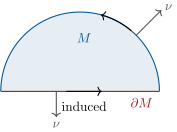
The outward-normal-first rule: at each boundary point, put the outward vector  first; the bases that complete it to a positive frame of M orient M. For a plane domain with the standard orientation this is the counterclockwise rule of Green–Riemann.
The outward-normal-first rule: at each boundary point, put the outward vector ν\nu first; the bases that complete it to a positive frame of MM orient M\partial M. For a plane domain with the standard orientation this is the counterclockwise rule of Green–Riemann.

Examples

Example 21.24 (The classical theorems)

Let DR2D \subseteq \R^2 be a compact domain with smooth boundary, standardly oriented. For ω=P ⁣dx+Q ⁣dy\omega = P\,\dd x + Q\,\dd y:  ⁣dω=(xQyP) ⁣dx ⁣dy\dd\omega = \bigl(\partial_xQ - \partial_yP\bigr)\dd x\wedge\dd y, and Stokes reads

D(QxPy) ⁣dx ⁣dy=DP ⁣dx+Q ⁣dy:\int_D\Bigl(\frac{\partial Q}{\partial x} - \frac{\partial P}{\partial y}\Bigr)\dd x\,\dd y = \oint_{\partial D}P\,\dd x + Q\,\dd y :

Green–Riemann, proved for elementary domains in the Year 2 volume and now in natural generality. In R3\R^3, Stokes applied to the flux 22-form of a vector field on a compact domain gives the divergence theorem ΩdivF=ΩF,ν ⁣dS\int_\Omega\operatorname{div}F = \int_{\partial\Omega}\langle F, \nu\rangle\,\dd S, and applied to a 11-form on a surface-with-boundary, the classical Kelvin–Stokes curl theorem; Exercise 21.7 spells out both dictionaries.

Read in context →