সব বই

পেশাদার

1 Markets I: The Ecosystem and Exchange-Traded Marketsবাজার অনলাইন 2 Markets II: Rates, FX and Creditবাজার অনলাইন 3 Markets III: Commodities, Energy and Cryptoবাজার অনলাইন 4 Quantitative Methodsপদ্ধতি অনলাইন 5 Derivatives and Volatilityডেরিভেটিভস অনলাইন 6 Rates, Credit, XVA and Riskসুদহার, ঋণ ও ঝুঁকি অনলাইন 7 Research Craft: Predictors, Backtests, Measurement, Portfoliosগবেষণা অনলাইন 8 Strategies I: Equities and Futuresকৌশল অনলাইন 9 Strategies II: Volatility, Relative Value, Macro and the Bank Desksকৌশল অনলাইন 10 Microstructure and Executionএক্সিকিউশন অনলাইন 11 Market Making and High-Frequency Tradingমার্কেট মেকিং অনলাইন 12 Machine Learning for Marketsমেশিন লার্নিং অনলাইন 13 Low-Latency Softwareপ্রযুক্তি অনলাইন 14 Networks, Hardware and Trading Infrastructureপ্রযুক্তি অনলাইন 15 Research, Data and Risk Platformsপ্রযুক্তি অনলাইন 16 The Desk and the Firmপ্রতিষ্ঠান অনলাইন 17 The Industry: Firms, Roles and Careersক্যারিয়ার অনলাইন 18 Interviews I: Maths, Probability and Speedক্যারিয়ার অনলাইন 19 Interviews II: Markets, Trading Games and the Final Roundক্যারিয়ার অনলাইন 20 Interviews III: Codeক্যারিয়ার অনলাইন
অ্যাপ পরিচিতি Coach সাইন ইন পড়া শুরু করো

বইগুলো এখনো বাংলা ভাষায় পাওয়া যায় না — ইংরেজি সংস্করণ দেখানো হচ্ছে।

Mathematics · পরিভাষা

Variation table কী?

Definition 3.9 High School Mathematics · অধ্যায় 3 — Functions

A variation table summarizes on which intervals ff increases and decreases, with arrows ↗\nearrow and ↘\searrow, and records the values of ff at the turning points.

উদাহরণ

Example 3.10

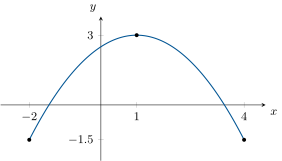
Consider the function graphed below on [−2, 4]\intcc{-2}{4}.

A function defined on [-2, 4], increasing then decreasing.
A function defined on [−2, 4]\intcc{-2}{4}, increasing then decreasing.

Reading the graph: ff increases from f(−2)=−1.5f(-2) = -1.5 up to its maximum f(1)=3f(1) = 3, then decreases down to f(4)=−1.5f(4) = -1.5. Its variation table is

xx−2-21144
ff−1.5-1.5↗\nearrow33↘\searrow−1.5-1.5

Example 3.11 (Proving a variation)

Show that f(x)=3x+1f(x) = 3x + 1 is strictly increasing on R\R. Take any u<vu < v and compare the images:

f(v)−f(u)=(3v+1)−(3u+1)=3(v−u)>0,f(v) - f(u) = (3v + 1) - (3u + 1) = 3(v - u) > 0,

because v−u>0v - u > 0. So f(u)<f(v)f(u) < f(v): the function is strictly increasing. The same computation with a negative slope, e.g. g(x)=−2x+5g(x) = -2x + 5, gives g(v)−g(u)=−2(v−u)<0g(v) - g(u) = -2(v-u) < 0: strictly decreasing.

প্রসঙ্গসহ পড়ো →