High School Mathematics · कक्षा 10–12
3Functions
A function is a machine that takes a number in and produces a number out, always the same output for the same input. Functions are the central objects of the analysis you will build over the next years (Chapter 10 onward); this chapter sets up the vocabulary — domain, image, graph, variations — and trains the essential skill of reading information off a graph.
3.1 Vocabulary: images and preimages
Definition 3.1 (Function)
Let be a set of real numbers. A function defined on associates to each number exactly one real number, written and called the image of . The set is the domain of . We write
If , then is a preimage of .
Remark 3.2
Each in the domain has exactly one image, but a number can have several preimages, or none. For : the image of is , and has two preimages, and ; the number has no preimage.
Example 3.3 (Finding a domain)
When a function is given by a formula, its domain is the set of for which the formula makes sense.
Example 3.4 (Computing images and preimages)
Let , defined on .
Image of : substitute : .
Preimages of : solve :
so the preimages of are and .
3.2 The graph of a function
Definition 3.5 (Graph)
In a coordinate system, the graph (or curve) of is the set of all points for in the domain. In other words, a point lies on the graph exactly when .
Method 3.6 (Reading a graph)
On the graph of :
- image of : go vertically from on the horizontal axis to the curve, then horizontally to the vertical axis; the value read there is ;
- preimages of : draw the horizontal line ; the preimages are the -coordinates of all its intersection points with the curve;
- solutions of : same as the preimages of ;
- solutions of : the for which the curve is on or below the line .
![Solving f(x) = k graphically: the solutions x_1 and x_2 are the abscissas of the intersection points of the curve with the horizontal line y = k. Here f(x) ≤ k holds on [x_1, x_2], where the curve is below the line.](/images/onecourse/chapters/math-2/g10-functions/fig-d26495113fd4.svg)
Example 3.7
Is the point on the graph of ? Compute : yes, since equals the -coordinate of . The point is not on the graph, because .
3.3 Variations of a function
Definition 3.8 (Increasing, decreasing)
Let be defined on an interval .
- is increasing on when for all , if then : the outputs grow with the inputs, and the graph climbs from left to right.
- is decreasing on when implies : the graph falls from left to right.
With strict inequalities (resp. ) we say strictly increasing (resp. decreasing).
Definition 3.9 (Variation table)
A variation table summarizes on which intervals increases and decreases, with arrows and , and records the values of at the turning points.
Example 3.10
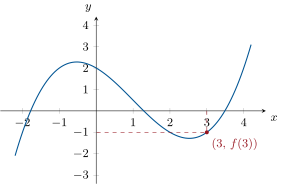
Consider the function graphed below on .
![A function defined on [-2, 4], increasing then decreasing.](/images/onecourse/chapters/math-2/g10-functions/fig-0353dee9a0b8.svg)
Reading the graph: increases from up to its maximum , then decreases down to . Its variation table is
Example 3.11 (Proving a variation)
Show that is strictly increasing on . Take any and compare the images:
because . So : the function is strictly increasing. The same computation with a negative slope, e.g. , gives : strictly decreasing.
3.4 Extrema
Definition 3.12 (Maximum, minimum)
Let be defined on and . The value is the maximum of on when for all ; it is the minimum when for all . On a graph, they are the highest and lowest points of the curve.
Example 3.13
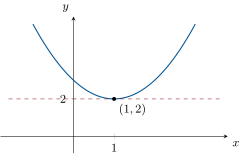
Show that has minimum on , attained at . For every , the square is , so ; and , so the value is actually reached. Both facts together prove that is the minimum.
3.5 Exercises
Exercise 3.1 ★
Let . Compute the images of , , and .
Solution
Solution of Exercise 3.1.
; ; ; .
Exercise 3.2 ★
Give the domain of each function:
Exercise 3.3 ★
Let . Find all preimages of , of , and of .
Exercise 3.4 ★
Does the point belong to the graph of ? And the point ? Justify by a computation.
Exercise 3.5 ★
A function defined on has the variation table
- What are the maximum and the minimum of on ?
- Compare and without knowing their values.
- How many solutions does the equation have at most on each interval of the table?
Solution
Solution of Exercise 3.5.
1. The largest value in the table is (maximum), the smallest is (minimum).
2. On the function decreases, and , so .
3. On each interval of monotonicity, takes each value at most once, so has at most one solution per interval: at most solutions in total. (Here lies between and , between and , and between and , so there are exactly three.)
Exercise 3.6 ★★
Let . Show, by comparing and for , that is strictly decreasing on .
Exercise 3.7 ★★
Show that the function has a minimum on , and give its value and where it is attained. (Hint: write for the right constant .)
Solution
Solution of Exercise 3.7.
Complete the square: , so
For every , , so ; and . The minimum of is , attained at .
Exercise 3.8 ★★
A rectangular garden has perimeter m. Let be its width, in meters.
- Express the length, then the area , as functions of . For which does this make sense?
- Compute , , , and . What do you conjecture about the shape of largest area?
Solution
Solution of Exercise 3.8.
1. Length width , so the length is and
Both dimensions must be positive: .
2. , , , , . The values rise until then fall symmetrically: the area seems largest for , i.e. for a square garden. (Chapter 10 proves this conjecture.)
Exercise 3.9 ★★
Let , defined on .
Solution
Solution of Exercise 3.9.
1. For every : , so is positive, and since , taking inverses (both sides positive) gives .
2. Maximum: and for all , so is the maximum, attained at . Minimum: always, but no value of achieves (a quotient of nonzero numbers is nonzero), and takes values as close to as we like for large ; so has no minimum.
Exercise 3.10 ★★★
Let on .
- Let . Factor and deduce that is strictly increasing on .
- Adapt the argument to show that is strictly decreasing on .
Solution
Solution of Exercise 3.10.
1. . If , then and (sum of a nonnegative and a positive number), so : is strictly increasing on .
2. If , then still, but now (sum of a nonpositive and a negative number), so : is strictly decreasing on .
3.6 Problem: Machines fed their own output
Problem 3.1
Weekend problem — fixed points, iteration, and three famous machines: Heron’s improver, the squarer, and the unsolved hailstone
A function is a machine: a number goes in, a number comes out. The most interesting experiments feed the machine its own output, again and again — and then two questions dominate: does the process settle somewhere (a fixed point), and how does the machine’s variation drive it there? One of this problem’s machines has been polishing square roots for two thousand years; another guards the most famous unsolved problem elementary mathematics has to offer.
Part I — Heron’s machine. Consider the function
- Give the domain of , and compute , and as exact fractions.
- Find all preimages of : solve (clear the denominator and use the methods of Problem 2.1).
- A fixed point of is a number unchanged by the machine: . Find both fixed points of . Which old acquaintance guards the positive one?
- Starting from , feed the machine its own output three times and record the exact results. Which sequence of the irrationality weekend problem of the Middle School volume have you rebuilt — and what was “Heron’s recipe”, in the language of functions?
- On one picture, sketch the graph of (for ) and the diagonal line . Where are the fixed points on this picture? (Compare the two-thermometers weekend problem of the Middle School volume: the temperature reading the same in both scales was the same idea.)
Part II — Why the machine cannot miss.
For , show by reduction to a common denominator that
and deduce the variations of on : decreasing up to a point, then increasing — which point? (Same technique as Exercise 3.10.)
- Deduce that on the function has a minimum, worth exactly , attained at . What does this say about every output of the machine (positive inputs)?
- Show that if then : a too-big guess is always improved, never overshot. (For , compare with .)
- Assemble questions 6–8 into the variation table of on (Definition 3.9), minimum included.
- A second machine: . Its fixed points are and (check). Iterate four times from , then four times from (calculator, three decimals). One fixed point attracts, the other repels: which is which?
Part III — The hailstone machine. On the whole numbers, define: if is even, and if is odd. Numbers bounce under like hailstones in a storm cloud.
- Compute the full flight of under , down to . How many steps does it take, and how high does it fly?
- Start the flight of and compute ten steps. (Its full flight lasts steps and peaks at — from a starting point of .) What lesson about simple rules do and teach?
- Explain why any flight that reaches a power of crashes straight to , and what happens at (compute , , ). Does have any fixed point among the positive whole numbers? What does the end of every observed flight form instead?
- The Collatz conjecture claims every starting number eventually reaches . Computers have verified it far beyond ; no human has proved it. What two kinds of discovery would disprove it? And why does massive verification still not close the case (the matchstick-oracle weekend problem of the Middle School volume rang this bell)?
- “Mathematics is not yet ripe for such questions,” said Paul Erdős of this conjecture. In one sentence: what separates the hailstone machine from Heron’s, where questions 6–8 settled everything?
Part IV — The machine user’s manual.
- Domains as intervals (Problem 1.1’s language): give the domains of , , .
- Back to Heron’s : find the exact preimages of (solve by completing the square).
- A stone is thrown upward: its height is meters after seconds. On which time interval does the formula make physical sense? Complete the square to find the maximal height and its time (Definition 3.12), and give the variation table.
- For how long is the stone at least m high? (Solve with a sign table, Method 2.17.)
- Finale: this problem ran four machines — Heron’s improver, the squarer, the hailstone, the stone’s height. In two or three sentences, state what every function has (a domain, a rule, a graph) and the two great questions this problem asked of each (where does iteration settle? how does the function vary?) — questions the next chapters take up one by one.
Solution
Solution of Problem 3.1.
1. Domain: (division by ). ; ; .
2. gives , i.e. : the preimages of are and — as question 1 announced.
3. gives , so , : fixed points and . The positive one is the diagonal of the unit square, irrational by the irrationality weekend problem of the Middle School volume.
4. : Heron’s approximations of . His recipe “average the guess with guess” is exactly iterating the function — and the number the process chases is ’s fixed point.
5. The fixed points are the crossings of the graph with the diagonal : feeding outputs back in walks the point along the graph towards that crossing. In the two-thermometers weekend problem of the Middle School volume, the reading was the same crossing-the-diagonal idea for the conversion function.
6. . For : , the bracket is negative, : decreasing. For : : increasing. Turning point: .
7. Decreasing before , increasing after: attains its minimum at , worth . Consequence: every output of the machine (positive input) is at least — after one turn of the crank, guesses live in .
8. If , then , so and the average of and is less than ; and by question 7, with equality only at . So : each iteration strictly improves without overshooting — the sequence of question 4 slides down onto .
9. On : decreasing from (near ) down to the minimum at , then increasing without bound.
10. gives , : fixed points and . From : , , , — sliding towards . From : , , , — fleeing to infinity. The fixed point attracts, repels: a hair’s difference at the start, opposite destinies.
11. : sixteen steps, peaking at .
12. — still climbing after ten steps, on its way to a peak of and a -step flight. Lesson: a two-line rule can produce behavior no one can predict at a glance — next-door numbers (, , ) have wildly different flights.
13. A power of halves down its whole ladder: . At the bottom, , , : the flight enters the cycle . Fixed points would need (only ) or (negative): none among the positive integers — the observed flights end not at a fixed point but in that little cycle.
14. A counterexample would be either a flight that grows forever (never returning to ) or a second cycle disjoint from . Verification up to leaves infinitely many untested numbers — exactly the circle-regions lesson of the matchstick-oracle weekend problem of the Middle School volume: agreement on finitely many cases proves nothing about all of them.
15. For Heron’s machine we had structure — a factored difference (question 6) revealing variations, a minimum, a squeeze — while the hailstone’s parity-switching rule offers no such handle: nobody has found the structure that tames it.
16. : needs : . : needs : deprived of and . : needs : .
17. gives , so , i.e. : or (both positive: two exact preimages).
18. Physical sense while the stone is aloft: for . Completing: : maximum m at s. Variations: increasing on from to , decreasing on back to .
19. : two full seconds above m.
20. Each machine has a domain (where the rule is allowed), a rule (the formula or the parity switch), and a graph or table displaying it whole. Of each we asked the two great questions: where does repetition lead (fixed points, cycles, attraction — solved for Heron, open for the hailstone) and how does the output move with the input (variations, extrema — the stone’s summit, Heron’s minimum). The chapters ahead sharpen both: reference functions next, then, in later years, derivatives to measure variation and limits to certify where iterations land.