 Coach
CoachThe apparent weight of a body is the normal force between it and its support — what a scale under it reads.
Examples
Example 25.14 (The elevator)
A passenger stands on a scale in an elevator of vertical acceleration (upward positive): , so . Pulling up at : , heavy; braking near the top: , light; steady cruise: — the first law; free fall, : , weightlessness on a scale.
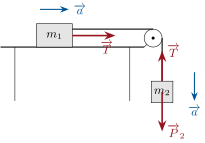
Example 25.15 (Two blocks and a pulley)
A block on a frictionless table is tied by a light rope, over an ideal pulley, to a hanging block . The rope transmits the same tension at both ends; the blocks share one magnitude of acceleration . One second law each, along each motion: and , so and — smaller than , as it must be for to accelerate downward.
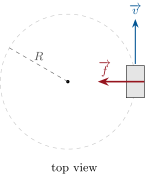
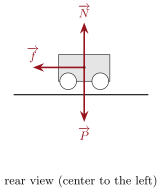
Example 25.16 (The flat curve)
A car of mass rounds a flat curve of radius at constant speed . In the Frenet frame (Chapter 24) the acceleration is purely normal, , aimed at the center. Vertically, ; horizontally, the only centripetal force on offer is the static friction of road on tyres: , so , whatever the mass. For , dry road (): (); on ice the ceiling collapses — Exercise 25.13 banks the road; Exercise 25.10 swings the same projection on a wire.